


Editors Pick
Latest Article
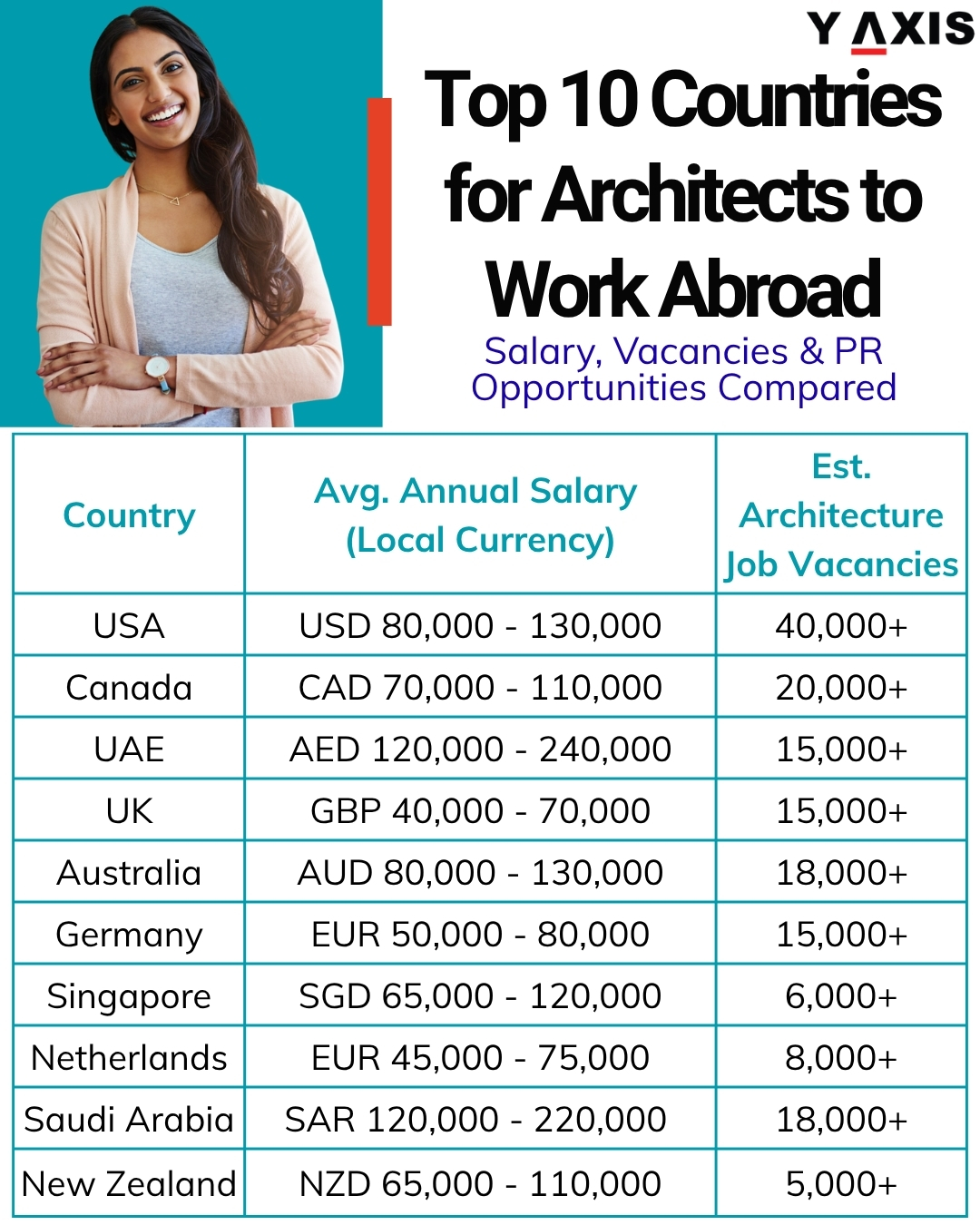
Top 10 Countries for Architects to Work Abroad
Top 10 Countries for Architects to Work Abroad
Top 10 Countries for Architects to Work Abroad: Salary, Demand & PR Opportunities Compared
The global demand for architects is accelerating. Countries like Canada, the USA, the UK, Germany, the UAE, and Australia are actively recruiting qualified architecture professionals. Roles including residential architects, commercial architects, urban designers, sustainable design specialists, heritage conservation architects, and BIM managers are in shortage across North America, Europe, the Middle East, and Asia-Pacific.
Countries like Canada and New Zealand offer direct PR pathways. Germany and the UK have structured visa routes for design professionals. The UAE and Saudi Arabia offer tax-free income with mega-project pipelines running through 2030. Demand is being driven by global housing shortages, national net-zero retrofit targets, digital construction mandates, and the world's largest architectural programmes in the Gulf.
Quick Facts: Best Countries for Architects from India
- Highest Salary: USA (up to INR 1.09 Cr per year for experienced architects)
- Fastest PR: Canada (6-18 months via Express Entry)
- Easiest Visa: UAE (employer-sponsored visa processed in 2-4 weeks)
- Best for Indians: Canada and Australia (strong Indian professional communities, B.Arch credentials recognised)
- Best for Career Growth: USA and UK (global design hubs, largest project pipelines, most prestigious firms)
- Best Tax-Free Option: UAE and Saudi Arabia (zero income tax, high total compensation packages including housing and flights)
- Fastest Direct-to-PR: New Zealand (Green List Straight to Residence for registered architects)
*Want to work abroad as an architect? Let Y-Axis guide you with the steps.
Top 10 Countries Hiring Indian Architects: Key Pathways at a Glance
Indian architects are in active demand across Canada, the USA, the UAE, the UK, Australia, Germany, Singapore, the Netherlands, Saudi Arabia, and New Zealand. Record housing shortages, net-zero building mandates, and mega-project pipelines are boosting international recruitment for design professionals. Salary potential, professional registration routes, PR pathway availability, and long-term settlement options are the primary factors when choosing the right country.
|
Country |
Why Top Destination for Architects |
Top Cities / Hubs |
In-Demand Architecture Roles |
Fast-Track / Preferred Hiring |
PR / Long-Term Options |
|
Federal FSWP; Tech PNP Streams; housing crisis driving record architectural demand |
Toronto, Vancouver, Calgary, Ottawa, Montreal |
Residential Architect, Urban Designer, Sustainable Design Architect, Project Architect, Interior Architect |
Express Entry; PNP Streams; LMIA-backed Work Permit |
Express Entry PR (6-18 months); citizenship after 3 years |
|
|
Highest architecture salaries globally; IRA green building investment; largest commercial and residential design market |
New York, Los Angeles, Chicago, Houston, San Francisco, Seattle |
Commercial Architect, High-Rise Designer, Sustainable Architect, Urban Designer, Healthcare Architect |
H-1B; O-1; L-1; EB-2 NIW |
Green Card EB-2/EB-3 (10-20+ year backlog for Indians); citizenship after 5 years |
|
|
NEOM spillover; Expo legacy; luxury mega-projects; fastest visa processing; zero income tax |
Dubai, Abu Dhabi, Sharjah |
Commercial Architect, Hospitality Architect, High-Rise Designer, Interior Architect, Masterplanner |
Employer-sponsored Work Permit (2-4 weeks) |
Golden Visa (10 years); no traditional PR |
|
|
National Housing Strategy; GBP 600bn infrastructure; listed building sector; Skilled Worker Visa |
London, Manchester, Edinburgh, Bristol, Birmingham |
Residential Architect, Heritage Conservation Architect, Urban Designer, Commercial Architect, BIM Manager |
Skilled Worker Visa; Global Talent Visa (RIBA/RAEng endorsement) |
ILR after 5 years; citizenship after 6 years |
|
|
AUD 230bn infrastructure pipeline; architects on CSOL; housing density targets; AACA assessment |
Sydney, Melbourne, Brisbane, Perth, Canberra |
Residential Architect, Urban Designer, Sustainable Design Architect, Commercial Architect, Project Architect |
482 Skills in Demand Visa; 189/190 Skilled Independent |
PR in 12-18 months; 482 to 186 PR pathway |
|
|
EU Blue Card; housing crisis (900,000 units needed); energy retrofit programme; Skilled Immigration Act (FEG) |
Berlin, Munich, Hamburg, Frankfurt, Stuttgart |
Residential Architect, Urban Planner, Sustainable Design Architect, Industrial Designer, Project Architect |
Skilled Worker Visa; EU Blue Card; Chancenkarte |
PR after 4 years; EU Blue Card PR in 21-33 months |
|
|
Smart Nation; HDB renewal; Changi T5; Tuas Mega Port; luxury commercial and hospitality design |
Singapore City |
Commercial Architect, Urban Designer, BIM Manager, Sustainable Design Architect, Hospitality Architect |
Employment Pass (3-6 weeks) |
PR after 2 years; citizenship after 2-3 years of PR |
|
|
Netherlands |
Housing shortage (900,000 homes target by 2030); world-class design culture; Rotterdam/Amsterdam urban regeneration; EU Blue Card |
Amsterdam, Rotterdam, The Hague, Utrecht, Eindhoven |
Urban Designer, Residential Architect, Sustainable Architect, Masterplanner, Parametric Designer |
Kennismigrant (Knowledge Migrant) Visa; EU Blue Card |
PR after 5 years; Dutch citizenship after 5 years |
|
Saudi Arabia |
NEOM; Red Sea Project; Qiddiya; Diriyah Gate; tax-free packages; peak execution 2026 |
Riyadh, Jeddah, NEOM, Dammam |
Masterplanner, Commercial Architect, Hospitality Architect, Urban Designer, Interior Architect |
Saudi Work Visa (4-8 weeks) |
50-year Premium Residency (selective); no general PR |
|
New Zealand |
Green List Straight to Residence; housing shortage; sustainable design mandate; Canterbury rebuild |
Auckland, Wellington, Christchurch, Hamilton |
Residential Architect, Sustainable Design Architect, Urban Designer, Heritage Architect |
AEWV; Green List Straight to Residence |
Skilled Migrant Category - 12-18 months; Straight to Residence |
*Want to get your resume noticed by international architecture employers? Avail Y-Axis Resume Marketing Services to find the right role.
Jobs for Architects in Canada
Canada job market offers several high paying jobs for Indian architects, driven by the country’s growing housing and infrastructure demand. Canada is facing a major housing shortage and has committed over CAD 40 billion through the National Housing Strategy to build 5.8 million new homes by 2031. This has significantly increased in-demand jobs in Canada across architecture, urban planning, and sustainable design sectors. Leading firms such as DIALOG, Zeidler Architecture, Stantec Architecture, Arcadis (formerly IBI Group), B+H Architects, Perkins+Will Canada, and KPMB Architects are actively hiring skilled professionals. Roles including residential architects, urban designers, BIM managers, and sustainable design specialists are among the most sought-after and high-paying opportunities in Canada for qualified Indian professionals.
|
Program |
Federal Skilled Worker Program (FSWP); Canadian Experience Class (CEC); Tech PNP Streams; RAIC BEFA Pathway |
|
In-Demand Architecture Roles |
Residential Architect, Urban Designer, Sustainable Design Architect, Project Architect, BIM Manager, Heritage Conservation Architect, Commercial Architect, Interior Architect, Masterplanner, Landscape Architect |
|
Work Visa Options |
Express Entry (FSWP, CEC); Provincial Nominee Program (PNP) - Ontario Tech, BC PNP, Alberta Advantage Immigration Program; LMIA-backed Work Permit; Intra-Company Transfer (ICT) |
|
Required Qualifications |
COA-approved B.Arch or M.Arch; CACB credential assessment required; CLB 7 English (approximately IELTS 6.0); minimum 1 year skilled work experience; provincial architectural licence required for independent practice (OAA, AIBC, AAA, etc.) |
|
Fast-Track Hiring |
IRCC category-based Express Entry draws targeting STEM and design occupations; Ontario Immigrant Nominee Program (OINP); BC PNP Tech Pilot; LMIA-exempt categories for senior roles; RAIC international architecture hiring outreach |
|
Long-Term Stay Options |
Canada PR via Express Entry in 6-18 months; PNP to PR in 8-18 months; Canadian citizenship after 3 years of permanent residence |
|
Family Sponsorship |
PR holders and work permit holders can sponsor spouses and dependent children; spouses receive open work permits; children eligible for free public schooling |
*Want to apply for a Canada work visa? Let Y-Axis guide you with the process.
Jobs for Architects in the USA
The USA job market continues to create strong opportunities for international architecture professionals, especially as the country invests heavily in sustainable infrastructure and urban development. The United States remains the world’s largest architecture market, with the Inflation Reduction Act (IRA) allocating over USD 369 billion toward clean energy buildings and sustainable retrofits. This has increased demand for several in-demand occupations in USA across architecture, urban planning, and green building sectors. Cities such as New York, Los Angeles, Chicago, Houston, and San Francisco are home to leading global design firms, federal agencies, and large real estate developers. Commercial architects, healthcare architects, sustainable design architects, and urban designers are among the highest paying jobs in USA within the architecture industry. Top employers including Gensler, SOM, HOK, KPF, Perkins+Will, AECOM Architecture, HDR Architecture, and Ennead Architects continue to hire international talent through structured recruitment pipelines.
|
Program |
H-1B Specialty Occupation Visa; O-1 Extraordinary Ability Visa; EB-2 National Interest Waiver (NIW); EB-1A |
|
In-Demand Architecture Roles |
Commercial Architect, Healthcare Architect, Sustainable Design Architect, Urban Designer, High-Rise Designer, BIM Manager, Hospitality Architect, Masterplanner, Interior Architect, Educational Facility Architect |
|
Work Visa Options |
H-1B (annual lottery, cap 85,000); O-1 (no cap, for exceptional ability); L-1A (intracompany transfer); EB-2 NIW (self-petition, no employer required); TN Visa for Canadians and Mexicans |
|
Required Qualifications |
B.Arch or M.Arch minimum; H-1B requires employer sponsorship and specialty occupation classification; O-1 requires evidence of extraordinary achievement; EB-2 NIW requires advanced degree and national interest justification; NCARB licensure required for independent practice (state-by-state ARE exam) |
|
Fast-Track Hiring |
O-1 visa has no lottery and no cap - fastest route for highly accomplished Indian architects; EB-2 NIW self-petition for senior designers and academics; major global design firms run structured H-1B sponsorship pipelines; AIA Architecture Firm Survey shows sustained demand |
|
Long-Term Stay Options |
EB-2 NIW or EB-1A Green Card (Indian nationals face backlogs of 10-20+ years for EB-2/EB-3); O-1 holders can pursue EB-1A with shorter backlogs; US citizenship typically 5 years after Green Card |
|
Family Sponsorship |
H-1B holders can bring dependents on H-4 visas; H-4 EAD (work authorisation) available for spouses of H-1B holders with approved I-140; Green Card holders can sponsor spouses and unmarried children under 21 |
*Want to apply for a USA work visa? Connect with Y-Axis for expert guidance.
Jobs for Architects in the UAE
The UAE job market offers excellent opportunities for Indian architects, especially with the country’s rapid urban expansion and tax-free income benefits. Dubai continues to be a global architecture hub with mega-projects such as Dubai Creek Harbour, Palm Jebel Ali, Dubai Urban Plan 2040, and Abu Dhabi’s Saadiyat Cultural District driving strong demand for skilled professionals. This has created several in-demand occupations in UAE across architecture, urban planning, hospitality, and commercial design sectors. Major employers including NORR Group, KEO International Consultants, Dewan Architects, Atkins Realis, Perkins+Will UAE, HOK Middle East, Gensler Dubai, and KPF are actively hiring international talent. Commercial architects, hospitality architects, high-rise designers, and masterplanners are among the highest paying jobs in UAE for qualified architecture professionals. Indians also form the largest expatriate workforce in the UAE, while employer-sponsored visa processing remains one of the fastest globally at just 2–4 weeks.
|
Program |
MOHRE Employment Visa; UAE Golden Visa (Architecture and Design Specialisation); Green Visa |
|
In-Demand Architecture Roles |
Commercial Architect, Hospitality Architect, High-Rise Designer, Interior Architect, Masterplanner, Urban Designer, Sustainable Design Architect, BIM Manager, Project Architect, Residential Architect |
|
Work Visa Options |
Employer-sponsored Employment Visa via MOHRE; UAE Golden Visa (10-year) for architects meeting salary and expertise thresholds (AED 30,000+/month); Green Visa (5-year) for skilled design professionals; Free Zone Work Permit (DIFC, ADGM, Dubai Design District D3) |
|
Required Qualifications |
B.Arch or M.Arch from a recognised institution; UAE Embassy attestation of Indian degree (via MEA attestation in India followed by UAE Embassy); 2-5 years of relevant experience; employer must hold valid UAE trade licence; Dubai Municipality or Abu Dhabi DM registration for stamp authority |
|
Fast-Track Hiring |
MOHRE processing typically 2-4 weeks; UAE Golden Visa processing ~2-3 weeks for eligible architects; Cityscape Global (Dubai) and World Architecture Festival attract design talent; Dubai Design Week international recruitment; Abu Dhabi Urban Planning Council hiring events |
|
Long-Term Stay Options |
2-3 year renewable employment visa; 5-year Green Visa for eligible architects; UAE Golden Visa (10 years) for exceptional talent and high earners; no direct permanent residency or citizenship pathway |
|
Family Sponsorship |
Employment visa holders meeting salary thresholds can sponsor spouse and children (sons up to 25, unmarried daughters of any age); Golden Visa holders can sponsor extended family; mandatory health insurance for dependents |
Jobs for Architects in the United Kingdom
The UK job market offers strong opportunities for Indian architects, supported by major housing and infrastructure investments across the country. The UK’s National Housing Strategy aims to build 1.5 million new homes over five years, increasing demand for residential architects, urban designers, and planning consultants. At the same time, the National Infrastructure Strategy has committed GBP 600 billion through 2030 for transport hubs, public buildings, and energy infrastructure projects. This has created several in-demand occupations in UK within architecture, urban planning, and infrastructure design sectors. Projects such as HS2 stations, the Levelling Up programme, and London’s commercial regeneration continue to generate hiring demand. Leading employers including Foster + Partners, Zaha Hadid Architects, Arup, Atkins, Grimshaw, Allies and Morrison, Hawkins Brown, Sheppard Robson, and Faithful+Gould actively recruit international talent from India. Residential architects, urban designers, and planning consultants are among the highest paying jobs in UK for architecture professionals. The Global Talent Visa also offers an employer-independent pathway for highly skilled Indian architects.
|
Program |
UK Skilled Worker Visa (SOC 2463 Architects); Global Talent Visa (RIBA / Royal Academy of Engineering endorsement); Graduate Visa (post-study work permit)[PGWP] |
|
In-Demand Architecture Roles |
Residential Architect, Heritage Conservation Architect, Urban Designer, Commercial Architect, BIM Manager, Sustainable Design Architect, Project Architect, Masterplanner, Healthcare Architect, Retrofit Design Specialist |
|
Work Visa Options |
Global Talent Visa (no job offer required; endorsed by DCMS or Royal Academy of Engineering); Skilled Worker Visa (employer-sponsored); Graduate Visa (for recent UK graduates); Innovator Founder Visa (for architecture startups) |
|
Required Qualifications |
Global Talent route: demonstrated leadership or emerging talent (publications, major project delivery, RIBA awards, design fellowships); Skilled Worker route: job offer from licensed UK sponsor; B.Arch or M.Arch; B2 English (from 2026); ARB Part 3 pathway for full independent licensure |
|
Fast-Track Hiring |
Global Talent Visa has no annual cap and no employer requirement - fastest route for senior Indian architects; Skilled Worker CoS processing ~3-8 weeks; RIBA Chartered Membership and ARB registration significantly improve job market access |
|
Long-Term Stay Options |
Global Talent Visa to Indefinite Leave to Remain (ILR) after 3 years (Exceptional Talent) or 5 years (Exceptional Promise); Skilled Worker Visa to ILR after 5 years; British citizenship after 6 years total residence |
|
Family Sponsorship |
Skilled Worker and Global Talent visa holders can bring spouses and dependent children under 18; spouses receive full work rights; dependent children eligible for state schooling |
*Want to apply for a UK work visa? Contact Y-Axis to guide you with the steps.
Jobs for Architects in Australia
The Australia job market offers strong opportunities for Indian architects due to the country’s AUD 230 billion infrastructure and housing pipeline by 2030. Architects are listed on the Core Skills Occupation List (CSOL), making migration pathways more accessible for skilled professionals. This has increased in-demand occupations in Australia across architecture, urban planning, and infrastructure design. Major employers including Cox Architecture, Architectus, BVN, Woods Bagot, HASSELL, HDR Architecture, and Aurecon are actively hiring. Architects and urban designers are also among the highest paying jobs in Australia for qualified professionals.
|
Program |
AACA Overseas Qualified Applicants (OQA) Assessment; Core Skills Occupation List (CSOL); Skills in Demand Visa (Subclass 482) |
|
In-Demand Architecture Roles |
Residential Architect, Urban Designer, Sustainable Design Architect, Commercial Architect, Project Architect, BIM Manager, Masterplanner, Heritage Architect, Healthcare Architect, Landscape Architect |
|
Work Visa Options |
482 Skills in Demand Visa (Core Skills Stream); 189 Skilled Independent Visa; 190 Skilled Nominated Visa; 491 Skilled Work Regional Visa; 186 Employer Nomination Scheme |
|
Required Qualifications |
COA-approved B.Arch or M.Arch eligible for AACA OQA assessment; IELTS 6.0 or equivalent; occupation listed on CSOL (ANZSCO 232111 Architect); minimum 1 year relevant work experience for Subclass 482; state registration required for independent architectural practice |
|
Fast-Track Hiring |
State nomination rounds for Subclass 190 and 491; employer-sponsored Subclass 482 with faster processing; regional employer sponsorship with additional points under Subclass 491; dedicated state housing and infrastructure streams (NSW, Victoria, Queensland, WA) |
|
Long-Term Stay Options |
Subclass 189/Subclass190 offers direct Australia PR in 12-18 months; Subclass 491 leads to Subclass 191 PR after 3 years of regional work; Subclass 482 to Subclass 186 PR after 2 years with the same employer |
|
Family Sponsorship |
Spouse and dependent children can be included in visa applications; spouses receive full work rights; dependent children can accompany the primary applicant |
*Want to apply for an Australia work visa? Let Y-Axis assist you with the process.
Jobs for Architects in Germany
The Germany job market offers strong opportunities for Indian architects due to the country’s housing shortage and large infrastructure investments. Germany aims to build 400,000 new homes annually, while major infrastructure and energy retrofit programmes are increasing demand for skilled professionals. This has created several in-demand occupations in Germany across architecture, sustainable design, and urban planning. Major employers, including Ingenhoven Architects, Behnisch Architekten, Snohetta Germany, Sauerbruch Hutton, Gensler Germany, HPP Architekten, and Buro Happold are actively hiring. Architects and urban planners are also among the highest-paying jobs in Germany for qualified professionals.
|
Program |
Skilled Immigration Act (FEG); EU Blue Card; Chancenkarte (Opportunity Card); Recognition Partnership Visa |
|
In-Demand Architecture Roles |
Residential Architect, Urban Planner, Sustainable Design Architect, Passive House Designer, Industrial Designer, Project Architect, Heritage Preservation Architect, BIM Manager, Masterplanner, Facade Engineer |
|
Work Visa Options |
Skilled Worker Visa (for those with recognised qualifications and job offer); EU Blue Card (for roles meeting salary threshold); Chancenkarte for job seekers (no job offer needed); Recognition Partnership Visa (start work before full credential recognition) |
|
Required Qualifications |
COA-approved B.Arch or M.Arch; degrees assessed via Anabin database or ZAB; German language A2-B1 preferred (many roles at international firms accept English); salary must meet EU Blue Card threshold (approx. EUR 45,552/year); Architektenkammer membership required for independent practice |
|
Fast-Track Hiring |
Recognition Partnership allows candidates to start work pending credential recognition; India-Germany bilateral recruitment agreements; employer-led international hiring at Architecture events in Berlin and Munich; Interbau and BAU trade shows attract design talent |
|
Long-Term Stay Options |
Permanent Residence (Niederlassungserlaubnis) after 4 years; EU Blue Card holders eligible for PR in 21-33 months with B1 German; German citizenship possible after 5 years (dual citizenship permitted since 2024) |
|
Family Sponsorship |
Spouses and dependent children eligible for family reunification; spouses receive immediate work rights; children eligible for free public education; government-supported language integration programmes |
*Want to apply for a Germany work visa? Let Y-Axis help you with the process.
Jobs for Architects in Singapore
The Singapore job market offers excellent opportunities for Indian architects through major urban development and infrastructure projects. Initiatives like Smart Nation, Changi Airport Terminal 5, Tuas Mega Port, and the Greater Southern Waterfront redevelopment are driving demand for skilled professionals. This has created several in-demand occupations in Singapore across architecture, urban design, and BIM management. Major employers including CPG Corporation, DP Architects, RSP Architects, Surbana Jurong, Arup Singapore, AECOM Singapore, and KPF Singapore are actively hiring. Architects, urban designers, and BIM managers are also among the highest paying jobs in Singapore for qualified professionals..
|
Program |
Employment Pass (EP); Tech.Pass; ONE Pass (Overseas Networks and Expertise Pass) |
|
In-Demand Architecture Roles |
Commercial Architect, Urban Designer, BIM Manager, Sustainable Design Architect, Hospitality Architect, High-Rise Designer, Project Architect, Masterplanner, Healthcare Architect, Transit-Oriented Development Specialist |
|
Work Visa Options |
Employment Pass (min. SGD 5,000/month for architecture roles); Tech.Pass (fixed-term expert route); ONE Pass (for top earners and world-class talent); S Pass for mid-level roles |
|
Required Qualifications |
B.Arch or M.Arch from a recognised university; Employment Pass requires job offer from Singapore-registered employer; minimum monthly salary of SGD 5,000-6,000 for EP; BOA (Board of Architects) registration required for stamp authority; English proficiency expected |
|
Fast-Track Hiring |
MOM IPA (In-Principle Approval) typically issued within ~10 business days for EP; URA (Urban Redevelopment Authority), HDB, and major consultancies run international recruitment for senior architecture roles; DesignSingapore Council talent programmes |
|
Long-Term Stay Options |
Permanent Residence possible after 2 years on EP; citizenship eligibility after minimum 2 years as PR; EP and Tech.Pass holders subject to quota limits and MOM selection criteria |
|
Family Sponsorship |
EP holders earning above SGD 6,000/month can sponsor spouse and children; Tech.Pass and ONE Pass holders have full family sponsorship rights; Dependant Pass holders may apply for work authorisation |
*Want to apply for a Singapore work visa? Contact Y-Axis to consult the experts.
Jobs for Architects in the Netherlands
The Netherlands job market offers strong opportunities for Indian architects due to the country’s large housing and urban development projects. The Dutch government plans to build 900,000 new homes by 2030, increasing demand for skilled professionals across architecture and urban planning. This has created several in-demand occupations in Netherlands for residential architects, urban designers, and masterplanners. Major employers including OMA, MVRDV, UNStudio, Mecanoo, Benthem Crouwel, and Kaan Architecten are actively hiring. Architects and urban designers are also among the highest paying jobs in Netherlands for qualified professionals.
|
Program |
Kennismigrant (Knowledge Migrant) Visa; EU Blue Card; GVVA (Combined Residence and Work Permit) |
|
In-Demand Architecture Roles |
Urban Designer, Residential Architect, Sustainable Architect, Masterplanner, Parametric Designer, Heritage Architect, BIM Coordinator, Landscape Architect, Project Architect, Building Physics Specialist |
|
Work Visa Options |
Kennismigrant Visa (requires employer recognition by IND and minimum salary of EUR 5,688/month for 30+; EUR 4,171 for under 30); EU Blue Card (for shortage occupations meeting salary threshold); GVVA (Combined Permit for residence and work); Orientation Year Visa for recent graduates |
|
Required Qualifications |
B.Arch or M.Arch from COA-approved institution; degree assessed via DUO (Dienst Uitvoering Onderwijs); Bureau Architectenregister title for protected 'Architect' designation in the Netherlands; English proficiency standard at major Dutch design firms; Dutch A2 helpful for government-sector roles |
|
Fast-Track Hiring |
Kennismigrant Visa IND processing within 2 weeks for recognised employers (IND fast-track); OMA, MVRDV, and major Rotterdam/Amsterdam firms run international recruitment; World Architecture Festival Rotterdam; Open Ateliers Amsterdam design hiring events; Dutch Design Week (Eindhoven) talent pipeline |
|
Long-Term Stay Options |
Permanent Residence (Permanente Verblijfsvergunning) after 5 years; Dutch citizenship after 5 years of legal residence; EU Blue Card holders may gain faster access to permanent residence in other EU member states; Netherlands allows dual citizenship in limited circumstances |
|
Family Sponsorship |
Kennismigrant Visa holders can sponsor spouse and dependent children; spouses receive a dependent residence permit with unrestricted work rights; children eligible for Dutch public education |
*Want to apply for a Netherlands work visa? Let Y-Axis guide you with the process.
Jobs for Architects in Saudi Arabia
The Saudi Arabia job market offers major opportunities for Indian architects through Vision 2030 and large-scale mega projects like NEOM, the Red Sea Project, Qiddiya, and Diriyah Gate. These developments are driving strong demand for skilled professionals across architecture, urban planning, and commercial design. This has created several in-demand occupations in Saudi Arabia for hospitality architects, masterplanners, urban designers, and commercial architects. Major employers including Dar Group, Omrania, Saudi Binladin Group, AECOM KSA, Arup KSA, Atkins Realis KSA, and Perkins+Will KSA are actively hiring. Architects and urban planning specialists are also among the highest paying jobs in Saudi Arabia for qualified professionals.
Saudi Arabia Jobs in 2026: Opportunities for Skilled Professionals
Saudi Arabia is rapidly emerging as one of the top destinations for overseas professionals, driven by Vision 2030 and mega projects like NEOM. From IT and healthcare to construction, tourism, and engineering, the demand for skilled foreign workers continues to grow across multiple sectors. Watch this video to understand the Saudi Arabia job market, work visa process, salary opportunities, and why 2026 could be the right time to explore jobs in Saudi Arabia.
Watch for More Details: Jobs in Saudi Arabia 🇸🇦 | Visa Process, Salary & Vision 2030 Explained
Explore job opportunities in Saudi Arabia, salary expectations, work visa processes, and the impact of Vision 2030 on skilled professionals and international workers.
|
Program |
Saudi Iqama (work residency) - employer-sponsored; Premium Residency Card (selective) |
|
In-Demand Architecture Roles |
Masterplanner, Commercial Architect, Hospitality Architect, Urban Designer, Interior Architect, High-Rise Designer, Sustainable Design Architect, Project Architect, Heritage Architect, BIM Manager |
|
Work Visa Options |
Employer-sponsored Saudi Iqama (renewable work residency); 50-year Premium Residency Card for high-skilled professionals (fee-based, selective); Investor Visa for senior design entrepreneurs |
|
Required Qualifications |
B.Arch or M.Arch from a recognised institution; Indian degrees widely accepted; SCE (Saudi Council of Engineers) registration required for independent stamp authority; 3-5 years of relevant experience preferred; Arabic not required for most expat architecture positions; MEA and Saudi Embassy attestation of degree mandatory |
|
Fast-Track Hiring |
NEOM Development Company, Saudi Aramco, Roshn Real Estate, and Dar Al-Handasah run structured international hiring from India; Saudi Cityscape (Riyadh) attracts design talent; employer-led recruitment drives in major Indian cities; Index Design event in Dubai attracts Saudi employers |
|
Long-Term Stay Options |
2-3 year renewable Iqama (work residency); 50-year Premium Residency Card for exceptional professionals (selective); no general permanent residency or citizenship pathway for expats |
|
Family Sponsorship |
Iqama holders meeting salary thresholds can sponsor spouse and children; mandatory health insurance for all dependents; children eligible for international school enrolment |
*Want to apply for a Saudi Arabia work visa? Let Y-Axis guide you with the process.
Jobs for Architects in New Zealand
The New Zealand job market offers excellent opportunities for Indian architects through clear PR pathways and growing housing demand. Architect (Registered) is listed on the Green List Tier 1, allowing eligible professionals to apply for Straight to Residence pathways. This has created several in-demand occupations in New Zealand across residential architecture, sustainable design, and heritage conservation. Major employers including Architectus NZ, Warren and Mahoney, Jasmax, Beca Architecture, Opus Architecture, and Aurecon NZ are actively hiring international talent. Architects and sustainable design specialists are also among the highest-paying jobs in New Zealand for qualified professionals.
|
Program |
Accredited Employer Work Visa (AEWV); Green List Straight to Residence; Skilled Migrant Category (SMC) |
|
In-Demand Architecture Roles |
Residential Architect, Sustainable Design Architect, Urban Designer, Heritage Architect, Project Architect, BIM Manager, Masterplanner, Commercial Architect, Healthcare Architect, Educational Facility Architect |
|
Work Visa Options |
Accredited Employer Work Visa (AEWV) - employer must be NZBN-accredited; Green List Straight to Residence (direct PR, no prior NZ work required for Registered Architect tier); Skilled Migrant Category (SMC) - points-based; Graduate Visa (for NZ graduates) |
|
Required Qualifications |
B.Arch or M.Arch from COA-approved institution; NZRAB assessment required for PR; IELTS 6.5 or equivalent; NZIA membership supports PR application; minimum 3 years of relevant post-graduation experience recommended; New Zealand registered architect status required for independent practice |
|
Fast-Track Hiring |
AEWV processing: 4-8 weeks; Green List Straight to Residence: 3-6 months; Auckland Council, Wellington City Council, Kāinga Ora (Homes and Communities), and major consultancies run international recruitment; Canterbury rebuild projects driving sustained demand |
|
Long-Term Stay Options |
Green List Straight to Residence (direct PR, no prior NZ work required for Registered Architect Tier 1); SMC to PR in 12-18 months; AEWV to SMC after building points; NZ citizenship after 5 years of residency |
|
Family Sponsorship |
Spouses and dependent children can accompany the permit holder under most visa categories; spouses receive full work rights from arrival; children eligible for free public education |
*Want to apply for a New Zealand work visa? Let Y-Axis guide you with the process.
Emerging Destination to Watch: Japan
The Japan job market is creating new opportunities for Indian architects through the country’s Society 5.0 urban strategy and growing India–Japan partnership. Japan plans to welcome 500,000 Indian professionals by 2030, increasing demand for skilled international talent. This has created several in-demand occupations in Japan across seismic design, sustainable architecture, transit-oriented development, and hospitality design. Major employers including Nikken Sekkei, Takenaka Corporation, Obayashi, Shimizu Corporation, and Kengo Kuma and Associates are actively hiring. Architects and sustainable design specialists are also among the highest paying jobs in Japan for qualified professionals.
Quick Snapshot:
- Visa: J-Skip Visa (for senior architects); Engineer/Specialist in Humanities Visa; Highly Skilled Professional (HSP) Visa
- Language: English accepted for architecture roles at international firms; Japanese N4/N3 helps in daily life
- Salary: JPY 5M-10M/year (approx. INR 27-54 LPA)
- Arch/M.Arch Accepted: Yes, widely recognised by Japanese architecture employers
- PR: Permanent residence expedited for J-Skip holders (minimum 1-3 years); standard 10-year route otherwise
*Interested in a Japan work visa? Let Y-Axis guide you with the process.
How to Migrate Abroad as an Architect from India?
Migrating abroad as an architect from India requires completing the relevant credential assessment, clearing language proficiency requirements where applicable, and securing a work visa in your target country. Architecture professionals should focus on high-demand specialisations based on their qualifications, experience, and career goals.
The steps to migrate abroad as an architect from India are as follows:
Step 1: Identify your architecture specialisation such as residential design, commercial architecture, urban design, sustainable/green architecture, heritage conservation, BIM management, hospitality architecture, healthcare architecture, masterplanning, or parametric and computational design.
Step 2: Shortlist the top countries for architecture jobs based on salary potential, visa pathway, PR timeline, and your long-term settlement goals.
Step 3: Get your architecture qualifications assessed by the relevant authority in your target country.
Step 4: Draft a comprehensive international CV and portfolio highlighting your architecture specialisation, software proficiency (Revit, AutoCAD, ArchiCAD, Rhino, Grasshopper, SketchUp, Navisworks, Lumion), standards applied (Eurocode, IBC, AS 1170, NBCC, BS 9999), and key project types delivered.
Step 5: Clear your country-specific language proficiency test where required — IELTS 6.0 for Canada and Australia, IELTS 6.5 for New Zealand, and B2 German for government-sector roles in Germany.
Step 6: Apply for architecture roles on international job search platforms such as LinkedIn, Indeed, etc.
Step 7: Secure a job offer from an employer in your target country after successful interview, portfolio review, and screening rounds.
Step 8: Apply for your architect work visa and submit the required documents such as passport, job offer letter, degree transcripts and certificates (apostilled by MEA India), credentials assessment result (CACB, AACA, ARB, etc.), language test scores, employment history proof, police clearance certificate, and health insurance.
Step 9: Await work visa approval to fly to your destination country.
Step 10: Upon receiving your work visa, travel abroad to work as an architect.
Architect Salary Comparison: How Much Can You Earn Abroad?
Top countries including the USA, Canada, and Germany are actively competing for architecture talent due to a global shortage of qualified design professionals. The USA offers the highest absolute salaries for architects, driven by the Inflation Reduction Act's green building incentives and sustained commercial real estate investment. Germany and the UK offer strong purchasing power in Europe. Canada and Australia balance high wages with direct PR pathways and a large Indian professional community. The UAE and Saudi Arabia provide tax-free packages with full expat benefits on landmark architectural programmes.
|
Country |
Avg. Annual Salary (Local Currency) |
Approx. Annual Salary (INR) |
Difficulty Rating |
Min. Language Score |
Estimated Architecture Job Vacancies |
|
United States (USA) |
USD 80,000 - 130,000 |
INR 67,20,000 - 1,09,20,000 |
High (H-1B lottery) |
None (employer preference) |
40,000+ |
|
Canada |
CAD 70,000 - 110,000 |
INR 44,10,000 - 69,30,000 |
Moderate |
CLB 7 (IELTS ~6.0) |
20,000+ |
|
UAE |
AED 120,000 - 240,000 (tax-free) |
INR 27,60,000 - 55,20,000 |
Easy |
None (English widely used) |
15,000+ |
|
United Kingdom (UK) |
GBP 40,000 - 70,000 |
INR 42,80,000 - 74,90,000 |
Moderate |
B2 English |
15,000+ |
|
Australia |
AUD 80,000 - 130,000 |
INR 44,00,000 - 71,50,000 |
Moderate |
IELTS 6.0 |
18,000+ |
|
Germany |
EUR 50,000 - 80,000 |
INR 46,00,000 - 73,60,000 |
Moderate |
A2-B1 German (many roles in English) |
15,000+ |
|
Singapore |
SGD 65,000 - 120,000 |
INR 40,95,000 - 75,60,000 |
Moderate |
English (official language) |
6,000+ |
|
Netherlands |
EUR 45,000 - 75,000 |
INR 41,40,000 - 69,00,000 |
Moderate |
English accepted at design firms; Dutch helpful |
8,000+ |
|
Saudi Arabia |
SAR 120,000 - 220,000 (tax-free) |
INR 27,00,000 - 49,50,000 |
Moderate |
None (English widely used) |
18,000+ |
|
New Zealand |
NZD 65,000 - 110,000 |
INR 33,80,000 - 57,20,000 |
Moderate |
IELTS 6.5 |
5,000+ |
*Not sure which country suits your architect profile? Sign Up with Y-Axis for end-to-end assistance.
Which Country is Best for Indian Architects?
Choosing the right country depends on your specialisation, salary expectations, and long-term settlement goals. Here is a direct comparison table for Indian architects currently making the decision.
|
Factor |
Canada |
USA |
UAE |
Australia |
UK |
Saudi Arabia |
|
PR Timeline |
6-18 months |
10-20+ years |
No general PR |
12-18 months |
5 years |
No general PR |
|
Avg. Salary (INR) |
INR 44-69 LPA |
INR 67-109 LPA |
INR 28-55 LPA (tax-free) |
INR 44-72 LPA |
INR 43-75 LPA |
INR 27-50 LPA (tax-free) |
|
Language Requirement |
English (CLB 7) |
None mandatory |
None (English accepted) |
IELTS 6.0 |
B2 English |
None (English accepted) |
|
Family Work Rights |
Yes (open work permit for spouse) |
Limited (H-4 EAD) |
Yes (family visa) |
Yes |
Yes |
Limited (sponsored) |
|
Indian Community |
Very large |
Very large |
Very large |
Large |
Large |
Very large |
|
B.Arch Credentials Accepted |
Yes (CACB assessment) |
Yes (NCARB evaluation) |
Yes (attestation required) |
Yes (AACA assessment) |
Yes (ARB Part 3 pathway) |
Yes (SCE registration) |
Architect Qualifications Recognition: Country-by-Country Guide
Understanding how your Indian B.Arch or M.Arch degree is assessed abroad is critical before you apply. Degrees from SPA Delhi, CEPT Ahmedabad, RV School of Architecture, Sir JJ College of Architecture, Manipal School of Architecture, and equivalent Council of Architecture (COA) approved institutions are recognised across most major destinations, though formal assessment and licensing processes vary by country.
|
Country |
Assessment Authority |
Credentials Accepted from India |
Notes |
|
Canada |
CACB (Canadian Architectural Certification Board); RAIC |
B.Arch/M.Arch from COA-approved institutions |
CACB assessment mandatory; provincial licensing through OAA, AIBC, AAA, etc.; RAIC Broadly Experienced Foreign Architect (BEFA) pathway available for experienced candidates; 5+ years of experience helps |
|
USA |
NCARB (National Council of Architectural Registration Boards) |
B.Arch/M.Arch from COA-approved institutions |
NCARB evaluates credentials; Architectural Experience Program (AXP) internship required; ARE (Architect Registration Examination) required for independent licensure; H-1B requires employer sponsorship |
|
UAE |
MOEI / UAE Embassy Attestation |
All degrees require MEA attestation (India) + UAE Embassy attestation |
No specific architectural skills assessment body; employer-driven acceptance; Dubai Municipality and Abu Dhabi DM registration required for stamp authority; DHA/HAAD for healthcare projects |
|
United Kingdom |
ARB (Architects Registration Board); UK ENIC |
B.Arch/M.Arch from COA-approved institutions |
ARB Part 3 Prescription Overseas pathway for qualified international architects; Skilled Worker Visa requires job offer from licensed UK sponsor; RIBA membership strongly recommended; B.Arch from India typically maps to ARB Part 1 equivalency |
|
Australia |
AACA (Architects Accreditation Council of Australia); state registration boards |
B.Arch/M.Arch from COA-approved institutions eligible for AACA assessment |
AACA Overseas Qualified Applicants (OQA) process is mandatory for most visa subclasses; state/territory registration required for independent practice; SPA Delhi and CEPT Ahmedabad well regarded |
|
Germany |
Architektenkammer (regional chambers); Anabin/ZAB |
IIT, SPA, CEPT, and NIT B.Arch/M.Arch degrees assessed case-by-case |
Recognition Partnership Visa allows work to start pending credential recognition; Architektenkammer membership required for independent practice; B2 German helpful; many international firms operate in English |
|
Singapore |
Board of Architects (BOA) Singapore; MOM |
B.Arch/M.Arch from recognised Indian institutions |
BOA registration required for stamp authority; employer-sponsored Employment Pass with salary floor of SGD 5,000/month; IIT/SPA/CEPT credentials well regarded at international firms |
|
Netherlands |
BNA; Bureau Architectenregister |
B.Arch/M.Arch from COA-approved institutions |
EU recognition directives apply; degree must be assessed via DUO (Dienst Uitvoering Onderwijs); Kennismigrant Visa requires minimum monthly salary of EUR 5,688 (30+) or EUR 4,171 (under 30); Bureau Architectenregister for registered architect title |
|
Saudi Arabia |
Saudi Council of Engineers (SCE) / SCI |
Indian architecture degrees widely accepted; attestation required |
SCE engineering registration required for independent practice; MEA and Saudi Embassy attestation mandatory; Arabic not required for most expat architectural positions; 3-5 years experience expected |
|
New Zealand |
NZRAB (New Zealand Registered Architects Board); NZIA |
B.Arch/M.Arch from recognised Indian institutions |
NZRAB assessment required for PR; NZIA membership supports PR application; Green List assessment includes degree review; IELTS 6.5 required; COA-accredited Indian degrees reviewed positively |
*Confused about which is the best country for architect jobs? Check your eligibility for an architect work visa abroad with a free Y-Axis assessment.
Are You Ready to Work Abroad? Check Your Architect Profile Now
Not every architecture profile qualifies for the same destination. Your CRS score, years of experience, and design specialisation matter for Canada. Your salary history and professional memberships matter for the UK Global Talent Visa. Your degree attestation affects your UAE visa timeline. Your AACA or NZRAB assessment determines your Australia and New Zealand eligibility.
Get your free profile assessment from Y-Axis before you apply:
- Free eligibility check for top 10 countries
- Resume gap analysis for international architecture job applications
- Credential assessment guidance (CACB, AACA, ARB, Architektenkammer, NZRAB)
- End-to-end visa application support - from assessment to relocation
Best Country for Your Architecture Specialisation: Quick Match Guide
The best country for an architect depends on your design specialisation, career goals, and whether you are prioritising earnings, PR speed, or creative project exposure.
|
Architecture Specialisation |
Best Country |
Why |
|
Residential Architect |
Canada / Australia |
National housing crisis driving record hiring; fastest PR; large Indian design professional communities |
|
Commercial / High-Rise Architect |
USA / UAE |
World's largest commercial real estate markets; iconic tower and mixed-use project pipelines |
|
Hospitality / Resort Architect |
UAE / Saudi Arabia |
World's largest luxury hotel and resort construction programmes; tax-free packages; peak execution phase 2026 |
|
Sustainable / Green Architect |
Germany / Netherlands |
Passive House and DGNB certification hubs; energy retrofit programme; Europe's strongest green building mandates |
|
Urban Designer / Masterplanner |
Netherlands / Singapore |
Rotterdam/Amsterdam global urban design leadership; Smart Nation programme; HDB renewal masterplanning |
|
Heritage / Conservation Architect |
UK / New Zealand |
Largest listed building stock in Europe; Canterbury rebuild; NZ Green List direct PR |
|
Healthcare Architect |
USA / Australia |
Largest healthcare infrastructure investment programmes; highest project fees; OSHPD and HIA standards |
|
BIM Manager / Digital Architect |
UK / Singapore |
UK BIM Level 2 mandate across all public projects; Singapore BCA digital construction requirements |
|
Parametric / Computational Designer |
Netherlands / USA |
OMA, MVRDV, UNStudio studios in Netherlands; SOM, KPF, Skidmore innovation labs in USA |
|
Landscape Architect |
Canada / New Zealand |
Urban parks and green infrastructure programmes; climate adaptation mandates; strong CSLA/NZILA pathways |
*Are you looking for step-by-step assistance with overseas immigration? Contact Y-Axis, the world’s No. 1 overseas immigration consultancy, for end-to-end assistance!
FAQs
Which country is best for architects to work abroad?
Canada and Australia are the top two choices for Indian architects. Both offer fast PR (6-18 months), strong salaries (INR 44-72 lakhs/year), and high demand due to national housing shortages and infrastructure investment. Germany is the best option in Europe via the EU Blue Card, with PR in 21-33 months. The Netherlands is the best choice for architects seeking a world-class design culture with firms like OMA, MVRDV, and UNStudio. UAE and Saudi Arabia offer the highest tax-free packages for those prioritising earnings over PR, with landmark architectural programmes running through 2030.
Where are salaries highest for architects working abroad?
The USA offers the highest gross salaries for architects at USD 80,000-130,000/year (INR 67-109 lakhs). On a tax-free basis, the UAE offers AED 120,000-240,000/year with housing and flight allowances. Germany, Australia, and Singapore give the best balance of high salary, fast PR, and quality of life. Canada offers strong salaries of CAD 70,000-110,000/year combined with the fastest PR pathways.
Can Indian architects work abroad?
Yes. Indian architects are in high global demand currently. All 10 countries in this guide actively recruit Indian design talent. Your B.Arch or M.Arch degree from a COA-approved institution is accepted after a credentials assessment - AACA in Australia, CACB in Canada, ARB in the UK, Architektenkammer in Germany, NZRAB in New Zealand, and DUO/Bureau Architectenregister in the Netherlands.
Which country gives the fastest PR for architects from India?
Canada is the fastest - Express Entry PR is typically delivered in 6-18 months. New Zealand's Green List Tier 1 offers Straight to Residence for registered architects without needing prior New Zealand work experience. Australia's Skilled Independent visa (Subclass 189) takes 12-18 months. Germany's EU Blue Card provides PR in 21-33 months with B1 German language proficiency.
Is IELTS required for architects working abroad?
It depends on the country. Canada requires IELTS or CELPIP (minimum CLB 7 / IELTS 6.0 per band). Australia requires IELTS or PTE-A (minimum 6.0 per band). New Zealand requires IELTS 6.5 for PR. The UK, UAE, and USA do not require IELTS for work visas. Germany requires B2 German for government-sector architecture roles, though most international design firms in Berlin, Munich, and Hamburg operate in English. The Netherlands requires English proficiency at major design firms; Dutch is helpful but not mandatory for the Kennismigrant Visa.
Can architects move abroad without a job offer?
Yes, in several countries. Canada's Federal Skilled Worker stream and Australia's Subclass 189 both allow you to apply for PR without a prior job offer if you score high enough on their points-based systems. New Zealand's Green List Straight to Residence also does not require a job offer for registered architects on Tier 1. Germany's Chancenkarte (Opportunity Card) lets you enter Germany for 1 year to find work before applying for a Skilled Worker Visa. The Netherlands Kennismigrant Visa, however, requires a recognised employer and a formal job offer.
What architecture skills are most in demand abroad currently?
The most sought-after specialisations are sustainable and green architecture (LEED, BREEAM, Passive House), BIM management (Revit, ArchiCAD, Navisworks), urban design and masterplanning, parametric design (Rhino and Grasshopper), heritage conservation, healthcare architecture, and transit-oriented development design. Holding professional certifications like LEED AP, BREEAM Assessor, Passive House Designer, AIA Membership, or Chartered Architect status (RIBA, AAA, OAA) significantly improves your employability and visa prospects.
How long does visa processing take for architects moving abroad?
Approximate timelines are as follows:
| Country / Visa Pathway | Processing Time |
| UAE | 2–4 weeks |
| Netherlands Kennismigrant | 2–3 weeks (fast-track employer route) |
| UK Skilled Worker | 3–8 weeks |
| Germany | 4–12 weeks |
| Saudi Arabia | 4–8 weeks |
| Singapore Employment Pass | 3–6 weeks |
| Australia Employer-Sponsored Subclass 482 | 3–6 months |
| Canada Express Entry PR | 6–18 months |
| New Zealand AEWV | 4–8 weeks |
| New Zealand Green List Straight to Residence | 3–6 months |
Can family join an architect working abroad?
Yes, in all 10 countries covered in this guide. Your spouse and dependent children under 18 can join you on a dependent or family visa. In the UK, Canada, Australia, Germany (EU Blue Card), and the Netherlands (Kennismigrant), spouses receive the right to work without any additional permit. UAE and Saudi Arabia also allow family visas with spousal work rights. Singapore EP holders earning above SGD 6,000/month can sponsor spouses and children.
How can Y-Axis help architects apply for jobs abroad?
Y-Axis offers complete support - free eligibility assessment, country shortlisting, CV optimisation, credentials assessment guidance (CACB, AACA, ARB, NZRAB, Architektenkammer, Bureau Architectenregister), IELTS/PTE referrals, job search support, visa application preparation, and post-arrival guidance. With 25+ years of experience and over 10 lakh clients served, Y-Axis is India's No. 1 immigration consultancy. Call +91-7670800000 or visit www.y-axis.com.
📞 Call: +91-7670800000
📩 Email: info@y-axis.com
🌐 Visit: https://www.y-axis.com
Posted on May 26 2026

Work and PR Visa Options Abroad for Indians with Career Gaps
Work and PR Visa Options Abroad for Indians with Career Gaps
Migrate Abroad with a Career Gap: Can Indians with Employment Gaps Get a Work or PR Visa?
Moving abroad is a dream for many Indian professionals. Higher salaries, better lifestyle, career growth, and permanent settlement opportunities encourage thousands of people to migrate every year. However, many people feel unsure about applying because they have gaps in their work history. Today, career gaps are very common. People may take breaks because of higher studies, family responsibilities, health issues, job loss, career changes, business attempts, or skill improvement courses. Many countries understand these situations and still accept skilled professionals who meet the visa requirements.
According to the OECD International Migration Outlook 2025, India is the largest source of skilled migrants in the world. Nearly 600,000 Indians moved to OECD countries in 2023, which was an 8% increase from the previous year. As of 2025, more than 15.85 million Indians are living and working abroad. Many of them also had career gaps before moving overseas. This guide is for Indian professionals who want to move abroad for work or permanent residency but are worried about employment gaps. It explains how countries like Canada, Australia, the UK, Germany, New Zealand, the UAE, and Ireland look at career gaps during the visa process.
*Planning to migrate abroad with a career gap? Sign-up to Y-Axis experts for complete work visa and PR guidance.
What Is a Career Gap and Why Does It Matter for Migration Visas?
A career gap, also known as an employment gap, is a period when a person is not working in a regular paid job after previously being employed. For work visas and PR visas, this becomes important because many countries ask applicants to show recent and genuine work experience.
There are many common reasons why Indian applicants may have career gaps, such as:
- Job loss, company shutdown, or layoffs
- Taking care of parents, children, or family members
- Health problems or medical treatment
- Running a small business or doing freelance work
- Preparing for exams like IELTS, PTE, or skills assessments
- Waiting for visa results or immigration processing
- Taking a personal break, travelling, or reducing work stress
- Returning to India after working abroad
Immigration officers mainly want to understand what you were doing during the gap period and whether you can provide proof for it. If the career gap is explained properly with supporting documents and fits your migration plans, it usually does not become a major problem.
*Looking to work abroad? Get in touch with experts at Y-Axis for end-to-end assistance.
Why Indians Choose to Migrate Abroad?
Many Indians still plan to move abroad even if they have a career gap because global demand for skilled workers is very high. Many countries are facing worker shortages in industries such as IT, healthcare, engineering, construction, and finance. For example, Germany has more than 400,000 vacant skilled jobs. Australia has announced 185,000 permanent migration places for 2026–27, and Canada continues to invite thousands of skilled workers through Express Entry every month. Indian professionals are among the largest groups applying for these opportunities.
Some of the main reasons Indians choose to migrate abroad even after a career break include:
- Higher salaries: Many jobs abroad offer much better pay compared to India. For example, an IT professional earning ₹12 lakh per year in India may earn AUD 90,000–120,000 in Australia or EUR 55,000–75,000 in Germany.
- Permanent residency opportunities: Countries such as Canada, Australia, Germany, and New Zealand provide clear pathways to permanent residency and citizenship within a few years.
- Better job security and benefits: Many countries offer benefits like free or affordable healthcare, unemployment support, pension plans, and quality education for children.
- Better value for skills and experience: Many Indian professionals feel their education, skills, and work experience receive better recognition and career growth opportunities abroad.
- Joining family members abroad: Some people migrate because their relatives or family members are already settled in another country.
- Starting fresh after job loss: Some professionals use their career gap period to learn new skills, improve their language test scores, and prepare for migration opportunities abroad.
Does a Career Gap Affect Your Chances of Getting a Work or PR Visa?
A career gap can affect your work visa or PR application, but it does not automatically lead to rejection. The impact mainly depends on the country you choose, the visa type, and how clearly you explain the gap period. For work visas and PR visas, immigration authorities usually focus on your work experience, skills, and current employability. Because of this, a career gap may affect your application in two main ways.
Lower Points in Points-Based Immigration Systems
Countries like Canada, Australia, and New Zealand use points-based systems for skilled migration. In these systems, applicants receive points for factors such as age, education, language scores, and skilled work experience. If you have a career gap, your total years of work experience may become lower, which can reduce your points score. However, this does not mean you become ineligible to apply.
For example, in Canada’s Express Entry system, candidates receive more CRS points as their skilled work experience increases. A person with one year of foreign work experience receives fewer points compared to someone with three or five years of experience. So, if an applicant has a two-year career gap, they may not be able to claim points for those years. Still, they can remain competitive if they have strong language test scores, higher education, a provincial nomination, or a valid job offer.
Questions About Recent Work Experience
For employer-sponsored visas such as the UK Skilled Worker Visa, Germany Skilled Worker Visa, or UAE Employment Visa, immigration officers and employers usually want to see recent and relevant work experience. If there is a long unexplained career gap, they may ask questions about your current skills or job readiness. In most cases, this issue can be handled properly by submitting a clear explanation letter along with supporting documents such as medical records, course certificates, freelance proof, or family-related documents.
Best Countries to Migrate with a Career Gap
Canada is one of the most popular countries for Indians who want to settle abroad. The Express Entry system manages major immigration programs such as the Federal Skilled Worker Program (FSWP), Canadian Experience Class (CEC), and Federal Skilled Trades Program (FSTP).
How Career Gaps Affect Your Canada PR Application
A career gap does not stop you from applying for Express Entry. You can still create a profile if you meet the minimum requirement of at least one year of continuous full-time skilled work experience in an eligible occupation. However, career gaps can reduce your total years of work experience, which may lower your CRS score. Immigration authorities in Canada may also ask for a Letter of Explanation (LOE) to explain the gap period. It is important to provide correct details about your work history. Giving false information or fake experience can lead to visa refusal or future immigration bans.
Ways to Improve Your Express Entry Profile
- Provincial Nominee Program (PNP): A provincial nomination adds 600 CRS points, which greatly increases your chances of getting PR. Provinces like Saskatchewan, Manitoba, and Nova Scotia often have suitable options for skilled workers.
- Category-Based Draws: Canada now conducts special draws for sectors such as healthcare, STEM, trades, and French-speaking applicants. These draws usually have lower CRS cut-off scores.
- Job Offer from Canada: A valid job offer from a Canadian employer can add extra CRS points.
- Higher IELTS or CELPIP Scores: Better language test scores can improve your CRS score and strengthen your application.
Important Canada Updates for 2026
Canada has reintroduced CRS points for valid job offers in some categories. The government is also planning changes to the Express Entry system, with updated CRS rules expected later in 2026.
*Check your eligibility to Canada through the Y-Axis Canada CRS Score Calculator.
2. Australia — Skilled Independent Visa
Australia has announced 185,000 permanent migration places for 2026–27, with most places reserved for skilled migrants. Indians continue to be one of the top groups receiving invitations for Australian PR.
How Career Gaps Affect Australia PR Applications
Australia uses a points-based immigration system. Points are given based on age, education, English language ability, and skilled work experience. Career gaps may reduce the number of years of work experience you can claim. This can lower your total points score, but it does not make you ineligible.
For example:
|
Overseas Work Experience |
Points |
|
Less than 3 years |
0 |
|
3–4 years |
5 |
|
5–7 years |
10 |
|
8+ years |
15 |
The minimum score to apply is 65 points, but many occupations currently need around 85–95 points to receive an invitation.
Ways to Improve Your Australia PR Chances
- Skills Assessment: A positive skills assessment from approved authorities such as ACS, Engineers Australia, or AHPRA can strengthen your profile.
- Australian Work Experience: Previous work experience in Australia can give additional points and improve your PR opportunities.
- Better English Scores: High IELTS or PTE scores can add more points to your application.
- Specialist Skills Pathway: Australia has introduced faster visa processing for highly skilled workers in selected occupations.
Important Australia Updates for 2026
Australia is reviewing its points system and may give more importance to Australian work experience and job relevance in the future. Healthcare, IT, construction, engineering, and aged care remain high-demand sectors in Australia.
*Want to work in Australia? Start here to get expert guidance with Migrate to Australia Flipbook.
3. United Kingdom — Skilled Worker Visa
The UK Skilled Worker Visa is an employer-sponsored visa. This means you must first get a job offer from a UK employer before applying for the visa. In the UK, career gaps are mainly checked by employers rather than immigration authorities.
How Career Gaps Are Viewed in the UK
There is no fixed limit for career gaps under the UK Skilled Worker Visa. Having a gap in your work history does not automatically affect your eligibility. The main requirement is that you must qualify for the job offered by the UK employer. From July 2025, many sponsored jobs require skills equal to graduate-level qualifications (RQF Level 6). If you have a career gap between jobs, it usually does not affect your visa status. However, a long unexplained gap in your CV may make some employers less confident while hiring. In most cases, the challenge comes during the job search stage rather than during the visa process.
Important UK Updates for 2026
- The minimum salary requirement has increased to £41,700.
- From July 2025, many jobs require graduate-level qualifications.
- The English language requirement has increased from B1 to B2 level from January 2026.
- Indian applicants continue to receive a large number of UK Skilled Worker Visas every year.
Tips for Applicants with Career Gaps
- Keep your CV updated and clearly explain your career gap.
- Use a cover letter or Letter of Explanation (LOE) to explain the reason for the gap honestly.
- Apply for jobs in high-demand sectors such as healthcare, IT, engineering, finance, and education.
*Want to work in the UK? Let Y-Axis guide you with the process.
4. Germany
Germany is considered one of the best countries for professionals with career gaps. The country has a large shortage of skilled workers and is actively hiring international professionals, including Indians.
How Germany Treats Career Gaps
German immigration authorities usually do not treat career gaps as a major problem if they are explained properly with documents.
Germany mainly focuses on:
- Your educational qualifications
- Recognition of your degree
- Your skills and work experience
- Salary offered by the employer
Germany introduced the Opportunity Card (Chancenkarte) in 2024. This visa allows skilled professionals to enter Germany and search for jobs for up to one year without having a job offer before travelling. Because of this system, career gaps become less important during the initial visa process.
The EU Blue Card is for skilled professionals with a job offer in Germany.
Minimum salary requirements for 2026:
- Standard occupations: around EUR 50,700 per year
- Shortage occupations and recent graduates: around EUR 45,934 per year
Important Germany Updates for 2026
- Germany has increased work visa opportunities for Indian professionals.
- The India–Germany Migration and Mobility Partnership Agreement has made the hiring and visa process easier for skilled workers.
- High-demand sectors include IT, software development, data science, nursing, physiotherapy, mechanical engineering, and electrical engineering.
*Want to work in Germany? Let Y-Axis guide you with the process.
5. New Zealand - Accredited Employer Work Visa
New Zealand is welcoming skilled workers from India, especially in healthcare, IT, engineering, construction, and agriculture. The country mainly offers two migration options — the Accredited Employer Work Visa (AEWV) for people with a job offer and the Skilled Migrant Category (SMC) for permanent residency.
How Career Gaps Are Viewed in New Zealand
For the AEWV, the main focus is whether you meet the job requirements and have a valid job offer. Career gaps usually do not become a major issue. For the Skilled Migrant Category (SMC), work experience is important because it affects your points score. Career gaps may reduce your total years of experience, but they do not stop you from applying.
From August 2026, New Zealand is introducing new PR pathways:
- Skilled Work Experience Pathway: Requires 5 years of related work experience, including 2 years of work experience in New Zealand.
- Trades and Technician Pathway: Requires a Level 4 qualification and 4 years of work experience after qualification.
Important New Zealand Updates for 2026
- Indian bachelor’s degree holders are now exempt from additional qualification assessments in many cases.
- Eligible graduates can receive a 3-year open work visa after studies.
- High-demand sectors include nursing, engineering, construction, software development, and agriculture management.
*Want to work in New Zealand? Let Y-Axis guide you with the process.
6. UAE / Dubai - Employment Visa
The UAE, especially Dubai and Abu Dhabi, is one of the easiest and fastest countries for Indians with career gaps to move to for work. Unlike countries that use points-based immigration systems, the UAE mainly focuses on your current job offer, skills, and qualifications.
How Career Gaps Are Viewed in the UAE
There are no strict rules against career gaps in UAE work visas. Once you get a valid job offer, career gaps usually do not affect the visa approval process. However, employers may ask questions during recruitment if the gap is long. The UAE also offers a Job Seeker Visa, which allows skilled professionals to stay in the country for up to 120 days to search for jobs without having a job offer before travelling.
Popular UAE Visa Options
|
Visa Type |
Duration |
Sponsor Needed |
Main Benefit |
|
Employment Visa |
2 years |
Yes |
Most common work visa |
|
Green Visa |
5 years |
No |
Self-sponsored visa |
|
Golden Visa |
10 years |
No |
For skilled professionals and investors |
|
Job Seeker Visa |
120 days |
No |
Search for jobs after arriving |
|
Freelance Permit |
1–2 years |
No |
For freelancers and consultants |
Important UAE Updates for 2026
- Dubai employment visa applicants must complete a health check at approved centres.
- The Golden Visa now covers more professionals in IT, AI, healthcare, education, and research.
- Employment visa processing has become faster, with approvals often completed within 7–10 working days.
*Want to apply for a Dubai work visa? Let Y-Axis guide you with the process.
7. Ireland - Critical Skills Employment Permit
Ireland is a popular destination for skilled Indian professionals because many global companies like Google, Meta, Apple, and Pfizer have offices there. Ireland mainly offers employer-sponsored work permits, meaning you usually need a job offer before applying.
How Career Gaps Are Viewed in Ireland
Ireland does not have strict penalties for career gaps in work permit applications.
The main focus is on:
- Your job offer
- Salary offered
- Skills and qualifications
- Demand for your occupation
Career gaps may be discussed during employer interviews, but they usually do not become a major problem during visa approval if your job offer is genuine.
PR Pathway in Ireland
After legally living and working in Ireland for 5 years, many workers can apply for long-term residency or citizenship. Students who graduate from Irish universities may also stay back and work for 1–2 years under the Third Level Graduate Scheme.
Important Ireland Updates for 2026
- Ireland continues to hire skilled workers in software development, data science, finance, healthcare, and pharmacy.
- Cities like Dublin and Cork have strong demand for Indian IT and pharma professionals.
Country Comparison Table: Migration with a Career Gap at a Glance
|
Country |
Visa Type |
Gap Impact |
Career Gap Flexibility |
|
Canada |
Express Entry / PNP |
Reduces CRS points (not disqualifying) |
Moderate – LOE required |
|
Australia |
Subclass 189/190 |
Reduces points score |
Moderate – points-based |
|
UK |
Skilled Worker Visa |
No formal penalty (employer-driven) |
High – employer sponsor focus |
|
Germany |
Blue Card / Opportunity Card |
No penalty – well-documented gaps accepted |
Very High – most flexible |
|
New Zealand |
AEWV / SMC |
Reduces SMC points |
High – AEWV employer-led |
|
UAE / Dubai |
Employment / Green / Golden |
No formal penalty |
Very High – fastest access |
|
Ireland |
Critical Skills Permit |
No formal penalty |
High – permit-based |
*Want to apply for an Ireland work visa? Sign up with Y-Axis to help you with the process.
What to Do During a Career Gap to Improve Your Migration Chances?
If you are currently on a career break and planning to move abroad, the steps you take during this time can improve your work visa or PR application. Using your gap period wisely can make your profile stronger for both employers and immigration authorities.
Improve Your Skills and Qualifications
- Take online certification courses related to your field. Certifications like AWS, Google Cloud, PMP, CFA, CISSP, and other industry-related courses can improve your job opportunities abroad.
- Prepare for language tests early. Exams such as IELTS, PTE, and OET are required for many migration programs. Higher scores can increase your immigration points.
- Complete your skills assessment if you are applying for countries like Australia or New Zealand. Skills assessments from approved authorities can usually be completed during your career gap period and remain valid for several years.
- Learn basic German if you are planning for Germany. Even beginner-level German language skills can improve your chances of finding a job.
Prepare Your Documents and Finances
- Collect all important job documents such as experience letters, offer letters, relieving letters, salary slips, and tax documents from your previous jobs.
- Prepare a clear Letter of Explanation (LOE) explaining the reason for your career gap honestly and professionally.
- Build your savings and maintain a healthy bank balance. Some countries like Canada require proof of settlement funds during the PR process.
- Learn about occupation codes such as NOC codes for Canada and ANZSCO codes for Australia. Choosing the correct occupation code is important for skilled migration applications.
Build Your Professional Profile and Network
- Update your LinkedIn profile and job portal accounts such as Indeed, Seek, Glassdoor, and Naukri Gulf with your latest skills and experience.
- Join Indian communities abroad through Facebook groups, Reddit communities, and WhatsApp groups. These groups can help you with job referrals, migration guidance, and networking.
- Connect with recruitment agencies in countries like the UK, Germany, and the UAE that regularly hire Indian professionals for overseas jobs.
*Check your eligibility to migrate abroad instantly for FREE through the Y-Axis eligibility points calculator.
How to Write a Letter of Explanation (LOE) for a Career Gap?
A Letter of Explanation (LOE) is an important document used to explain your career gap during a work visa or PR application. Unlike a student visa SOP, an LOE is usually shorter, more direct, and focused mainly on explaining your employment gap clearly and honestly.
Paragraph 1: Explain the Career Gap
In the first paragraph, clearly mention the period of your career gap and explain the reason for it in simple and direct words. Instead of using unclear phrases like “personal reasons,” mention the actual reason such as health issues, family responsibilities, job loss, higher studies, business activities, or exam preparation.
Paragraph 2: Explain What You Did During the Gap
In the second paragraph, explain how you used your gap period productively. You can mention online certifications, freelance work, business activities, language test preparation, skills assessments, job searching, or taking care of family responsibilities. If you have supporting documents for these activities, mention that you are attaching them with the application.
Paragraph 3: Show That You Are Ready to Continue Your Career
The third paragraph should explain that you are now fully ready to continue your professional career. You can mention completed certifications, language test scores, updated skills, or recent professional activities that show your readiness to work abroad.
Paragraph 4: Mention Supporting Documents
In the final paragraph, mention the documents you are submitting along with the LOE. These may include experience letters, offer letters, relieving letters, tax documents, course certificates, medical records, freelance proofs, business documents, or any other papers that support your explanation for the career gap.
Best Occupations to Migrate Abroad with a Career Gap: High-Demand Fields for Indians
Choosing the right job field is very important when planning to migrate abroad. Some industries have a high demand for skilled workers, and in these sectors, career gaps are usually less of a problem. Many countries focus more on your skills, qualifications, and experience rather than short employment breaks.
The IT industry is one of the best options for Indians planning to move abroad with a career gap. Countries like Germany, Canada, Australia, and the UK are facing a shortage of skilled tech professionals. Jobs such as Software Engineer, Cloud Architect, Data Scientist, Cybersecurity Analyst, AI/ML Engineer, and Full Stack Developer are in high demand. Germany offers good opportunities through the EU Blue Card and Opportunity Card, while Canada regularly conducts STEM category draws under Express Entry. Australia and the UAE also continue to hire skilled IT workers. If you completed online certifications like AWS, Azure, or Google Cloud during your career gap, it can improve your profile. Freelancing work, open-source projects, and personal projects can also help show your technical skills.
Healthcare is another field with strong international demand. Countries like the UK, Canada, Australia, Germany, and New Zealand actively hire Indian healthcare professionals because of worker shortages in hospitals and healthcare services. Popular healthcare jobs include Registered Nurse, Doctor, Pharmacist, Physiotherapist, Radiologist, and Medical Laboratory Scientist. Even if you worked in private hospitals or clinics in India during your career gap, that experience can still be useful if properly documented. Many countries value practical healthcare experience and offer fast-track migration pathways for medical professionals.
Engineering professionals are also highly needed in countries like Australia, Canada, and Germany. Growing infrastructure projects and construction activities have increased demand for Civil Engineers, Mechanical Engineers, Electrical Engineers, Structural Engineers, and Construction Project Managers. Countries such as Australia and Canada have dedicated skills assessment systems for engineers, while Germany offers good opportunities through the EU Blue Card. If you worked on freelance projects, consulting work, teaching, or project management during your career gap, it can still strengthen your engineering profile.
Finance and accounting professionals have strong opportunities in countries like the UK, UAE, Canada, and Singapore. Indian professionals with qualifications such as CA, CFA, ACCA, or CPA are highly valued in international financial companies. Common roles include Financial Analyst, Chartered Accountant, Risk Manager, Tax Consultant, and Investment Banker. Using your career gap period to prepare for professional exams like CFA, CPA, or ACCA can improve your migration chances and make your profile more competitive.
Common Mistakes Indians Make When Applying for Migration Visas with a Career Gap
Not Mentioning the Career Gap
One of the biggest mistakes applicants make is hiding or not mentioning their career gap. Immigration authorities expect complete and honest employment history from every applicant. A declared career gap is usually acceptable if explained properly, but hiding it can create serious problems. It may lead to visa rejection, cancellation of visa status, or even a ban from applying again for several years.
Showing Unverified Work Experience
Some applicants try to show freelance work, business activities, or temporary work during the gap period as official employment without proper proof. Immigration departments often verify work history carefully. It is always safer to mention only the work experience that you can support with documents such as invoices, contracts, bank statements, tax records, or experience letters.
Ignoring the Impact on Immigration Points
For countries like Canada and Australia, career gaps can reduce the total immigration points because they lower the number of years of work experience. Some applicants apply without calculating their updated score properly. Before applying, it is important to check whether your score is competitive. If your points are lower, you may need better IELTS scores, a provincial nomination, or a valid job offer to improve your chances.
Delaying the Skills Assessment
Many applicants with career gaps delay their skills assessment process for countries like Australia and New Zealand. However, a skills assessment is required before submitting an Expression of Interest (EOI) in many cases. Since the assessment process can take several months, delaying it can slow down the entire migration process.
Not Submitting a Letter of Explanation (LOE)
Some applicants think they only need to provide a Letter of Explanation if immigration authorities ask for it. In reality, it is better to include an LOE for any career gap longer than a few months. A clear and honest explanation helps immigration officers understand your situation and shows transparency in your application.
Waiting Too Long to Start the Migration Process
Many people delay their migration plans because they feel their profile is not perfect. However, PR and work visa processing can already take many months or even years. Waiting too long can increase the total gap period further. Starting early gives you more time to improve your profile, complete language tests, collect documents, and explore job opportunities abroad.
*Want to migrate overseas? Talk to Y-Axis for further guidance
Final Thoughts
A career gap is not the barrier it might seem when it comes to migrating abroad. The world's major immigration destinations Canada, Australia, UK, Germany, New Zealand, UAE, and Ireland all have pathways for skilled Indian professionals, and none of them automatically exclude you because of an employment break.
What they do require is honesty, documentation, and strategy. A well-written Letter of Explanation, strong language scores, a current skills assessment, and the right occupation choice can turn a career gap from a concern into a non-issue. And for destinations like Germany and UAE, your gap may not even come up as a meaningful factor in the visa decision.
India is the world's largest source of skilled migrants. The global demand for Indian talent has never been higher. Your career gap is a chapter in your story, not the end of it.
*Start your overseas career journey with confidence. Contact Y-Axis, the world’s No. 1 overseas immigration consultancy, for end-to-end support!
FAQs
Can I apply for Canada PR through Express Entry if I have a career gap?
Yes, you can apply for Canada PR through Express Entry with a career gap. Express Entry does not disqualify you for having employment breaks. However, a gap reduces the total skilled work experience you can claim, which lowers your CRS score. You must provide a Letter of Explanation for any gaps in your employment history. Strategies like a Provincial Nominee Program nomination or a valid job offer can compensate for a lower score.
How does a career gap affect my CRS score for Canada Express Entry?
A career gap reduces the number of qualifying years of work experience you can claim. For example, if you have 6 years of skilled work history but a 2-year gap, you can claim 4 qualifying years. This places you in a lower CRS work experience bracket. The impact depends on your overall profile — strong education, language, and job offer points can more than offset a reduction in work experience points.
Does Australia's points test penalise career gaps?
Australia's points test does not directly penalise career gaps, but gaps reduce your total years of qualifying overseas work experience. Australia only counts experience in your nominated occupation from the past 10 years. You need a minimum of 65 points to lodge an EOI. A career gap may lower your overseas experience points, so you should compensate through stronger language scores, Australian work experience, or specialist qualifications.
Can I get a UK Skilled Worker Visa with a career gap?
Yes. The UK Skilled Worker Visa does not have a formal penalty for career gaps. It is employer-sponsored, so the key requirement is a valid job offer from a licensed UK sponsor employer. The gap may affect your ability to secure that job offer from an employer, but once you have the offer and meet the salary threshold (£41,700 in 2026) and skill level requirements, your visa application can proceed normally.
Which country is the easiest to migrate to with a career gap from India?
Germany and the UAE are the most accessible migration destinations for Indians with career gaps. Germany's Opportunity Card allows you to enter without a job offer and search for work on arrival. The UAE has no formal points system and multiple self-sponsored visa options including the Green Visa and Job Seeker Visa. Both countries focus on your skills and qualifications rather than penalising employment breaks.
What is a Letter of Explanation (LOE) and when do I need one?
A Letter of Explanation (LOE) is a brief, formal document that explains any unusual aspects of your immigration application — including career gaps. You should include an LOE for any employment break longer than 3 months in your work history. It should state when the gap occurred, why it happened, what you did during the period, and confirm that the situation is resolved. Supporting documents like medical records, tax returns, or certification letters should accompany it.
Can I use freelance or self-employment work to fill a career gap in my migration application?
Yes, freelance and self-employment experience can be claimed as work experience in immigration applications for most countries, including Canada, Australia, and New Zealand. However, you must provide strong documentation: client contracts, invoices, bank statements showing payments, business registration documents, and tax filings. For skills assessments in Australia, authorities like ACS accept freelance ICT work if it is properly evidenced.
How does a career gap affect my Australia PR points score?
A career gap reduces the number of years of skilled work experience you can claim in your nominated occupation. Australia awards points for 3–4 years, 5–7 years, and 8+ years of overseas experience. If a 2-year gap drops you from the 5-year bracket to the 3-year bracket, you lose 5 points. You should compensate by targeting a higher IELTS or PTE score, claiming Australian work experience if available, or applying for a state nomination (Subclass 190) which adds 5 extra points.
What documents do I need to explain a career gap in a migration visa application?
Documents needed to explain a career gap include: a notarised Letter of Explanation; experience letters and salary slips from employers before and after the gap; income tax returns (ITR) for the gap years; medical records if the gap was due to illness; caregiving records if due to family responsibility; freelance contracts and invoices if you worked independently; business registration documents if you ran a business; and certification completion letters for any courses taken during the gap.
Can a career gap affect my Germany Blue Card application?
A career gap does not automatically affect a Germany Blue Card application. German immigration authorities focus primarily on your qualifications (APS certificate), the relevance of your experience to the offered role, and whether your salary meets the Blue Card threshold (EUR 50,700 for standard occupations in 2026). If your gap was due to work in a different country or sector, it may need to be briefly explained in your cover letter to the German embassy.
Is there an age limit for skilled worker visas in countries like Canada, Australia, and the UK?
There is no official age limit that disqualifies you from applying for a skilled worker visa in Canada, Australia, the UK, Germany, or the UAE. However, points-based systems like Canada (CRS) and Australia do award fewer points for older applicants — CRS age points peak at 20–29, and Australia's age points zero out at 45. This means older applicants need to compensate through stronger language scores, education, or specific program selection such as PNP or state nomination.
Can I migrate to Canada without a job offer if I have a career gap?
Yes, you can migrate to Canada through Express Entry without a job offer, even with a career gap. A valid job offer adds 50–200 CRS points, but it is not mandatory. Many candidates receive Invitations to Apply (ITA) through category-based draws (STEM, healthcare, French language, trades) or through Provincial Nominee Programs (PNP) without employer-sponsored job offers. A strong overall profile — good language scores, higher education, and a relevant occupation — can offset the absence of a job offer.
How do I migrate to Germany with a career gap and no job offer?
Germany's Opportunity Card (Chancenkarte), fully operational in 2026, is designed precisely for this situation. It is a job-seeker visa that allows skilled Indian professionals to enter Germany for up to 1 year without a prior job offer, search for employment actively, and apply for a work permit or Blue Card upon securing a role. To qualify, you need a recognised qualification (APS certificate for Indian graduates), relevant work experience, and basic financial proof.
What is the minimum work experience required to migrate to Canada through Express Entry?
The Federal Skilled Worker Program (FSWP) requires at least 1 year of continuous, full-time (or equivalent part-time) skilled work experience in a single NOC TEER 0, 1, 2, or 3 occupation within the past 10 years. Career gaps do not break this continuity requirement as long as the total qualifying experience adds up to at least 1 year. However, gaps directly reduce the total work experience points you earn in the CRS.
Do I need to explain every gap in my work history, or only long ones?
Best practice is to explain every gap in your work history that is longer than 3 months. For very short gaps (1–4 weeks between jobs), no explanation is typically required. For gaps of 1–3 months, a brief note in your CV or LOE is sufficient. For gaps longer than 6 months, a formal Letter of Explanation with supporting documents is strongly recommended regardless of the country you are applying to.
How does a career gap affect the UAE Green Visa or Golden Visa?
The UAE Green Visa requires you to be a skilled professional earning AED 15,000 per month or more — it does not assess your historical career gaps. The Golden Visa requires you to qualify as an exceptional talent, investor, or top professional in your field. Neither visa type reviews your work history the same way a points-based PR system does. A career gap does not directly disqualify you from either visa as long as you currently meet the relevant criteria.
Can Indians get New Zealand PR with a career gap?
Yes, Indians can obtain New Zealand permanent residency with a career gap. The Skilled Migrant Category (SMC) uses a points-based system where work experience earns points. A career gap reduces total qualifying experience, but does not disqualify you. The new 2026 residence pathways under the SMC focus on New Zealand work experience and wage levels rather than lifetime work history. Many Indian professionals start on an AEWV work visa, build local NZ experience, and then apply for PR.
Will a previous visa refusal plus a career gap make it impossible to migrate abroad?
A previous visa refusal combined with a career gap does make your application more complex, but it does not make migration impossible. You must declare any previous refusals in your new application. Both the refusal and the gap need clear, honest explanation in your LOE. Working with an experienced immigration consultant is strongly recommended in this situation to ensure the new application is substantially stronger than the refused one.
Can I migrate to the UK with a career gap if I was laid off?
Yes, you can migrate to the UK with a career gap caused by redundancy or layoff. The UK Skilled Worker Visa is employer-sponsored — as long as you secure a valid job offer from a licensed UK sponsor and meet the salary and skills requirements, your previous employment break due to layoff does not affect your eligibility. A brief LOE explaining the layoff and confirming you are now seeking new employment in the UK can be included in your application for completeness.
Is German language proficiency required to migrate to Germany with a career gap?
German language proficiency is not required for the initial EU Blue Card or the Opportunity Card. However, learning German (A1–B1 level) significantly improves your chances of finding employment in Germany — most employers beyond the IT sector prefer German-speaking candidates. For permanent residency (Niederlassungserlaubnis), B1 German is required within 33 months of arriving on the Blue Card (or 21 months for advanced B1 speakers).
How long does it take to get Australian PR if I have a career gap?
The timeline for Australian PR with a career gap depends on your points score and the visa subclass. The Subclass 189 (Skilled Independent) invitation is issued through SkillSelect based on your points rank. High-scoring applicants with 90+ points may receive invitations within weeks. After the invitation, application processing typically takes 8–14 months. A career gap may lower your initial points score, extending the time you wait for an invitation — but this can be mitigated by targeting state nomination (Subclass 190) streams.
What is the settlement fund requirement for Canada PR with a career gap?
Canada's Federal Skilled Worker Program requires proof of settlement funds unless you have a valid Canadian job offer or are currently working in Canada. The settlement fund requirement is updated regularly by IRCC. As of 2026, a single applicant needs approximately CAD 14,690 in settlement funds. For a family of four, this rises to approximately CAD 27,000. Career gaps do not affect the fund requirement — the amount is fixed regardless of employment history.
Can an immigration consultant improve my PR chances if I have a career gap?
Yes, significantly. A qualified immigration consultant — such as a Y-Axis RCIC (Regulated Canadian Immigration Consultant) or a registered migration agent (MARA agent for Australia) — can identify the most career-gap-friendly pathway for your profile, calculate the precise CRS or points impact of your gap, recommend compensating strategies such as PNP streams or language score improvements, draft a strong Letter of Explanation, and verify your entire application for consistency before submission.
What is the single most important thing to do when migrating abroad with a career gap?
The most important step is to take your career gap seriously as a documentation challenge not a dealbreaker. Every day you spend in a gap is an opportunity to add something to your file: a certification, a language test result, a freelance project, a professional development course. When the time comes to apply, present your gap honestly, explain it thoroughly, and support every claim with a document. Immigration authorities respond to transparency and preparation. A career gap managed well becomes just another part of your story.
📞 Call: +91-7670800000
📩 Email: info@y-axis.com
🌐 Visit: https://www.y-axis.com
Posted on May 26 2026

Test
Test
Posted on May 26 2026

How Many Years Does It Take for an Indian to Buy a House in Dubai?
How Many Years Does It Take for an Indian to Buy a House in Dubai?
For most Indians working in Dubai, buying a house takes 3 to 7 years, depending on salary, savings rate, and the type of property targeted. A mid-level professional saving AED 4,000–5,000 a month can typically accumulate the required down payment and fees in about 4 to 5 years. Dubai's zero income tax policy and growing freehold zones make homeownership genuinely achievable for Indian expats — with the right financial plan.
*Want to apply for a Dubai work visa? Let Y-Axis guide you with the process.
What Is the Average Salary of an Indian in Dubai?
The average monthly salary in Dubai is approximately AED 15,700, though Indians in skilled roles such as IT, finance, engineering, and management commonly earn between AED 18,000 and AED 35,000 per month. Since Dubai has no income tax, your take-home pay equals your full salary which is one of the biggest financial advantages for Indian professionals here.
Many employers also provide housing allowances, transportation, and medical benefits as part of the package, which means a larger share of salary can go directly toward savings.
Also,read...
Can I get 0% tax on my foreign source income in Dubai while working on a Freelance Visa
How Much Can an Indian Realistically Save in Dubai?
Financial data suggests that Indians in Dubai typically save 15 to 25% of their monthly salary after rent, food, transportation, and lifestyle costs. On an AED 18,000 salary, this means saving roughly AED 2,700 to AED 4,500 per month
Singles or couples without school-age children tend to save at the higher end. Families paying private school fees save closer to the lower end of this range.
*Want to work in Dubai? Sign up with Y-Axis for end-to-end assistance.
How Much Does a House Cost in Dubai for an Indian Buyer?
| Category | Property Type / Metric | Popular Areas | Price / Value |
|---|---|---|---|
| Residential Property | 1BHK Apartment | Jumeirah Village Circle (JVC), Dubai Silicon Oasis, Arjan | AED 750,000 – AED 950,000 |
| Residential Property | 2BHK Apartment | Jumeirah Village Circle (JVC), Dubai Silicon Oasis, Arjan | From AED 1.1 million |
| Market Trend | Average Price per Sq. Ft. Across Dubai | — | AED 1,670 |
| Market Trend | Year-on-Year Price Increase | — | 12% |
Also, read...
Indians working in Dubai can save up to ₹15 Lakhs a year.
How Much Money Do You Need Before Buying?
As an expat, Indian buyers in Dubai must arrange the following costs upfront:
| Cost Component | Amount (AED 800K Property) |
|---|---|
| Down Payment (20%) | AED 1,60,000 |
| Dubai Land Department (DLD) Fee (4%) | AED 32,000 |
| Agent Commission (2%) | AED 16,000 |
| Mortgage Registration & Admin | AED 2,000 – 4,000 |
| Property Valuation Fee | AED 2,500 – 3,500 |
| TOTAL UPFRONT | AED 2,12,500 – 2,15,500 |
The total upfront cost for an AED 800,000 apartment is approximately AED 2,12,000 – 2,15,000 — which is the savings target most Indian buyers work toward.
Also,read..
Can I get 0% tax on Global Invoicing, if I set up a Business in UAE?
How Many Years Does It Actually Take to Save for a House in Dubai?
The table below shows realistic savings timelines for different salary levels to buy a house in Dubai:
| Monthly Savings (AED) | Monthly Savings (INR ~) | Target Upfront (AED) | Years to Save |
|---|---|---|---|
| 3,000 | ₹69,000 | 2,20,000 | 6–7 years |
| 4,500 | ₹1,03,500 | 2,20,000 | 4–5 years |
| 6,000 | ₹1,38,000 | 2,20,000 | ~3 years |
| 8,000 | ₹1,84,000 | 2,20,000 | ~2.5 years |
Note: Most Indians on a mid-level salary land in the 4 to 5 year range. Senior professionals earning AED 30,000 or above can get there in 2 to 3 years.
Also,read...
Can I set up a business in UAE within AED 5000?
Can You Get a Home Loan in Dubai as an Indian?
Yes. Indian nationals are eligible for mortgages in Dubai. Banks require a minimum monthly salary of AED 15,000 and a clean credit history. Expats can borrow up to 80% of the property value, meaning you only need to save the 20% down payment plus fees yourself.
Home loan interest rates in Dubai currently range from 4% to 5% per year with tenures of up to 25 years. Monthly EMIs on an AED 640,000 loan at 5% over 25 years work out to approximately AED 3,750 — comparable to renting in many Dubai areas.
What Is the Fastest Way to Buy a House in Dubai as an Indian?
The fastest route combines a higher salary role, disciplined savings, and off-plan property. Many Dubai developers offer off-plan apartments with payment plans requiring as little as 5–10% at booking, with the balance spread across construction milestones. This significantly reduces the upfront savings required.
Indians with existing NRI investments or savings in India can also use those funds as part of the down payment, potentially cutting the timeline by 1–2 years.
Also, read...
Best countries to migrate to for Indian professionals above 40 years
How Much Is Dubai Property Actually Worth for an Indian Family?
Many Indians underestimate the financial difference between renting indefinitely and buying. After paying off a mortgage, you own an asset that generates 6 to 9% annual rental yield in areas like JVC — one of the highest yields in the world for residential property.
Additionally, property ownership of AED 750,000 or above qualifies Indian buyers for a 2-year UAE Property Investor Visa, while AED 2 million or above qualifies for the 10-year Golden Visa — giving long-term residency stability.
Watch: Should You Move to Dubai in 2026? Here’s the Reality
Explore the realities of moving to Dubai in 2026, including job opportunities, salaries, cost of living, lifestyle benefits, and work visa options for professionals.
How to Save up Money to Buy a House in Dubai?
Given below are the steps to save up for buying a house in Dubai:
Step 1: Calculate your exact target such as for an AED 800,000 apartment, you need approximately AED 2,12,000–2,15,000 upfront including down payment and fees.
Step 2: Open a separate savings account and auto-transfer a fixed amount on salary day.
Step 3: Reduce your rent by moving to affordable areas like JVC, Dubai Silicon Oasis, or Al Nahda to save upto AED 10,000–20,000 a year.
Step 4: Save a minimum of 20–25% of your monthly salary every month without exception.
Step 5: Fix a monthly remittance limit to India and protect your Dubai savings from over-remitting.
Step 6: Consider an off-plan property such as some developers require only 5–10% at booking, cutting your upfront savings requirement by half.
Step 7: Put your entire annual bonus directly into your property savings account.
Step 8: Apply for mortgage pre-approval 6 months before you plan to buy to lock in your rate and borrowing limit.
*Are you looking for step-by-step assistance with UAE immigration? Contact Y-Axis, the world’s No. 1 overseas immigration consultancy, for end-to-end assistance!
FAQs
How many years does it take for an Indian to buy a house in Dubai?
Most Indians working in Dubai take 3 to 7 years to buy a house, depending on their salary level and monthly savings. A professional saving AED 4,500 per month will typically be ready to buy an entry-level apartment in about 4 to 5 years. Senior professionals earning AED 30,000 and above, saving AED 8,000–10,000 per month, can reach the goal in 2 to 3 years. The key factors are: how much you earn, how much you save after living costs, and whether you choose a ready property (requiring the full 20% down payment upfront) or an off-plan property (where you pay 5–10% at booking). Contact Y-Axis at +91-7670800000 for help with your Dubai work visa.
How much down payment does an Indian need to buy a property in Dubai?
Indian expat buyers in Dubai need a minimum 20% down payment for properties valued under AED 5 million — as per UAE Central Bank guidelines. For an AED 800,000 apartment, that is AED 1,60,000. On top of this, you must budget an additional 6–8% for closing costs: 4% Dubai Land Department (DLD) transfer fee, 2% agent commission, mortgage registration charges of AED 2,000–4,000, and a property valuation fee of AED 2,500–3,500. In total, plan for approximately AED 2,12,000 to AED 2,15,000 in upfront costs for an AED 800,000 apartment. This is the savings target most Indian buyers work toward.
Can Indians get a mortgage in Dubai?
Yes. Indian nationals and other expats are fully eligible for home loans in Dubai. UAE banks require a minimum monthly salary of AED 15,000, proof of employment, and a clean credit history to approve a mortgage. You can borrow up to 80% of the property value for properties under AED 5 million, meaning you only need to save the 20% down payment and fees yourself. Home loan interest rates in Dubai currently range from 4% to 5% per year, with repayment tenures of up to 25 years. Monthly EMIs on a AED 640,000 loan at 5% over 25 years work out to approximately AED 3,750 — which is often comparable to or lower than monthly rent for a similar apartment. Leading UAE banks for mortgages include Emirates NBD, ADCB, Mashreq Bank, and Dubai Islamic Bank. If you are planning to work and eventually buy property in Dubai, Y-Axis can help you apply for your Dubai work visa. Call +91-7670800000.
What is the cheapest area in Dubai for Indians to buy an apartment?
The most affordable freehold areas in Dubai popular with Indian buyers include Jumeirah Village Circle (JVC), Dubai Silicon Oasis (DSO), Arjan, and International City. A 1BHK apartment in JVC starts from around AED 750,000 to AED 850,000, making it one of the most accessible entry points for first-time Indian buyers. Dubai Silicon Oasis is also popular among Indian IT professionals for its proximity to tech companies. Arjan offers newer developments with competitive pricing. These areas also offer strong rental yields of 7–9% per year, which is important if you plan to rent out the property in the future. Y-Axis can guide you on which Dubai work visa is right for your profession. Call +91-7670800000.
How much can an Indian save per month while working in Dubai?
Indians working in Dubai typically save 15 to 25% of their monthly salary after rent, food, transportation, and lifestyle costs. On the average Indian salary of AED 18,000 per month in Dubai, this translates to saving AED 2,700 to AED 4,500 per month. Singles and couples without school-age children tend to save at the higher end of this range. Families with private school fees tend to save closer to AED 2,500–3,500 per month. Senior professionals earning AED 30,000 or above can save AED 8,000–10,000 per month, allowing them to reach their home purchase goal significantly faster. Dubai's zero income tax policy is the most important factor — your gross salary is also your net salary, which is simply not the case in countries like Canada, the UK, or Germany.
Do Indians need a residency visa to buy property in Dubai?
No, a UAE residency visa is not required to buy property in Dubai. Indian nationals can purchase freehold properties in designated freehold zones as non-resident foreign investors. All you need is a valid Indian passport and the required funds. However, owning property in Dubai creates a pathway to UAE residency. Buying a property worth AED 750,000 or more makes you eligible for a 2-year UAE Property Investor Visa, which is renewable and allows you to live, work, and travel in and out of the UAE freely. Buying a property valued at AED 2 million or more qualifies you for the 10-year UAE Golden Visa — one of the most sought-after long-term residency options in the Middle East for Indians. Y-Axis can help with your complete UAE visa process. Call +91-7670800000.
Is it better for Indians to buy or rent in Dubai?
For Indians planning to stay in Dubai for 5 or more years, buying is generally the stronger financial decision. Monthly mortgage EMIs on an AED 800,000 apartment at 5% over 25 years work out to approximately AED 4,700 per month — comparable to, or lower than, the annual rent for a similar 1BHK in JVC (currently around AED 55,000–75,000 per year). When you rent, you build zero equity. When you buy, every monthly payment builds ownership in an asset that is appreciating at 10–12% per year in many Dubai areas. Additionally, Dubai charges no annual property tax (only a 5% housing fee on rental value through DEWA bills for owner-occupiers), and rental yields of 7–9% make Dubai one of the highest-yielding residential markets in the world. If you are not yet working in Dubai, Y-Axis can help you secure a Dubai work visa. Call +91-7670800000.
Can Indians buy property in Dubai through off-plan payment plans?
Yes, and off-plan buying is actually one of the most popular and financially smart routes for Indians in Dubai. Many Dubai developers offer off-plan projects where you pay only 5–10% of the property value at the time of booking, with the remaining balance paid in structured installments during the construction period — typically over 2–4 years. This dramatically reduces the upfront savings required. For example, on an AED 800,000 apartment, you may only need AED 40,000–80,000 at booking instead of the full AED 160,000 down payment required for a ready property. Off-plan properties are also generally priced 10–20% below comparable ready properties at launch, offering capital appreciation potential. The key risk is developer credibility — always buy from RERA-registered developers in Dubai. Y-Axis can connect you with trusted Dubai property partners. Call +91-7670800000.
Does buying a house in Dubai give an Indian permanent residency?
Buying property in Dubai does not give permanent residency in the UAE, as the UAE does not currently offer a standard permanent residency programme for expats. However, property ownership creates long-term visa options: a 2-year Property Investor Visa for properties valued at AED 750,000 or above, and a 10-year Golden Visa for properties valued at AED 2 million or above. Both visas are renewable and provide full freedom to live, work, sponsor family members, and travel internationally on a UAE residency basis. Many Indians in Dubai use the Golden Visa pathway as the closest equivalent to permanent residency — stable, long-term, and renewable indefinitely as long as you maintain the qualifying investment. For a complete guide on Dubai work and residency visas, contact Y-Axis at +91-7670800000 or email info@y-axis.com.
How can Y-Axis help me move to Dubai and eventually buy a house there?
Y-Axis is India's No. 1 immigration consultancy with 25+ years of experience and 10 lakh+ successful clients. For Dubai, Y-Axis provides: free Dubai work visa eligibility assessment; end-to-end assistance with Dubai Employment Visa, Freelance Visa, and Business Setup Visa; job search support with Dubai employers across IT, finance, engineering, healthcare, and hospitality; pre-departure guidance including salary negotiation, housing budgets, and savings planning; and post-arrival support for setting up your life in the UAE. Once you are settled and earning in Dubai, our property and financial planning partners can guide you on the right timeline and approach to buying your first Dubai property. We help you build the entire roadmap — from securing your Dubai job and visa to owning your first home. Call +91-7670800000 or email info@y-axis.com to book your free Dubai consultation today.
📞 Call: +91-7670800000
📩 Email: info@y-axis.com
🌐 Visit: https://www.y-axis.com
Posted on May 25 2026

Do Indian Immigrants Get Free Healthcare Benefits in Canada?
Do Indian Immigrants Get Free Healthcare Benefits in Canada?
Yes, Indian migrants in Canada can secure free healthcare through systematic pathways. Upon receiving a Canada permanent residence (PR) or qualifying for a work permit, you are enrolled in your province’s public health insurance plan. The provincial insurance program covers doctor visits, emergency care, hospital stays, and specialist consultations at zero cost for Indian PR holders in Canada. Many provinces and territories in Canada generally have a 3-month waiting period before the medical coverage starts. You need to arrange private health insurance during this period before the government funds are released. Free healthcare for Indian immigrants in Canada covers your entire family, including spouse and children.
*Want to migrate to Canada? Check your eligibility today through Y-Axis Canada Immigration Points Calculator.
What Does Free Healthcare in Canada Actually Cover?
Canada’s publicly funded system for healthcare benefits is called Medicare. It is a tax-funded framework operating separately in each Canadian province and territory(PTs). All eligible foreign migrants can secure the same coverage as a Canadian citizen.
| Services Covered Under Provincial Health Plans | Services Typically Not Covered |
|---|---|
| Doctor visits — General Practitioners (GPs) and specialists | Dental care — fillings, extractions, orthodontics |
| Emergency room treatment and hospital stays | Prescription medicines — partial coverage in some provinces |
| Surgeries and post-operative care | Vision care and prescription eyeglasses |
| Lab tests — blood work, X-rays, MRIs, CT scans | Physiotherapy beyond basic coverage limits |
| Maternity care and newborn services | Ambulance fees (varies by province) |
| Mental health consultations (coverage varies by province) | Cosmetic and elective procedures |
| Preventive screenings — cancer, diabetes, cardiovascular health checks |
Note: Most full-time employers in Canada, especially in IT, healthcare, and government sectors, provide additional dental and vision insurance benefits for professionals working in Canada.
Also, read...
Canada introduces a fast-track PR pathway for selected temporary workers. Apply now!
Do All Indian Professionals in Canada Qualify for Free Healthcare?
Healthcare eligibility in Canada depends on your visa type and immigration status.
The table below provides details about healthcare eligibility for Indians:
| Immigration Status | Free Healthcare? | Notes |
|---|---|---|
| Canada Permanent Resident (PR) | Yes | After a 3-month waiting period in most provinces |
| Express Entry — FSWP / CEC / FST | Yes | PR status provides full provincial health coverage |
| PNP — All Provincial Streams | Yes | Full healthcare coverage after PR landing in the province |
| Post-Graduate Work Permit (PGWP) | Yes | Most provinces allow PGWP holders to enroll |
| Canada Employer-Sponsored Work Permit | Yes | Coverage starts after work permit activation |
| Canada Spousal Open Work Permit (SOWP) | Yes | Usually covered alongside the primary applicant |
| International Student (Study Permit) | Partial | University health insurance is mandatory; provincial coverage may apply in some provinces |
| Canada Tourist Visa | No | Visitors must carry private travel insurance |
| Refugee Claimant (IFH Program) | Yes | Covered under the Interim Federal Health Program |
Also, read...
What's New in Canada Express Entry System? New Categories, Rules & Updates for Applicants
Is There a Waiting Period Before Healthcare Starts in Canada?
Yes, most provinces have a 3-month waiting period before healthcare insurance funds are released. However, provinces like Alberta and Manitoba offer exceptions with immediate approval of health insurance funds for eligible candidates.
| Province | Health Plan | Waiting Period | Savings Tip |
|---|---|---|---|
| Alberta | AHCIP | ⭐ None — Immediate | Best for new arrivals |
| Manitoba | Manitoba Health | ⭐ None — Immediate | Best for new arrivals |
| Ontario | OHIP | 3 months | Largest job market |
| British Columbia | BC MSP | 3 months | — |
| Saskatchewan | SK Health | 3 months | — |
| Nova Scotia | MSI | 3 months | — |
| New Brunswick | NB Medicare | 3 months | — |
| Quebec | RAMQ | 3 months | French required |
Quick tip: If your Canada permanent residence (PR) allows flexibility, settle in Alberta or Manitoba first as healthcare is active from Day 1.
Also, read...
Which Canada Immigration Pathway Gives You Healthcare Fastest?
All PR pathways give you access to Canada’s free public healthcare. But the waiting period depends on the province or territory in Canada where you have settled.
The table below compares major immigration pathways in Canada, offering the fastest healthcare access:
| Pathway | Status | Healthcare Wait | Family Covered? | Best For |
|---|---|---|---|---|
| Express Entry — FSWP | PR | 3 months (most provinces) | Yes | Skilled workers |
| Express Entry — CEC | PR | 3 months (most provinces) | Yes | Candidates with Canadian work experience |
| Alberta AINP | PR | Immediate | Yes | Faster healthcare access |
| Manitoba MPNP | PR | Immediate | Yes | Faster healthcare access |
| Ontario OINP | PR | 3 months | Yes | High-paying job opportunities |
| British Columbia PNP | PR | 3 months | Yes | Tech and healthcare professionals |
| Saskatchewan SINP | PR | 3 months | Yes | Healthcare and skilled trades |
| Atlantic Immigration Program | PR | 3 months | Yes | Atlantic province settlement |
| PGWP — Post-Study | Work Permit | 3 months (most provinces) | Yes | International graduates |
| LMIA Work Permit | Work Permit | 3 months (most provinces) | Yes | Employer-sponsored workers |
| Rural / Northern Immigration | PR | 3 months | Yes | Smaller towns and rural communities |
Also, read...
What Should You Do Before Your Healthcare Coverage Starts?
Follow these 3 steps to protect your family during the waiting period:
Step 1: Secure private health insurance before you fly (approximately CAD 100–200 per month) for the 3-month gap(not required for Alberta and Manitoba) .
Step 2: Apply for your health card upon arrival.
Step 3: Settle initially in Alberta or Manitoba with no waiting period for helathcare insurance approval.
*Want to work in Canada? Sign-up with Y-Axis to receive end-to-end assistance.
How Much Is Free Healthcare Actually Worth for an Indian Family?
Most Indians do not calculate this before deciding on Canada.
The table below highlights the real financial value of healthcare benefits in Canada for Indians:
| Medical Need | Typical Cost in India | Cost in Canada (Public System) |
|---|---|---|
| Emergency room visit | ₹15,000–50,000 | Free |
| Heart surgery | ₹3–8 Lakhs | Free |
| Childbirth (hospital) | ₹50,000–2 Lakhs | Free |
| Specialist consultation | ₹1,000–5,000 per visit | Free |
| MRI scan | ₹8,000–20,000 | Free |
| Cancer treatment (chemotherapy) | ₹10–30 Lakhs | Free |
| Annual family medical cost | ₹4–8 Lakhs/year | ~₹0 — Fully covered |
*Are you looking for step-by-step assistance with Canadian immigration? Contact Y-Axis, the world’s No. 1 overseas immigration consultancy, for end-to-end assistance!
FAQs
What healthcare benefits do Indian immigrants get in Canada?
Indian immigrants who receive Permanent Residency (PR) or a qualifying work permit in Canada are enrolled in the provincial public health insurance plan. This covers doctor consultations, emergency treatment, hospital stays, surgeries, diagnostic tests (MRI, X-ray, blood work), maternity care, and most specialist visits — completely free. The coverage extends to your spouse and children too. It is important to note that dental care, vision care, and prescription medicines are generally not included in the public plan, though many Canadian employers offer supplementary insurance. Contact Y-Axis at +91-7670800000 for help getting your Canada PR.
How long is the waiting period for free healthcare in Canada?
Most Canadian provinces impose a 3-month waiting period before your provincial health coverage activates. This applies to both new PR holders and many work permit holders. The 3-month clock typically starts from the date you submit your health card application — not the date you land. This means every day of delay in applying costs you coverage. Two provinces — Alberta and Manitoba — have no waiting period at all. If you land in either province, your healthcare card is active immediately. For new Indian immigrants, planning your landing province around this can save you CAD 300–600 in private insurance costs.
Does the healthcare waiting period apply to my family members too?
Yes and no. Your spouse and dependent children who are included on your PR application will be covered under the same provincial health plan — and the same 3-month waiting period applies to them as well. However, family members must each apply for their own provincial health card separately. If you land in Alberta or Manitoba, the entire family gets immediate coverage with no wait. During the 3-month gap in other provinces, you must purchase private health insurance that covers every family member. Many Indian immigrants underestimate the cost of this gap insurance, especially for families with young children.
Which Canadian province has no waiting period for healthcare?
Alberta and Manitoba are the two Canadian provinces that have no healthcare waiting period. In Alberta, you are enrolled in AHCIP (Alberta Health Care Insurance Plan) from the day your PR or eligible work permit is active. In Manitoba, Manitoba Health covers you immediately on arrival. This is a major strategic advantage for Indian immigrants choosing where to land in Canada. Alberta also has no provincial sales tax (PST), making it the top choice for new immigrants wanting both immediate healthcare and the highest net savings. Y-Axis can help you target the right province. Call +91-7670800000.
What is OHIP and how do Indian immigrants apply for it?
OHIP stands for Ontario Health Insurance Plan. It is Ontario’s provincial health insurance program that covers doctor visits, hospital care, emergency treatment, and diagnostic tests at no cost. Indian immigrants who land in Ontario with PR or an eligible work permit must apply for OHIP at a ServiceOntario office. You will need proof of identity (passport), proof of Ontario residency, and your PR card or work permit. There is a 3-month waiting period after your application. Your OHIP card typically arrives within 4–6 weeks after the waiting period ends. Buy private insurance immediately after landing to cover the gap. Call Y-Axis for Ontario immigration support: +91-7670800000.
Are dental and vision care free for Indian immigrants in Canada?
Generally no. Dental care, prescription eyeglasses, and routine vision tests are not covered under Canada’s public provincial health plans. This is one of the most common surprises for new Indian immigrants. However, most full-time employers in Canada offer group insurance plans that include dental and vision coverage as part of the compensation package. This is especially common in IT, healthcare, government, and finance sectors. Additionally, children under 18 in some provinces have access to subsidised dental care under the Canada Dental Benefit program. If you are self-employed or between jobs, dental insurance plans from providers like Manulife or Sun Life are widely available.
Do Indian international students get free healthcare in Canada?
Indian students on study permits do not automatically qualify for the full provincial health plan in all provinces. Coverage rules vary significantly by province. For example, in Ontario, international students are enrolled in the university’s private student health insurance (like UHIP at most universities) rather than OHIP. In Alberta and British Columbia, international students may qualify for the provincial plan after a waiting period. Many universities offer their own health plans that cover basic medical needs. Indian students should always verify the health coverage rules of the specific province and institution before arriving. Y-Axis provides complete Canada study permit guidance. Call +91-7670800000.
Can Indian immigrants on a Canadian work permit get free healthcare?
Yes, most Indian immigrants on Canadian work permits qualify for provincial health coverage. Post-Graduate Work Permit (PGWP) holders, employer-sponsored LMIA work permit holders, and spousal open work permit holders are generally eligible for enrollment in the provincial health insurance plan after the standard 3-month waiting period. The exact rules depend on the province. Alberta and Manitoba cover eligible work permit holders immediately with no waiting period. Visitor visa holders and those on short-term tourist permits are not eligible and must carry travel insurance. If you are planning to apply for a work permit in Canada, Y-Axis can help. Call +91-7670800000.
What private health insurance should I buy for the 3-month gap?
During the 3-month provincial health waiting period, Indian immigrants should purchase a temporary private health insurance plan. Top providers in Canada include Manulife (Visitors to Canada plan), Sun Life Financial, Blue Cross (provincial), Allianz Travel, and 21st Century Insurance. A basic plan for a single person costs approximately CAD 80–150 per month. A family of four typically pays CAD 200–400 per month. Key things to check: does it cover pre-existing conditions, emergency hospitalisation, and prescription medicines? Buy the plan before you fly, not after landing. Some Indian travel insurance providers like Niva Bupa and Star Health also offer Canada-specific emigrant plans. Consult Y-Axis for a pre-departure checklist: +91-7670800000.
How can Y-Axis help me get Canada PR and access free healthcare?
Y-Axis is India’s No. 1 immigration consultancy with 25+ years of experience and 10 lakh+ successful Canada clients. For Canada PR, Y-Axis provides: free CRS score calculation and Express Entry eligibility check; provincial nominee program (PNP) assessment for all major provinces including Alberta and Manitoba; complete document review and application filing; ECA (Educational Credential Assessment) guidance; job search support with Canadian employers; and pre-departure and post-arrival settlement guidance including province selection for immediate healthcare. We help you choose the right province so your family gets healthcare from Day 1. Call +91-7670800000 or email info@y-axis.com to book your free Canada assessment.
📞 Call: +91-7670800000
📩 Email: info@y-axis.com
🌐 Visit: https://www.y-axis.com
Posted on May 23 2026
Trending Article
Posted On May 26 2026
Top 10 Countries for Architects to Work Abroad