


Editors Pick
Latest Article
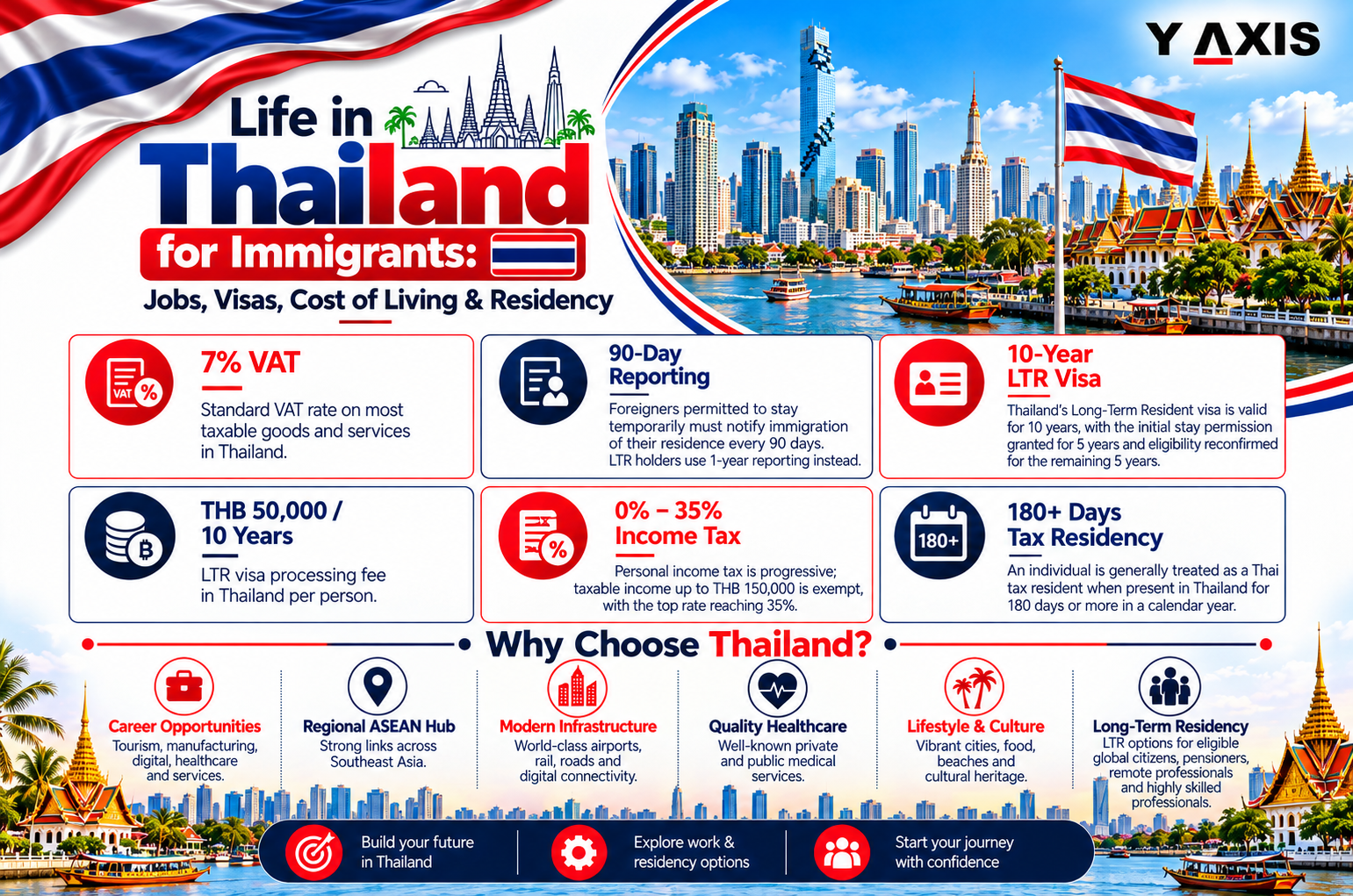
Life in Thailand for Immigrants: Jobs, Visas, Cost of Living & Residency
Life in Thailand for Immigrants: Jobs, Visas, Cost of Living & Residency
Life for immigrants in Thailand offers a low cost of living, a warm climate, and a growing job market in tourism, manufacturing, and technology. Most Indian professionals move on a Non-Immigrant B visa with a work permit, which needs a job offer from a Thai employer. Highly skilled professionals can apply for the 10-year Long-Term Resident (LTR) visa, which offers a flat 17% personal income tax rate. Remote workers can use the Destination Thailand Visa (DTV). Permanent residency is possible after 3 consecutive years on a work-based visa, but places are limited by a yearly quota. Sukhumvit, Sathorn, Chiang Mai, Phuket, and Pattaya are popular areas for expats.
Some quick facts about Thailand are as follows:
|
Population |
Approximately 66 million registered residents |
|
Capital |
Bangkok (Thailand's capital and largest city) |
|
Official Language |
Thai (English is widely used in international companies, tourism, and international schools) |
|
Currency |
Thai Baht (THB) |
|
Popular Immigrant Hubs |
Bangkok (Sukhumvit, Sathorn, Silom), Chiang Mai, Phuket, Pattaya |
|
Economy |
Strong tourism, automotive, electronics, and food-processing sectors; growing demand for IT, engineering, and hospitality professionals |
|
Typical Route to Long Stay |
Non-Immigrant B visa with a work permit, or the 10-year Long-Term Resident (LTR) visa for highly skilled professionals |
|
Long-Term Residency |
Permanent residency after 3 consecutive years on a work-based visa, subject to a yearly quota; citizenship by naturalisation after holding permanent residency |
*Want to settle in Thailand? Sign up with Y-Axis for end-to-end assistance.
Why Choose Thailand to Migrate Abroad?
Thailand runs an employer-sponsored work permit system for foreign professionals. It also offers long-stay visas for highly skilled workers, remote workers, and investors.
Here is why you should choose a life in Thailand:
- The Non-Immigrant B visa and work permit cover a wide range of professional jobs with Thai employers.
- The 10-year Long-Term Resident (LTR) visa offers a flat 17% income tax rate for eligible highly skilled professionals.
- The Destination Thailand Visa (DTV) lets remote workers stay for up to 180 days per entry over 5 years.
- Tourism, automotive, electronics, and IT offer steady jobs for skilled professionals.
- Living costs are much lower than in Singapore, Dubai, or most Western countries.
- World-class private hospitals, a warm climate, and a large Indian community make settling in easier.
Note: Indian passport holders can visit Thailand visa-free for up to 30 days for tourism only. Anyone with a job offer must get the correct work visa and must not use the visa exemption. All visitors must complete the Thailand Digital Arrival Card (TDAC) online within 72 hours before arrival.
*Want to work in Thailand? Let Y-Axis assist you with the process.
Can I Move to Thailand as an Indian Immigrant?
Most Indians move to Thailand on a Non-Immigrant B visa with a work permit, which needs a confirmed job offer. Highly skilled professionals can apply for the 10-year LTR visa instead.
The steps to migrate to Thailand as an Indian professional are as follows:
Step 1: Secure a job offer from a Thai employer, since the work visa and work permit need this before you apply
Step 2: Select a suitable pathway, such as the Non-Immigrant B visa, the LTR visa, or the Destination Thailand Visa
Step 3: Your employer prepares the company documents needed for your visa and work permit
Step 4: Apply for your visa through Thailand's official e-visa website or a Royal Thai Embassy or Consulate in India
Step 5: Travel to Thailand once your visa is approved
Step 6: Apply for your work permit with the Ministry of Labour before you start working
Step 7: Open a local bank account, register with the Social Security Office, and get a Thai mobile number
Also, read...
Highest Paying Job Opportunities in Thailand
Best Visa Options to Live in Thailand
Thailand offers several routes depending on your job offer, income, skills, and investment profile. The table below shows the main options and their route to long-term residence.
|
Visa Type |
Best For |
Duration |
Long-Term Pathway |
|
Non-Immigrant B Visa + Work Permit |
Job offer from a Thai employer that meets company and salary rules |
Usually 1 year, renewable |
Can lead to permanent residency after 3 consecutive years |
|
Long-Term Resident (LTR) Visa |
Highly skilled professionals, remote workers, wealthy individuals, and retirees who meet income or asset rules |
10 years (5 + 5) |
Long-term stay; flat 17% tax rate for eligible highly skilled professionals |
|
Destination Thailand Visa (DTV) |
Remote workers and digital nomads with proof of funds of at least THB 500,000 |
5 years, up to 180 days per entry |
Does not lead to permanent residency |
|
Thailand Privilege Visa |
Applicants who pay a membership fee for long-stay benefits |
5 to 20 years, depending on the package |
Long-term stay; does not allow work by itself |
Also, read...
The Thailand Job Market Outlook
Best Areas to Live in Thailand
Thailand's job market and living costs vary by area. Choosing the right neighbourhood can influence your commute, cost of living, housing expenses, and overall quality of life.
The table below highlights the major Thailand areas and their best qualities for settlement abroad:
|
Area |
Best For |
Sightseeing |
Average Rent |
Job Market |
How Much You Can Save |
|
Sukhumvit (Bangkok) |
Corporate professionals & expats |
Benjakitti Park, EmQuartier and Terminal 21 malls |
THB 20,000-45,000/mo (1BR condo) |
Strong, MNCs, IT & services |
Moderate, higher rents |
|
Sathorn & Silom (Bangkok) |
Finance & business professionals |
Lumpini Park, Mahanakhon SkyWalk |
THB 18,000-40,000/mo (1BR condo) |
Strong, banking, finance & corporate HQs |
Moderate savings potential |
|
Chiang Mai (Nimman area) |
Remote workers & families |
Doi Suthep Temple, Old City |
THB 10,000-20,000/mo (1BR condo) |
Moderate, education, IT & tourism |
Good savings potential |
|
Phuket |
Hospitality professionals & families |
Patong Beach, Old Phuket Town |
THB 15,000-35,000/mo (1BR condo) |
Good, hotels, tourism & international schools |
Moderate savings potential |
|
Pattaya & Eastern Seaboard |
Manufacturing & engineering professionals |
Sanctuary of Truth, Jomtien Beach |
THB 10,000-25,000/mo (1BR condo) |
Good, automotive & industrial estates |
Good savings potential |
Note: Most Thai rentals need a security deposit of 2 months plus 1 month of rent in advance. Figures vary by building age, size, and distance from BTS or MRT stations. Confirm current listings before budgeting.
Also, read...
What Are the Most In-Demand Jobs in Thailand for the Next 10 Years?
Cost of Living in Thailand
Thailand's cost of living changes by location. Central Bangkok and Phuket cost the most, while Chiang Mai and smaller cities are more affordable.
Below is a breakdown of average monthly expenses for a single adult living outside the most premium areas:
|
Rent (1BR condo, outside prime area, e.g. Chiang Mai/Pattaya) |
THB 10,000-20,000/month |
|
Utilities (electricity, water & internet) |
THB 2,000-4,000/month |
|
Groceries |
THB 6,000-10,000/month |
|
Public Transport (BTS / MRT / buses) |
THB 1,500-3,000/month |
|
Healthcare |
Employees join the Social Security Fund through their employer and pay 5% of salary up to a monthly cap; most expats also take private health insurance |
|
Dining Out (per meal) |
THB 60-150 (local food), THB 300-600 (mid-range restaurant) |
|
Mobile & Internet |
THB 700-1,500/month |
|
Entertainment & Leisure |
THB 3,000-8,000/month |
Also, read...
What are the Eligibility Requirements for a Thailand Work Visa?
Is Thailand Expensive Compared to Malaysia or Singapore?
Thailand is much cheaper than Singapore, especially for rent, food, and transport. Living costs in Bangkok are broadly similar to Kuala Lumpur.
Salaries for foreign professionals are good compared to local living costs. Many immigrants can save well, especially outside central Bangkok and Phuket.
Central Bangkok and Phuket are the priciest areas. However, they also offer the most jobs in multinational companies, finance, and hospitality.
Work in Thailand
Thailand's job market is led by tourism, automotive, electronics, and food processing. Leading employers include Toyota Thailand, Delta Electronics, Agoda, CP Group, and international hotel chains.
The table below shows some of the most in-demand jobs in Thailand for immigrants.
|
Occupation |
Average Monthly Salary |
Demand Level |
Average Savings |
|
IT & Software Development |
THB 60,000-150,000 |
High |
THB 20,000-60,000/month |
|
Automotive & Electronics Engineering |
THB 50,000-120,000 |
High |
THB 15,000-45,000/month |
|
Finance & Shared Services |
THB 45,000-120,000 |
High |
THB 12,000-40,000/month |
|
International School Teaching |
THB 35,000-100,000 |
Moderate |
THB 8,000-30,000/month |
|
Hospitality & Tourism Management |
THB 40,000-100,000 |
High |
THB 10,000-30,000/month |
|
Digital Marketing |
THB 40,000-90,000 |
Moderate |
THB 10,000-25,000/month |
Settling in Thailand
Once you arrive in Thailand, you need to get your work permit, register with social security, enrol children in school, and set up your day-to-day essentials.
Here is a quick overview of what to expect during your first weeks in the country:
|
Housing |
Healthcare |
Education for Children |
Banking & Financial Essentials |
|
Search via portals like DDproperty and Hipflat, or English-speaking agents; condos near BTS and MRT stations are in high demand |
Employees join the Social Security Fund, which covers treatment at a registered hospital |
International schools teach in English, with British, American, and IB curriculum options |
Open an account with Bangkok Bank, Kasikornbank, SCB, or Krungthai Bank |
|
Landlords usually ask for a 2-month deposit plus 1 month of rent in advance; your landlord must report your address to immigration (TM30) |
Private hospitals such as Bumrungrad, Bangkok Hospital, and Samitivej offer high-quality care |
International school fees range from around THB 400,000 to THB 1,000,000+ a year |
Banks usually ask for your passport, visa, and work permit or an employer letter |
|
Allow 1-3 weeks to find a rental; most leases run for 6-12 months |
Most expats take private health insurance for wider cover |
Apply for school places early; popular international schools have waitlists |
Basic accounts can often be opened on the same day with the right documents |
Permanent Residency and Long-Term Residency in Thailand
Long-term residency in Thailand is mainly available through the 10-year LTR visa and Thai permanent residency, which has a yearly quota.
|
Non-Immigrant B Visa + Work Permit |
Renewed every year with continuous employment; counts towards permanent residency |
|
Long-Term Resident (LTR) Visa |
Valid for 10 years (5 + 5) for eligible highly skilled professionals and other qualifying groups |
|
Thai Permanent Residency |
Needs 3 consecutive years on a Non-Immigrant visa with extensions, a work permit, and minimum income or tax records |
|
Permanent Residency Quota |
Thailand accepts a limited number of applications each year, with a cap per nationality |
|
Thai Citizenship (Naturalisation) |
Generally needs permanent residency, years of residence, Thai language skills, and good conduct |
Important note: To apply for Thai permanent residency, you usually need at least 3 consecutive years on a Non-Immigrant visa with yearly extensions and a valid work permit. Applicants must also meet minimum income or tax requirements. Applications are accepted only during a yearly window, and each nationality has a limited quota, so approval can take time. The LTR visa offers a 10-year stay but does not count as permanent residency. Thai citizenship requires Thai language skills and other conditions. India does not allow dual citizenship.
Dependent Benefits for Immigrants in Thailand
Thailand allows work permit holders and LTR visa holders to bring their spouse and children on a dependent visa.
Here are the benefits of securing a Thailand dependent visa:
- Spouses and children can join you on a Non-Immigrant O dependent visa
- Dependent children can study in Thai schools or international schools
- LTR visa holders can bring a spouse and children under 20 as dependants
- Dependants need their own work permit before taking up a job
- Family members can be added to private health insurance plans for wider cover
Practical Settlement Checklist for Indians Moving to Thailand
The steps for smooth transition to Thailand for Indians are as follows:
Step 1: Confirm your job offer and work visa before travelling, and do not use the tourist visa exemption to start work
Step 2: Complete the Thailand Digital Arrival Card (TDAC) online within 72 hours before arrival
Step 3: Book temporary accommodation, such as a serviced apartment, for your first few weeks
Step 4: Search for long-term housing via DDproperty, Hipflat, or English-speaking agents
Step 5: Get your work permit, open a bank account, and buy a local mobile SIM
Step 6: Register with the Social Security Office through your employer and arrange private health insurance
Step 7: Enrol children in school as early as possible, given high demand for international schools
Step 8: Report your address to immigration every 90 days, as required for long-stay visa holders
Step 9: Join Indian community associations in Bangkok and Chiang Mai for support and networking
*Are you looking for step-by-step assistance with Thailand immigration? Contact Y-Axis, the world's No. 1 overseas immigration consultancy!
FAQs
What is the easiest way for Indians to move to Thailand?
Most Indians move on a Non-Immigrant B visa with a work permit, which needs a confirmed job offer from a Thai employer. Highly skilled professionals with strong salaries can apply for the 10-year Long-Term Resident (LTR) visa. Remote workers can use the Destination Thailand Visa, which does not allow work for Thai employers.
What is the LTR visa in Thailand?
The Long-Term Resident (LTR) visa is a 10-year visa for highly skilled professionals, remote workers, wealthy individuals, and retirees. Eligible highly skilled professionals can pay a flat 17% personal income tax rate. LTR holders can also bring their spouse and children under 20 as dependants.
Can I move to Thailand without a job offer?
Yes, but not to work for a Thai employer. The Destination Thailand Visa lets remote workers stay for up to 180 days per entry. The LTR visa also has categories for remote workers and wealthy individuals. To work for a Thai company, you need a job offer, a work visa, and a work permit.
Is healthcare free for immigrants in Thailand?
No. Employees join the Social Security Fund and pay 5% of their salary up to a monthly cap. This covers treatment at a registered hospital. Most expats also take private health insurance to use private hospitals such as Bumrungrad, Bangkok Hospital, or Samitivej.
What is the average salary for skilled workers in Thailand?
Salaries vary by sector and experience. IT professionals typically earn THB 60,000-150,000 a month, and engineers earn THB 50,000-120,000 a month. Thailand's personal income tax is progressive, from 0% to 35%, while eligible LTR holders can pay a flat 17%.
Can I bring my family to Thailand on a work visa?
Yes. Work permit holders can bring their spouse and children on a Non-Immigrant O dependent visa. Children can study in Thai or international schools. Dependants need their own work permit before taking up a job in Thailand.
Which area in Thailand is best for Indian immigrants?
Sukhumvit and Sathorn in Bangkok offer the most jobs and expat-friendly living, though they cost more. Chiang Mai suits remote workers and families looking for lower costs. Pattaya and the Eastern Seaboard suit engineers working in automotive and industrial estates.
How much does it cost to live in Thailand?
Thailand's cost of living varies by area. In Sukhumvit, a one-bedroom condo costs around THB 20,000-45,000 a month. In Chiang Mai or Pattaya, similar housing costs about THB 10,000-25,000. Groceries, utilities, and transport add around THB 10,000-17,000 a month.
How do I get permanent residency in Thailand?
You usually need 3 consecutive years on a Non-Immigrant visa with yearly extensions and a work permit, plus minimum income or tax records. Applications are accepted only during a yearly window, and each nationality has a limited quota. Approval can take a long time, so plan early.
How can I get Thai citizenship?
Thai citizenship by naturalisation generally needs permanent residency, years of residence, Thai language skills, a steady income, and good conduct. The process is strict and can take several years. India does not allow dual citizenship, so you would need to give up your Indian citizenship.
Posted on October 16 2026
Top 10 Countries to Work Abroad as a Supply Chain Manager
Top 10 Countries to Work Abroad as a Supply Chain Manager
Global demand for skilled supply chain managers continues to grow as companies strengthen logistics, sourcing, and inventory planning. Professionals skilled in planning, procurement, and data analytics are in demand across the USA, UK, Canada, and Germany, among other countries around the world.
This blog is for you if you are a Supply Chain Manager with:
- A degree in engineering, business, supply chain management, or logistics, or an MBA.
- Experience in demand planning, procurement, logistics, warehousing, or inventory management.
- Interested in relocating to a country with strong trade, retail, or manufacturing sectors.
- Mid-career or senior experience seeking better salaries and faster PR pathways.
- Profile of a Supply Chain Manager, Logistics Manager, Procurement Manager, Operations Manager, or Head of Supply Chain.
|
Quick Facts |
Details |
|
Global demand |
Supply chain roles keep growing across e-commerce, retail, manufacturing, pharma, and logistics in the US, Europe, the Gulf, and Asia |
|
US job outlook |
SOC 11-3071 (Transportation, Storage, and Distribution Managers) is projected to grow 6% over the decade, with about 18,500 openings a year |
|
Occupation code status |
Most countries have no single "Supply Chain Manager" code. Roles map to logistics, distribution, or purchasing manager codes (US SOC 11-3071, UK SOC 1241, Canada NOC 70020, Australia ANZSCO 133611) |
|
Highest salary |
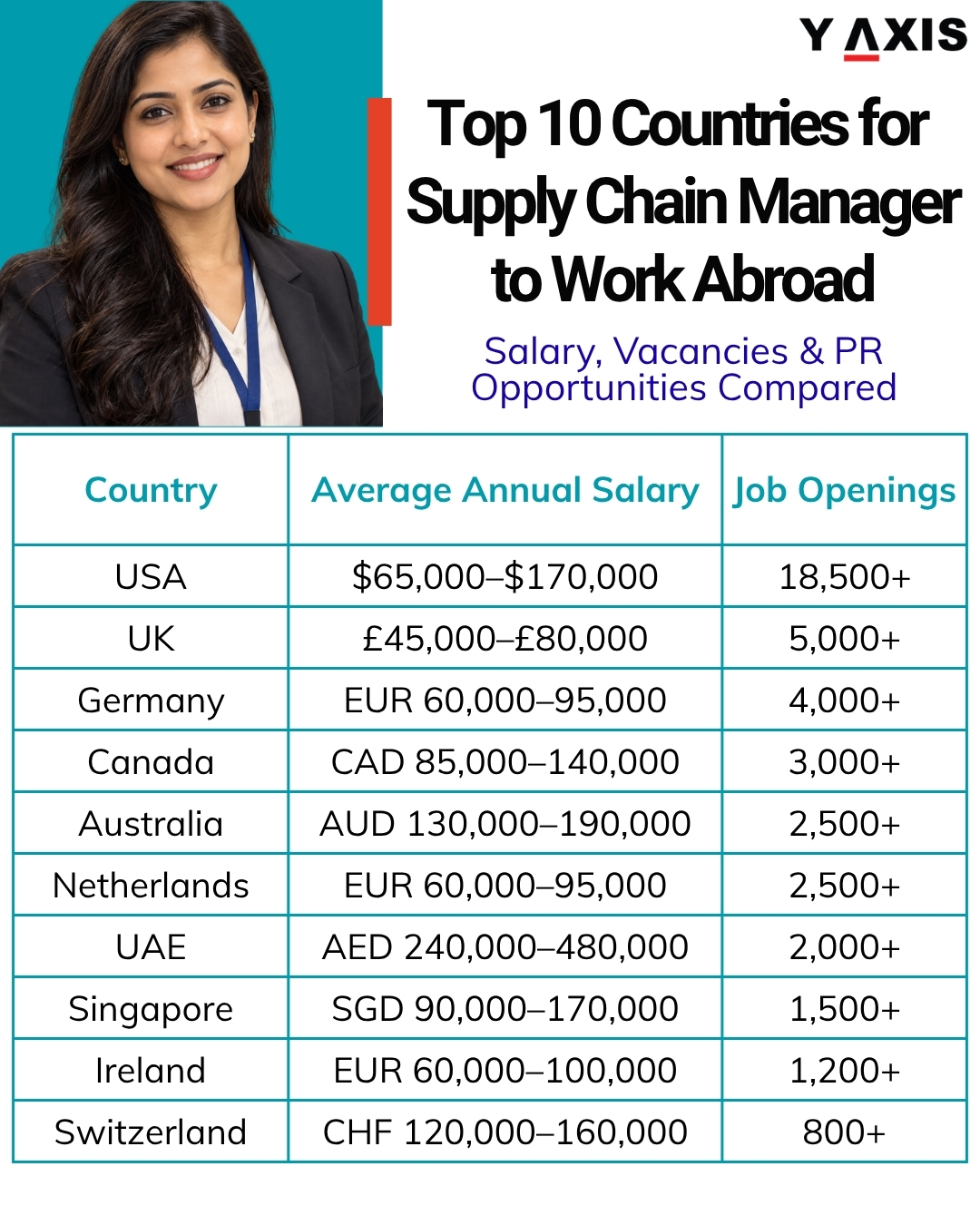
USA -- $65,000-$170,000+ per year (median $102,010, SOC 11-3071, BLS) |
|
Best PR + salary balance |
Canada -- CAD 85,000-140,000/year, classified under NOC 70020 or NOC 10012 (TEER 0), keeping Express Entry eligibility open |
|
Proof of impact |
Employers and visa sponsors expect clear results, such as cost savings, inventory turns, on-time delivery, or lead-time reduction |
|
Fastest EU permanent residence |
Germany -- EU Blue Card holders can get permanent residence in 21 months with B1 German |
|
Tax-free income route |
UAE -- no personal income tax, plus a 10-year Golden Visa for skilled professionals earning AED 30,000+ a month |
*Want to find Supply Chain Manager jobs abroad? Sign up with Y-Axis for end-to-end assistance.
Top 10 Countries for Supply Chain Managers: Quick Comparison
Supply Chain Managers are in demand due to growing e-commerce, global trade, and the need for resilient supply networks. The top countries offer strong salaries and clear visa routes.
Top 10 countries to migrate abroad as a Supply Chain Manager are as follows:
|
Country |
Average Annual Salary |
Work visa |
PR pathway |
Estimated job openings |
|
$65,000-$170,000 |
H-1B (specialty occupation) / L-1 intra-company transfer |
EB-1C / EB-2 / EB-3 Green Card |
18,500+ |
|
|
£45,000-£80,000 |
Skilled Worker Visa (SOC 1241 / 1134) |
ILR (earned settlement rules) |
5,000+ |
|
|
CAD 85,000-140,000 |
Employer-Sponsored Work Permit, PNP |
Express Entry (NOC 70020 / 10012) / PNP |
3,000+ |
|
|
AED 240,000-480,000 |
Employment Visa / Golden Visa |
Golden Visa (10-year renewable) |
2,000+ |
|
|
EUR 60,000-95,000 |
EU Blue Card / Skilled Worker Visa |
PR after 21 months (Blue Card) or 3 years |
4,000+ |
|
|
AUD 130,000-190,000 |
Skills in Demand (Subclass 482) under ANZSCO 133611 |
Subclass 186 / 190 / 491 |
2,500+ |
|
|
SGD 90,000-170,000 |
Employment Pass (COMPASS) / ONE Pass |
PR (discretionary scheme) |
1,500+ |
|
|
Netherlands |
EUR 60,000-95,000 |
Highly Skilled Migrant Permit / EU Blue Card |
Permanent residence after 5 years |
2,500+ |
|
Ireland |
EUR 60,000-100,000 |
Critical Skills / General Employment Permit |
Stamp 4 after 21 months (Critical Skills); long-term residence after 5 years |
1,200+ |
|
Switzerland |
CHF 120,000-160,000 |
L/B Permit (quota-based) |
C Permit after 10 years |
800+ |
*Estimated using current job board listings and industry reports; actual openings vary by year and role.
Which Country Is Best for You? Supply Chain Managers' Decision Table
The best country for Supply Chain Managers depends on factors like career goals, salary expectations, and available immigration pathways.
|
Your goal |
Best country |
Why |
|
Highest Salary |
USA |
Median pay for SOC 11-3071 is $102,010/year. Senior supply chain directors at large retailers and manufacturers earn $150,000+. |
|
Employer-Sponsored PR |
Australia |
ANZSCO 133611 (Supply and Distribution Manager) is on the Core Skills Occupation List, opening the 482 and 186 routes. |
|
Best PR and Immigration Access |
Canada |
NOC 70020 and NOC 10012 (TEER 0) cover logistics and procurement leadership, keeping Express Entry open without a job offer. |
|
Tax-Free Income |
UAE |
No personal income tax, plus a 10-year Golden Visa for skilled professionals earning AED 30,000+ a month. |
|
Fastest EU Permanent Residence |
Germany |
EU Blue Card holders can get permanent residence in 21 months with B1 German. |
|
Europe's Logistics Gateway |
Netherlands |
The Port of Rotterdam and Schiphol host many European distribution centres, with a Highly Skilled Migrant route. |
|
Fast Settlement Route |
Ireland |
The Critical Skills Employment Permit leads to Stamp 4 after 21 months, with no labour market test. |
|
Best Work-Life Balance |
Switzerland |
High salaries, strong labour protections, and supply chain roles at global headquarters. |
*Want to work abroad? Let Y-Axis guide you with the process.
1. USA: The World's Largest Logistics and Retail Market
The USA job market leads global supply chain hiring. Amazon, Walmart, FedEx, UPS, and Procter & Gamble run some of the world's largest supply networks. High-paying jobs in USA include transportation, storage, and distribution managers, who earn a median of $102,010/year (SOC 11-3071, BLS). Many Supply Chain Managers move to the US on the H-1B or an L-1 intra-company transfer.
|
Average Salary |
$65,000-$170,000+ per year (median $102,010, SOC 11-3071, BLS). |
|
Top Cities |
Chicago, Dallas, Atlanta, Los Angeles, and Memphis. |
|
In-Demand Roles |
Supply Chain Manager, Logistics Manager, Distribution Center Manager, Procurement Manager, and Demand Planning Manager. |
|
Work Visa |
H-1B (employer-sponsored; the role must need a relevant degree to pass specialty-occupation review) or L-1 for intra-company transfers from an Indian office. |
|
PR Pathway |
EB-2 or EB-3 Green Card through employer sponsorship, or EB-1C for multinational managers. |
|
Why Choose USA |
The world's largest consumer market, top logistics salaries, and global supply chain teams at leading retailers and manufacturers. |
*Want to apply for a USA work visa? Let Y-Axis guide you with the steps.
2. UK: Europe's Leading Retail and E-commerce Supply Chains
The UK job market has strong supply chain hiring in retail, e-commerce, and manufacturing. Tesco, Unilever, Ocado, and DHL run large networks across the country. High-paying jobs in UK include Supply Chain Managers under SOC 1241 (Managers in transport and distribution) and SOC 1134 (Purchasing managers and directors).
|
Average Salary |
£45,000-£80,000 per year (supply chain directors in London earn more). |
|
Top Cities |
London, Birmingham, Manchester, Milton Keynes, and Leeds. |
|
In-Demand Roles |
Supply Chain Manager, Logistics Manager, Procurement Manager, Distribution Manager, and Supply Chain Director. |
|
Work Visa |
Skilled Worker Visa (e.g., SOC 1241 or SOC 1134), employer-sponsored, with a general salary threshold of £41,700 or the going rate, whichever is higher. SOC 1243 (Managers in logistics) is classed as medium skilled and is not eligible for most new applications. |
|
PR Pathway |
Indefinite Leave to Remain (ILR) under the earned settlement rules, which set a longer baseline for most routes. |
|
Why Choose UK |
Europe's biggest e-commerce market, global retail and FMCG headquarters, and strong demand for procurement specialists. |
*Want to apply for a UK work visa? Let Y-Axis guide you with the steps.
3. Canada: Express Entry Routes via NOC 70020 and NOC 10012
Canada's job market has strong supply chain hubs in Toronto, Vancouver, Montreal, and Calgary, with employers like Loblaw, Canadian Tire, CN, and CPKC. In-demand jobs in Canada include NOC 70020 (Managers in transportation) and NOC 10012 (Purchasing managers), both TEER 0.
|
Average Salary |
CAD 85,000-140,000 per year (Toronto and Vancouver pay toward the higher end). |
|
Top Cities |
Toronto, Vancouver, Montreal, Calgary, and Mississauga. |
|
In-Demand Roles |
Supply Chain Manager, Logistics Manager, Procurement Manager, Materials Manager, and Distribution Manager. |
|
Work Visa |
Provincial Nominee Programs (PNP) or Employer-Sponsored Work Permit (LMIA-based). |
|
PR Pathway |
Express Entry (NOC 70020 or NOC 10012, TEER 0) or Provincial Nominee Program. Manufacturing-led roles may fit NOC 90010 (Manufacturing managers), also TEER 0. |
|
Why Choose Canada |
Clear Express Entry pathways for TEER 0 supply chain roles, plus major ports and rail networks that need logistics leaders. |
*Want to apply for a Canada work visa? Let Y-Axis guide you with the steps.
4. UAE: A Global Trade Hub with Tax-Free Salaries
The UAE's job market is built on global trade through Dubai and Abu Dhabi. DP World, Emirates SkyCargo, Aramex, and Noon run large logistics networks from Jebel Ali Port and Dubai's free zones. In-demand jobs in UAE pay tax-free salaries. Eligible skilled professionals can get a 10-year Golden Visa.
|
Average Salary |
AED 240,000-480,000 per year, tax-free. |
|
Top Cities |
Dubai, Abu Dhabi, and Sharjah. |
|
In-Demand Roles |
Supply Chain Manager, Logistics Manager, Procurement Manager, Warehouse Operations Manager, and Freight Forwarding Manager. |
|
Work Visa |
Employer-sponsored Employment Visa, or the Golden Visa for skilled professionals with a bachelor's degree and a monthly salary of at least AED 30,000. |
|
PR Pathway |
Golden Visa works as long-term residency; standard visas renew with continued sponsorship. |
|
Why Choose UAE |
Zero personal income tax, a 10-year Golden Visa route, and one of the world's busiest trade and re-export hubs. |
*Want to apply for a Dubai work visa? Let Y-Axis guide you with the steps.
5. Germany: Europe's Logistics Powerhouse
Germany's job market is Europe's largest logistics market. DHL, DB Schenker, Siemens, BMW, and Volkswagen run complex global supply chains. In-demand jobs in Germany are open via the EU Blue Card, which can lead to permanent residence in 21 months.
|
Average Salary |
EUR 60,000-95,000 per year (Munich, Frankfurt, and Hamburg pay above average). |
|
Top Cities |
Hamburg, Frankfurt, Munich, Düsseldorf, and Stuttgart. |
|
In-Demand Roles |
Supply Chain Manager, Logistics Manager, Procurement Manager, SAP Supply Chain Consultant, and Demand Planning Manager. |
|
Work Visa |
EU Blue Card (current standard threshold of EUR 50,700, with a lower threshold for shortage roles) or Skilled Worker Visa. |
|
PR Pathway |
Niederlassungserlaubnis in 21 months (Blue Card, with B1 German) or after 3 years on the Skilled Worker route. |
|
Why Choose Germany |
Europe's largest economy, strong automotive and industrial supply chains, and a fast Blue Card route to PR. |
*Want to apply for a Germany work visa? Let Y-Axis guide you with the steps.
6. Australia: Supply and Distribution Manager on the Core Skills List
Australia's job market has strong demand across retail, mining, and logistics, led by Sydney and Melbourne. Woolworths, Coles, Toll, and BHP run large supply networks. In-demand roles in Australia include ANZSCO 133611 (Supply and Distribution Manager), which sits on the Core Skills Occupation List.
|
Average Salary |
AUD 130,000-190,000 per year (senior supply chain leads earn more). |
|
Top Cities |
Sydney, Melbourne, Brisbane, and Perth. |
|
In-Demand Roles |
Supply Chain Manager, Logistics Manager, Procurement Manager (ANZSCO 133612), Distribution Manager, and Head of Supply Chain. |
|
Work Visa |
Skills in Demand Visa (Subclass 482), Core Skills stream, under ANZSCO 133611. Salary must meet the Core Skills Income Threshold, currently AUD 79,423. |
|
PR Pathway |
Employer Nomination Scheme Subclass 186, or state-nominated Subclass 190/491. A positive skills assessment from the Institute of Managers and Leaders (IML) is needed. |
|
Why Choose Australia |
High salaries, strong retail and resources supply chains, and both employer-sponsored and state-nominated PR routes. |
*Want to apply for an Australia work visa? Let Y-Axis guide you with the steps.
7. Singapore: Asia's Leading Shipping and Logistics Hub
Singapore job market is one of the world's busiest transhipment hubs, served by PSA's port and Changi Airport. DHL, Maersk, Kuehne+Nagel, and many manufacturers run their Asia-Pacific supply chains from here. In-demand jobs in Singapore are open via the Employment Pass under the COMPASS framework.
|
Average Salary |
SGD 90,000-170,000 per year. |
|
Top Cities |
Singapore (roles concentrated around Jurong, Tuas, Changi, and the central business district). |
|
In-Demand Roles |
Supply Chain Manager, Regional Logistics Manager, Procurement Manager, Demand Planning Manager, and Supply Chain Director (APAC). |
|
Work Visa |
Employment Pass (minimum qualifying salary SGD 5,600/month, subject to COMPASS), or ONE Pass for top earners with a fixed monthly salary of at least SGD 30,000. |
|
PR Pathway |
Permanent Residence via the discretionary PR scheme. |
|
Why Choose Singapore |
Asia's leading hub for regional supply chain teams, with low personal income tax. |
*Want to apply for a Singapore work visa? Let Y-Axis guide you with the steps.
8. Netherlands: Europe's Gateway via the Port of Rotterdam
The Netherlands job market is built around the Port of Rotterdam, Europe's largest port, and Amsterdam Airport Schiphol. Philips, Heineken, ASML, and many global distribution centres hire supply chain talent. In-demand jobs in the Netherlands are open via the Highly Skilled Migrant scheme.
|
Average Salary |
EUR 60,000-95,000 per year. |
|
Top Cities |
Rotterdam, Amsterdam, Eindhoven, Venlo, and Utrecht. |
|
In-Demand Roles |
Supply Chain Manager, Logistics Manager, Procurement Manager, European Distribution Manager, and Supply Chain Planning Lead. |
|
Work Visa |
Highly Skilled Migrant permit (minimum gross salary of EUR 5,942/month if aged 30 or over, or EUR 4,357/month if under 30), or the EU Blue Card. |
|
PR Pathway |
Permanent residence after 5 years of continuous residence. |
|
Why Choose Netherlands |
Europe's leading logistics gateway, English-friendly workplaces, and a tax benefit (the 30% ruling) for eligible skilled migrants. |
*Want to apply for a Netherlands work visa? Let Y-Axis guide you with the steps.
9. Ireland: Europe's Hub for Pharma and Tech Supply Chains
Ireland's job market has strong supply chain hiring in pharmaceuticals, medical devices, and technology. Pfizer, Intel, Apple, and Medtronic run major manufacturing and distribution operations. In-demand jobs in Ireland are open via the Critical Skills and General Employment Permits.
|
Average Salary |
EUR 60,000-100,000 per year. |
|
Top Cities |
Dublin, Cork, Galway, and Limerick. |
|
In-Demand Roles |
Supply Chain Manager, Materials Manager, Procurement Manager, Logistics Manager, and Planning Manager. |
|
Work Visa |
Critical Skills Employment Permit (minimum salary of EUR 68,911 for eligible roles not on the Critical Skills Occupations List), or a General Employment Permit. |
|
PR Pathway |
Stamp 4 permission after 21 months on a Critical Skills permit, then long-term residence after 5 years. |
|
Why Choose Ireland |
An English-speaking EU country, global pharma and tech manufacturing hubs, and a fast Stamp 4 route for critical skills workers. |
*Want to apply for an Ireland work visa? Let Y-Axis guide you with the steps.
10. Switzerland: Global Headquarters for Pharma and Commodity Supply Chains
Switzerland's job market hosts global supply chain teams at Nestlé, Roche, Novartis, and Kuehne+Nagel. Geneva and Zug are also major centres for commodity trading and shipping firms. High-paying jobs in Switzerland reward supply chain professionals with strong salaries and quality of life.
|
Average Salary |
CHF 120,000-160,000 per year. |
|
Top Cities |
Zurich, Basel, Geneva, Zug, and Lausanne. |
|
In-Demand Roles |
Supply Chain Manager, Procurement Manager, Demand Planning Manager, Logistics Manager, and Global Supply Chain Director. |
|
Work Visa |
Non-EU/EFTA L or B Permit (quota-based, employer and cantonal approval required). |
|
PR Pathway |
Settlement permit (C Permit) after 10 years of continuous residence, or 5 years for treaty countries. |
|
Why Choose Switzerland |
Some of Europe's highest salaries, global headquarters, and an excellent standard of living. |
*Want to apply for a Switzerland work visa? Let Y-Axis guide you with the steps.
What Skills Do Supply Chain Managers Need to Work Abroad?
Employers consistently look for the following skills while recruiting Supply Chain Managers:
- Supply Chain Planning: Demand forecasting, sales and operations planning (S&OP), and inventory optimisation
- ERP & Supply Chain Systems: SAP S/4HANA, Oracle, and warehouse and transport management systems
- Procurement & Supplier Management: Strategic sourcing, negotiation, and contract management
- Data & Analytics: Excel, SQL, Power BI, and KPIs such as on-time in full (OTIF) and inventory turns
- Trade Compliance & Sustainability: Customs rules, Incoterms, and carbon and ESG reporting
*Want to get your Supply Chain Manager profile assessed? Try Y-Axis Free Eligibility Assessment to evaluate your profile.
How to Migrate Abroad as a Supply Chain Manager?
The steps to apply for Supply Chain Manager jobs abroad are as follows:
Step 1: Check your country-wise eligibility based on qualifications, supply chain experience, and English proficiency.
Step 2: Identify the correct occupation code for your target country (SOC 11-3071 in the USA, NOC 70020 or 10012 in Canada, ANZSCO 133611 in Australia, or SOC 1241 or 1134 in the UK), based on your actual duties.
Step 3: Build a strong record of results, with clear metrics such as cost savings, inventory reduction, or on-time delivery.
Step 4: Apply for overseas supply chain roles across LinkedIn, Indeed, and company career pages.
Step 5: Secure a job offer after technical, case study, and stakeholder interview rounds.
Step 6: Upon visa approval, relocate, complete local registrations, and begin working legally abroad.
Common Mistakes Supply Chain Managers Make When Applying for Jobs Abroad
- Listing tasks instead of results with clear metrics, such as cost savings or inventory turns.
- Choosing an occupation code by job title alone, instead of matching your actual duties.
- Using UK SOC 1243 (Managers in logistics), which is not eligible for most new Skilled Worker visas, when your duties fit SOC 1241 or 1134.
- Accepting UK job offers below the £41,700 Skilled Worker general salary threshold or the going rate.
- Not getting a positive skills assessment from the Institute of Managers and Leaders (IML) before applying in Australia.
- Not checking tax rules on salary, bonuses, and allowances in the new country.
*Are you looking for step-by-step assistance with overseas immigration? Contact Y-Axis, the world's No. 1 overseas immigration consultancy, for end-to-end assistance!
FAQs
Which are the top 10 countries for Supply Chain Managers to work abroad?
The top 10 countries are the USA, the UK, Canada, the UAE, Germany, Australia, Singapore, the Netherlands, Ireland, and Switzerland. The USA offers the highest salaries while Canada offers clear Express Entry routes through NOC 70020 and NOC 10012. The UAE offers tax-free income and a 10-year Golden Visa for skilled professionals.
Is there a dedicated occupation code for Supply Chain Managers?
In most countries, no. Supply Chain Manager roles map to logistics, distribution, or purchasing manager codes. Examples include US SOC 11-3071 (Transportation, Storage, and Distribution Managers), UK SOC 1241 (Managers in transport and distribution), and Canada NOC 70020. In Australia, the role usually maps to ANZSCO 133611 (Supply and Distribution Manager).
Which occupation code do Supply Chain Managers use for Canada's Express Entry?
Logistics-focused Supply Chain Managers often use NOC 70020 (Managers in transportation), classified as TEER 0. Procurement-led roles may fit NOC 10012 (Purchasing managers), also TEER 0. Both are eligible for the Federal Skilled Worker Program without a job offer, if you meet the points threshold.
Can Supply Chain Managers get PR in Australia?
Yes. ANZSCO 133611 (Supply and Distribution Manager) is on the Core Skills Occupation List. This allows the Subclass 482 visa and the Subclass 186 permanent visa. State-nominated 190/491 visas are also possible, depending on each state's current list. A positive skills assessment from the Institute of Managers and Leaders (IML) is required.
Which country offers the fastest PR for Supply Chain Managers?
Germany offers one of the fastest routes through the EU Blue Card. Permanent residence is possible in 21 months for B1 German speakers. Ireland's Critical Skills Employment Permit leads to Stamp 4 after 21 months. Canada's Express Entry can also move quickly once you clear the CRS cut-off score.
What is the average salary for a Supply Chain Manager in the USA?
Supply Chain Manager roles in the USA often fall under SOC 11-3071 (Transportation, Storage, and Distribution Managers). The median annual wage is $102,010, according to the latest BLS data. Pay varies by industry and location. Senior supply chain directors at large retailers and manufacturers can earn $150,000 or more.
Can Supply Chain Managers move abroad without a job offer?
It is hard for most routes, since the H-1B, EU Blue Card, Skilled Worker Visa, and Employment Pass need a job offer. There are a few exceptions. Canada's Express Entry lets you compete on points. Australia's state-nominated Subclass 190 visa does not need an employer. Germany's Opportunity Card lets skilled workers look for jobs in Germany.
Do Supply Chain Managers need an engineering degree to work abroad?
Not always. Many employers hire graduates in engineering, business, logistics, or supply chain management. An MBA in operations or supply chain is also valued. For visa purposes, a relevant degree or proven management experience is usually needed. Your degree and duties help decide which occupation code fits.
What is the UAE Golden Visa for skilled professionals?
It is a 10-year renewable residence visa for eligible skilled professionals. Applicants usually need a bachelor's degree, a valid employment contract, and a monthly salary of at least AED 30,000. The visa does not need an employer sponsor to renew. It also allows you to sponsor your family members.
Do Supply Chain Managers need a certification to work abroad?
No, a certification is not a visa requirement. Employers care more about your experience and results. Certifications such as ASCM's CSCP or CPIM, CIPS for procurement, or a Lean Six Sigma Green Belt can still strengthen your profile. They are most useful when you move into a new market or industry.
Which visa should Supply Chain Managers apply for in the UK?
Most employed Supply Chain Managers apply for the Skilled Worker Visa. Logistics and distribution roles usually fall under SOC 1241, while procurement roles fall under SOC 1134. The employer must pay at least the £41,700 general threshold or the going rate, whichever is higher. Supply chain directors may fall under SOC 1140.
How much does a Supply Chain Manager earn in Germany?
Supply Chain Managers in Germany typically earn between EUR 60,000 and EUR 95,000 per year. Pay is higher in Munich, Frankfurt, and Hamburg. The EU Blue Card's current standard threshold of EUR 50,700 suits most supply chain management roles. A lower threshold applies to shortage occupations.
What documents are required for a Supply Chain Manager's work visa abroad?
Typical requirements include a valid passport, a degree certificate, a job offer, an updated resume, and experience letters. Police clearance may be needed in some countries. Some routes also need a skills assessment or degree recognition. Always confirm the exact checklist with the target country's immigration authority.
Can Supply Chain Managers bring their family when moving abroad?
In most countries on this list, sponsored work visas let you include your spouse and dependent children. This includes the USA, the UK, Canada, Germany, Australia, the Netherlands, and the UAE. Spouses often get work rights too. Family rules in Switzerland, Singapore, and Ireland depend on salary level and permit type.
Do employers expect proof of supply chain results?
Yes, in most hiring processes. Employers expect you to explain the supply chains you have managed or improved. Show clear results, such as cost savings, lower inventory, better on-time delivery, or shorter lead times. Many companies also run case study interviews. Strong results often matter more than your job title.
What skills do employers expect from Supply Chain Managers abroad?
Most employers expect strong planning and inventory management skills. ERP experience in SAP or Oracle is highly valued. Employers also look for procurement, supplier management, and data skills in Excel, SQL, or Power BI. Knowledge of trade compliance, automation, and sustainability reporting is becoming a strong advantage.
Are the L-1 or EB-1C visas options for Supply Chain Managers in the USA?
Yes, in the right situations. The L-1A visa suits managers transferring from an Indian office to a US office of the same company. Managers who have worked abroad for the same company group for at least one year may also qualify for the EB-1C Green Card. Both routes need a qualifying company link between India and the US.
Can contract or freelance Supply Chain Managers apply for these work visas?
Most employer-sponsored visas, including the H-1B, EU Blue Card, and Skilled Worker Visa, need an employment contract. Contract roles through a local employer can still qualify. Germany offers a Freelance Visa for self-employed professionals. Always check the rules on working for foreign clients before you move.
What is the difference between a Supply Chain Manager and a Procurement Manager for visa purposes?
Supply Chain Managers oversee the full flow of goods, from planning and sourcing to delivery. Procurement Managers focus on buying goods and services and managing suppliers. Their occupation codes often differ, such as UK SOC 1241 and SOC 1134, or Australia ANZSCO 133611 and 133612. Your actual duties decide the code.
Which are the fastest-growing Supply Chain Manager job markets right now?
The UAE, Singapore, and the Netherlands are seeing fast growth. Dubai is expanding its role as a global trade and re-export hub. Singapore hosts regional supply chain teams for global manufacturers. The Netherlands keeps attracting European distribution centres around Rotterdam and Schiphol, supported by the Highly Skilled Migrant route.
Posted on October 15 2026
Top 10 Countries to Work Abroad as a Product Manager
Top 10 Countries to Work Abroad as a Product Manager
Global demand for skilled product managers continues to grow as companies build digital, AI, and platform products. Professionals skilled in product strategy, data, and user research are in demand across the USA, UK, Canada, and Germany, among other countries around the world.
This blog is for you if you are a Product Manager with:
- A degree in engineering, computer science, business, or design, or an MBA.
- Experience in product ownership, roadmapping, agile delivery, or user research.
- Interested in relocating to a country with a strong technology or startup ecosystem.
- Mid-career or senior experience seeking better salaries and faster PR pathways.
- Profile of a Product Manager, Product Owner, Technical Product Manager, Group Product Manager, or Product Lead.
|
Quick Facts |
Details |
|
Global demand |
Product roles keep growing across technology, fintech, e-commerce, SaaS, and AI companies in the US, UK, Canada, and Europe |
|
US job outlook |
SOC 11-3021 (Computer and Information Systems Managers) is projected to grow 15% over the decade, with about 55,600 openings a year |
|
Occupation code status |
Most countries have no single "Product Manager" code. Roles map to IT or marketing manager codes (US SOC 11-3021, UK SOC 2132, Canada NOC 20012, Australia ANZSCO 135199) |
|
Highest salary |
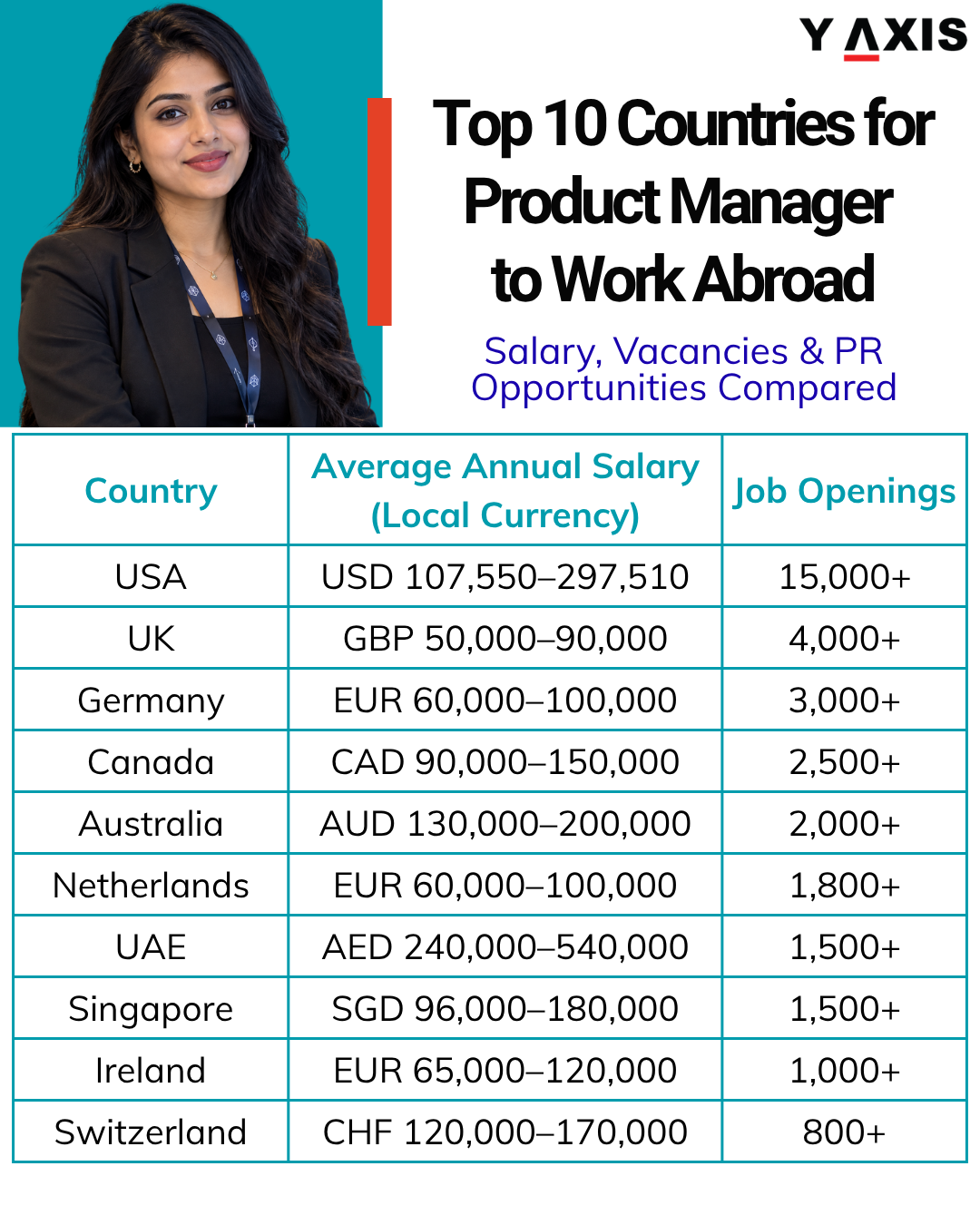
USA -- $107,550-$297,510+ per year (median $175,140, SOC 11-3021, BLS-aligned) |
|
Best PR + salary balance |
Canada -- CAD 90,000-150,000/year, classified under NOC 20012 (TEER 0), keeping Express Entry eligibility open |
|
Proof of impact |
Employers and visa sponsors expect product case studies with clear metrics, such as growth, retention, or revenue impact |
|
Fastest EU permanent residence |
Germany -- EU Blue Card holders can get permanent residence in 21 months with B1 German |
|
Tax-free income route |
UAE -- no personal income tax, plus a 10-year Golden Visa for skilled professionals earning AED 30,000+ a month |
*Want to find Product Manager jobs abroad? Sign up with Y-Axis for end-to-end assistance.
Top 10 Countries for Product Managers: Quick Comparison
Product Managers are in demand due to rising investment in digital, AI, and platform products worldwide. The top countries offer strong salaries and clear visa routes.
Top 10 countries to migrate abroad as a Product Manager are as follows:
|
Country |
Average Annual Salary |
Work visa |
PR pathway |
Estimated job openings |
|
$107,550-$297,510 |
H-1B (specialty occupation) / L-1 / O-1A for extraordinary ability |
EB-1 / EB-2 / EB-3 Green Card |
15,000+ |
|
|
£50,000-£90,000 |
Skilled Worker Visa / Global Talent Visa |
ILR (earned settlement rules) |
4,000+ |
|
|
CAD 90,000-150,000 |
Employer-Sponsored Work Permit, PNP |
Express Entry (NOC 20012) / PNP |
2,500+ |
|
|
AED 240,000-540,000 |
Employment Visa / Golden Visa |
Golden Visa (10-year renewable) |
1,500+ |
|
|
EUR 60,000-100,000 |
EU Blue Card / Skilled Worker Visa |
PR after 21 months (Blue Card) or 3 years |
3,000+ |
|
|
AUD 130,000-200,000 |
Skills in Demand (Subclass 482) under ANZSCO 135199 |
Subclass 186 / 190 / 491 |
2,000+ |
|
|
SGD 96,000-180,000 |
Employment Pass (COMPASS) / ONE Pass |
PR (discretionary scheme) |
1,500+ |
|
|
Netherlands |
EUR 60,000-100,000 |
Highly Skilled Migrant Permit / EU Blue Card |
Permanent residence after 5 years |
1,800+ |
|
Ireland |
EUR 65,000-120,000 |
Critical Skills Employment Permit |
Stamp 4 after 21 months; long-term residence after 5 years |
1,000+ |
|
Switzerland |
CHF 120,000-170,000 |
L/B Permit (quota-based) |
C Permit after 10 years |
800+ |
*Estimated using current job board listings and industry reports; actual openings vary by year and role.
Which Country Is Best for You? Product Managers' Decision Table
The best country for Product Managers depends on factors like career goals, salary expectations, and available immigration pathways.
|
Your goal |
Best country |
Why |
|
Highest Salary |
USA |
Median pay for SOC 11-3021 is $175,140/year. Senior product leaders at large tech firms clear $250,000+. |
|
Employer-Sponsored PR |
Australia |
ANZSCO 135199 (ICT Managers nec) is on the Core Skills Occupation List, opening the 482 and 186 routes. |
|
Best PR and Immigration Access |
Canada |
NOC 20012 (TEER 0) covers technology product leadership, keeping Express Entry open without a job offer. |
|
Tax-Free Income |
UAE |
No personal income tax, plus a 10-year Golden Visa for skilled professionals earning AED 30,000+ a month. |
|
Fastest EU Permanent Residence |
Germany |
EU Blue Card holders can get permanent residence in 21 months with B1 German. |
|
Global Talent Route |
UK |
The Global Talent Visa covers leaders in digital technology, next to London's fintech and SaaS scene. |
|
Fast Settlement Route |
Ireland |
The Critical Skills Employment Permit leads to Stamp 4 after 21 months, with no labour market test. |
|
Best Work-Life Balance |
Switzerland |
High salaries, strong labour protections, and product roles at global headquarters. |
*Want to work abroad? Let Y-Axis guide you with the process.
1. USA: The World's Largest Tech Product Market
The USA job market leads global product hiring. Google, Microsoft, Amazon, and Meta build products used worldwide. High-paying jobs in USA pay technology product leaders a median of $175,140/year (SOC 11-3021, BLS). Many Product Managers move to the US on the H-1B or an L-1 intra-company transfer.
|
Average Salary |
$107,550-$297,510+ per year (median $175,140, SOC 11-3021, BLS). |
|
Top Cities |
San Francisco Bay Area, Seattle, New York, Austin, and Boston. |
|
In-Demand Roles |
Product Manager, Technical Product Manager, AI Product Manager, Group Product Manager, and Product Owner. |
|
Work Visa |
H-1B (employer-sponsored; the role must need a relevant degree to pass specialty-occupation review) or O-1A for professionals with extraordinary ability in business or technology. |
|
PR Pathway |
EB-2 or EB-3 Green Card through employer sponsorship, or EB-1 for extraordinary ability and multinational managers. |
|
Why Choose USA |
The world's largest technology market, the highest product salaries, and global product teams at leading tech firms. |
*Want to apply for a USA work visa? Let Y-Axis guide you with the steps.
2. UK: London's Fintech and SaaS Product Hub
The UK job market is centred on London, home to Revolut, Monzo, Wise, and Deliveroo. High-paying jobs in UK include Product Managers under SOC 2132 (IT managers).
|
Average Salary |
£50,000-£90,000 per year (senior product leads in London earn more). |
|
Top Cities |
London, Manchester, Edinburgh, Cambridge, and Bristol. |
|
In-Demand Roles |
Product Manager, Senior Product Manager, Product Owner, Technical Product Manager, and Head of Product. |
|
Work Visa |
Skilled Worker Visa (e.g., SOC 2132 for IT product managers), employer-sponsored, with a general salary threshold of £41,700 or the going rate, whichever is higher; or the Global Talent Visa for leaders in digital technology. |
|
PR Pathway |
Indefinite Leave to Remain (ILR) under the earned settlement rules, which set a longer baseline for most routes. |
|
Why Choose UK |
Europe's leading fintech hub, plus a Global Talent visa pathway for recognised technology leaders. |
*Want to apply for a UK work visa? Let Y-Axis guide you with the steps.
3. Canada: A Clear Express Entry Route via NOC 20012
Canada's job market has growing tech hubs in Toronto, Vancouver, and Montreal, with employers like Shopify, Wealthsimple, and OpenText. In-demand jobs in Canada include NOC 20012 (Computer and information systems managers), which covers technology product leadership.
|
Average Salary |
CAD 90,000-150,000 per year (Toronto and Vancouver pay toward the higher end). |
|
Top Cities |
Toronto, Vancouver, Montreal, Waterloo, and Calgary. |
|
In-Demand Roles |
Product Manager, Product Owner, Technical Product Manager, Digital Product Manager, and Product Lead. |
|
Work Visa |
Provincial Nominee Programs (PNP) or Employer-Sponsored Work Permit (LMIA-based). |
|
PR Pathway |
Express Entry (NOC 20012, TEER 0) or Provincial Nominee Program. Marketing-led product roles may fit NOC 10022 (TEER 0). |
|
Why Choose Canada |
A clear Express Entry pathway under NOC 20012, plus a fast-growing tech and fintech scene. |
*Want to apply for a Canada work visa? Let Y-Axis guide you with the steps.
4. UAE: Tax-Free Salaries and a 10-Year Golden Visa
The UAE's job market is concentrated in Dubai and Abu Dhabi, home to Careem, Noon, and leading banks. In-demand jobs in UAE pay tax-free salaries. Eligible skilled professionals can get a 10-year Golden Visa.
|
Average Salary |
AED 240,000-540,000 per year, tax-free. |
|
Top Cities |
Dubai, Abu Dhabi, and Sharjah. |
|
In-Demand Roles |
Product Manager, Digital Product Manager, Fintech Product Manager, Product Owner, and E-commerce Product Lead. |
|
Work Visa |
Employer-sponsored Employment Visa, or the Golden Visa for skilled professionals with a bachelor's degree and a monthly salary of at least AED 30,000. |
|
PR Pathway |
Golden Visa works as long-term residency; standard visas renew with continued sponsorship. |
|
Why Choose UAE |
Zero personal income tax, a 10-year Golden Visa route, and fast-growing fintech and e-commerce sectors. |
*Want to apply for a Dubai work visa? Let Y-Axis guide you with the steps.
5. Germany: A Fast EU Blue Card Route to Permanent Residence
Germany's job market is strong in Berlin, Munich, Hamburg, and Frankfurt. SAP, Zalando, Delivery Hero, and N26 hire product talent. In-demand jobs in Germany are open via the EU Blue Card, which can lead to permanent residence in 21 months.
|
Average Salary |
EUR 60,000-100,000 per year (Berlin and Munich pay above average). |
|
Top Cities |
Berlin, Munich, Hamburg, and Frankfurt. |
|
In-Demand Roles |
Product Manager, Product Owner, Technical Product Manager, Data Product Manager, and Head of Product. |
|
Work Visa |
EU Blue Card (current standard threshold of EUR 50,700, with a lower threshold for shortage and IT roles) or Skilled Worker Visa. |
|
PR Pathway |
Niederlassungserlaubnis in 21 months (Blue Card, with B1 German) or after 3 years on the Skilled Worker route. |
|
Why Choose Germany |
Europe's largest economy, strong SaaS and fintech scenes, and a fast Blue Card route to PR. |
*Want to apply for a Germany work visa? Let Y-Axis guide you with the steps.
6. Australia: Employer-Sponsored Routes on the Core Skills List
Australia's job market is growing across fintech, SaaS, and e-commerce, led by Sydney and Melbourne. In-demand roles in Australia include ANZSCO 135199 (ICT Managers nec) and 131112 (Sales and Marketing Manager). Both sit on the Core Skills Occupation List, which opens employer-sponsored routes.
|
Average Salary |
AUD 130,000-200,000 per year (senior product leads earn more). |
|
Top Cities |
Sydney, Melbourne, Brisbane, and Perth. |
|
In-Demand Roles |
Product Manager, Product Owner, Technical Product Manager, Digital Product Manager, and Head of Product. |
|
Work Visa |
Skills in Demand Visa (Subclass 482), Core Skills stream, under ANZSCO 135199 or 131112. Salary must meet the Core Skills Income Threshold, currently AUD 79,423. |
|
PR Pathway |
Employer Nomination Scheme Subclass 186, or state-nominated Subclass 190/491 where the occupation is on a state list. |
|
Why Choose Australia |
High salaries, a strong tech scene led by Atlassian and Canva, and clear employer-sponsored PR routes. |
*Want to apply for an Australia work visa? Let Y-Axis guide you with the steps.
7. Singapore: Asia's Regional Hub for Tech Product Teams
Singapore job market hosts the Asia-Pacific offices of Google, Meta, and ByteDance, plus homegrown firms like Grab and Shopee. In-demand jobs in Singapore are open via the Employment Pass under the COMPASS framework.
|
Average Salary |
SGD 96,000-180,000 per year. |
|
Top Cities |
Singapore (roles concentrated in the central business district and one-north tech cluster). |
|
In-Demand Roles |
Product Manager, Technical Product Manager, Fintech Product Manager, Product Owner, and Head of Product. |
|
Work Visa |
Employment Pass (minimum qualifying salary SGD 5,600/month, subject to COMPASS), or ONE Pass for top earners with a fixed monthly salary of at least SGD 30,000. |
|
PR Pathway |
Permanent Residence via the discretionary PR scheme. |
|
Why Choose Singapore |
Asia's leading hub for regional product teams, with low personal income tax. |
*Want to apply for a Singapore work visa? Let Y-Axis guide you with the steps.
8. Netherlands: Europe's Startup-Friendly Tech Hub
The Netherlands job market is centred on Amsterdam, home to Booking.com, Adyen, and many international tech headquarters. In-demand jobs in the Netherlands are open via the Highly Skilled Migrant scheme.
|
Average Salary |
EUR 60,000-100,000 per year. |
|
Top Cities |
Amsterdam, Rotterdam, Utrecht, Eindhoven, and The Hague. |
|
In-Demand Roles |
Product Manager, Product Owner, Technical Product Manager, Growth Product Manager, and Product Lead. |
|
Work Visa |
Highly Skilled Migrant permit (minimum gross salary of EUR 5,942/month if aged 30 or over, or EUR 4,357/month if under 30), or the EU Blue Card. |
|
PR Pathway |
Permanent residence after 5 years of continuous residence. |
|
Why Choose Netherlands |
English-friendly workplaces, a strong startup scene, and a tax benefit (the 30% ruling) for eligible skilled migrants. |
*Want to apply for a Netherlands work visa? Let Y-Axis guide you with the steps.
9. Ireland: Europe's Base for Global Tech Companies
Ireland's job market is centred on Dublin, the European headquarters of Google, Meta, Microsoft, and Stripe. In-demand jobs in Ireland are open via the Critical Skills Employment Permit.
|
Average Salary |
EUR 65,000-120,000 per year. |
|
Top Cities |
Dublin, Cork, Galway, and Limerick. |
|
In-Demand Roles |
Product Manager, Senior Product Manager, Technical Product Manager, Product Owner, and Group Product Manager. |
|
Work Visa |
Critical Skills Employment Permit (minimum salary of EUR 40,904 for roles on the Critical Skills Occupations List, or EUR 68,911 for other eligible roles). |
|
PR Pathway |
Stamp 4 permission after 21 months on a Critical Skills permit, then long-term residence after 5 years. |
|
Why Choose Ireland |
An English-speaking EU country, global tech headquarters, and a fast Stamp 4 route for critical skills workers. |
*Want to apply for an Ireland work visa? Let Y-Axis guide you with the steps.
10. Switzerland: High Salaries and Top Work-Life Balance
Switzerland's job market hosts product teams at global firms like Google, Roche, and UBS in Zurich and Basel. High-paying jobs in Switzerland reward product professionals with strong salaries and quality of life.
|
Average Salary |
CHF 120,000-170,000 per year. |
|
Top Cities |
Zurich, Geneva, Basel, Lausanne, and Zug. |
|
In-Demand Roles |
Product Manager, Product Owner, Digital Product Manager, and Fintech Product Manager. |
|
Work Visa |
Non-EU/EFTA L or B Permit (quota-based, employer and cantonal approval required). |
|
PR Pathway |
Settlement permit (C Permit) after 10 years of continuous residence, or 5 years for treaty countries. |
|
Why Choose Switzerland |
Some of Europe's highest salaries, global headquarters, and an excellent standard of living. |
*Want to apply for a Switzerland work visa? Let Y-Axis guide you with the steps.
What Skills Do Product Managers Need to Work Abroad?
Employers consistently look for the following skills while recruiting Product Managers:
- Product Strategy & Roadmapping: Market research, prioritisation frameworks, and a clear product vision
- Data & Analytics: SQL, Amplitude, Mixpanel, Google Analytics, and A/B testing
- Agile Delivery: Scrum, Kanban, and tools like Jira and Confluence
- User Research & UX: User interviews, usability testing, and Figma prototypes
- Technical & AI Fluency: APIs, system design basics, and AI and machine learning use cases
*Want to get your Product Manager profile assessed? Try Y-Axis Free Eligibility Assessment to evaluate your profile.
How to Migrate Abroad as a Product Manager?
The steps to apply for Product Manager jobs abroad are as follows:
Step 1: Check your country-wise eligibility based on qualifications, product experience, and English proficiency.
Step 2: Identify the correct occupation code for your target country (SOC 11-3021 in the USA, NOC 20012 in Canada, ANZSCO 135199 in Australia, or SOC 2132 in the UK), based on your actual duties.
Step 3: Build a strong set of product case studies, with clear metrics such as growth, retention, or revenue impact.
Step 4: Apply for overseas product roles across LinkedIn, Indeed, and company career pages.
Step 5: Secure a job offer after product case interviews and stakeholder rounds.
Step 6: Upon visa approval, relocate, complete local registrations, and begin working legally abroad.
Common Mistakes Product Managers Make When Applying for Jobs Abroad
- Listing tasks instead of product outcomes with clear metrics.
- Choosing an occupation code by job title alone, instead of matching your actual duties.
- Confusing Product Manager and Project Manager codes, such as UK SOC 2132 and SOC 2131.
- Accepting UK job offers below the £41,700 Skilled Worker general salary threshold.
- Not checking the salary thresholds for the EU Blue Card or the Netherlands Highly Skilled Migrant permit.
- Not checking tax rules on salary, stock options, and bonuses in the new country.
*Are you looking for step-by-step assistance with overseas immigration? Contact Y-Axis, the world's No. 1 overseas immigration consultancy, for end-to-end assistance!
FAQs
Which are the top 10 countries for Product Managers to work abroad?
The top 10 countries are the USA, the UK, Canada, the UAE, Germany, Australia, Singapore, the Netherlands, Ireland, and Switzerland. The USA offers the highest salaries. Canada offers a clear Express Entry route through NOC 20012. The UAE offers tax-free income and a 10-year Golden Visa for skilled professionals.
Is there a dedicated occupation code for Product Managers?
In most countries, no. Product Manager roles map to IT or marketing manager codes. Examples include US SOC 11-3021 (Computer and Information Systems Managers), UK SOC 2132 (IT managers), and Canada NOC 20012. In Australia, product roles usually map to ANZSCO 135199 (ICT Managers nec) or 131112 (Sales and Marketing Manager).
Which occupation code do Product Managers use for Canada's Express Entry?
Most technology Product Managers use NOC 20012 (Computer and information systems managers), classified as TEER 0. Marketing-led product roles may fit NOC 10022 (Advertising, marketing and public relations managers), also TEER 0. Both are eligible for the Federal Skilled Worker Program without a job offer, if you meet the points threshold.
Can Product Managers get PR in Australia?
Yes, mainly through employer sponsorship. ANZSCO 135199 (ICT Managers nec) and 131112 (Sales and Marketing Manager) are on the Core Skills Occupation List. This allows the Subclass 482 visa and the Subclass 186 permanent visa. State-nominated 190/491 visas depend on each state's current list.
Which country offers the fastest PR for Product Managers?
Germany offers one of the fastest routes through the EU Blue Card. Permanent residence is possible in 21 months for B1 German speakers. Ireland's Critical Skills Employment Permit leads to Stamp 4 after 21 months. Canada's Express Entry can also move quickly once you clear the CRS cut-off score.
What is the average salary for a Product Manager in the USA?
Technology Product Manager roles in the USA often fall under SOC 11-3021 (Computer and Information Systems Managers). The median annual wage is $175,140, according to the latest BLS data. The lowest 10 percent earn under $107,550, while the top 10 percent earn over $297,510. Pay is highest in the San Francisco Bay Area and Seattle.
Can Product Managers move abroad without a job offer?
It is hard for most routes, since the H-1B, EU Blue Card, Skilled Worker Visa, and Employment Pass need a job offer. There are a few exceptions. Canada's Express Entry lets you compete on points. The UK Global Talent Visa suits recognised technology leaders. Germany's Opportunity Card lets skilled workers look for jobs in Germany.
Do Product Managers need a technical background to work abroad?
Not always, but it helps. Many technology employers prefer a degree in engineering or computer science. Business and design graduates with strong product experience also get hired. For visa purposes, a relevant degree or proven experience is usually needed. Technical skills often decide which occupation code fits your duties.
What is the UAE Golden Visa for skilled professionals?
It is a 10-year renewable residence visa for eligible skilled professionals. Applicants usually need a bachelor's degree, a valid employment contract, and a monthly salary of at least AED 30,000. The visa does not need an employer sponsor to renew. It also allows you to sponsor your family members.
Do Product Managers need a certification to work abroad?
No, a certification is not a visa requirement. Employers care more about your product experience and results. Certifications such as Certified Scrum Product Owner (CSPO), Pragmatic Institute, or Product School courses can still strengthen your profile. They are most useful when you are moving into product management from another role.
Which visa should Product Managers apply for in the UK?
Most employed Product Managers apply for the Skilled Worker Visa. IT product managers fall under SOC 2132 (IT managers). The employer must pay at least the £41,700 general threshold or the going rate, whichever is higher. Recognised technology leaders can also apply for the Global Talent Visa in digital technology.
How much does a Product Manager earn in Germany?
Product Managers in Germany typically earn between EUR 60,000 and EUR 100,000 per year. Pay is higher in Berlin and Munich. The EU Blue Card's current standard threshold of EUR 50,700 suits most product roles. A lower threshold applies to shortage occupations, including many IT roles.
What documents are required for a Product Manager's work visa abroad?
Typical requirements include a valid passport, a degree certificate, a job offer, an updated resume, and experience letters. Police clearance may be needed in some countries. Some routes also need a skills assessment or degree recognition. Always confirm the exact checklist with the target country's immigration authority.
Can Product Managers bring their family when moving abroad?
In most countries on this list, sponsored work visas let you include your spouse and dependent children. This includes the USA, the UK, Canada, Germany, Australia, the Netherlands, and the UAE. Spouses often get work rights too. Family rules in Switzerland, Singapore, and Ireland depend on salary level and permit type.
Are product case studies required for Product Manager jobs abroad?
Yes, in most hiring processes. Employers expect you to explain products you have built or improved. Show clear results, such as user growth, retention, revenue, or cost savings. Many companies also run product case interviews. Strong case studies often matter more than your job title.
What skills do employers expect from Product Managers abroad?
Most employers expect product strategy and roadmapping skills. Data skills in SQL, Amplitude, or Mixpanel are highly valued. Employers also look for agile delivery, user research, and clear stakeholder communication. Knowledge of AI and machine learning use cases is becoming a strong advantage.
Are the L-1 or O-1 visas options for Product Managers in the USA?
Yes, in the right situations. The L-1 visa suits Product Managers transferring from an Indian office to a US office of the same company. The O-1A visa is for people with extraordinary ability in business or technology. It needs strong evidence, such as awards, patents, high salary, or major product impact.
Can freelance or contract Product Managers apply for these work visas?
Most employer-sponsored visas, including the H-1B, EU Blue Card, and Skilled Worker Visa, need an employment contract. Contract roles through a local employer can still qualify. Germany offers a Freelance Visa for self-employed professionals. Always check the rules on working for foreign clients before you move.
What is the difference between a Product Manager and a Project Manager for visa purposes?
Product Managers decide what to build and why. Project Managers plan and deliver projects on time and budget. Their occupation codes often differ, such as UK SOC 2132 (IT managers) and SOC 2131 (IT project managers). In Australia, ICT Project Managers use ANZSCO 135112. Your actual duties decide the code.
Which are the fastest-growing Product Manager job markets right now?
The UAE, Singapore, and Germany are seeing fast growth. Dubai and Abu Dhabi are investing heavily in fintech and e-commerce. Singapore hosts regional product teams for global tech firms. Germany's SaaS and fintech sectors keep hiring product talent, supported by the EU Blue Card route.
Posted on October 01 2026
Top 10 Countries to Work Abroad as a Content Creator
Top 10 Countries to Work Abroad as a Content Creator
Global demand for skilled Content Creators continues to grow with brands, platforms, and media companies demanding short-form video, social posts, blogs, and podcasts. Professionals skilled in storytelling, video editing, and audience growth are in demand across the USA, UK, Canada, and UAE, among other countries around the world.
This blog is for you if you are a Content Creator with:
- A degree or diploma in mass communication, journalism, marketing, film, or English.
- Experience across video, social media, blogging, podcasting, or copywriting.
- Interested in relocating to a country with a strong media or creator economy.
- Mid-career or senior experience seeking better salaries and faster PR pathways.
- Profile of a Content Creator, Content Writer, Video Producer, Social Media Manager, or Content Strategist.
|
Quick Facts |
Details |
|
Global demand |
Content roles keep growing across brands, agencies, streaming platforms, and in-house marketing teams in the US, UK, Canada, and UAE |
|
US job outlook |
SOC 27-3043 (Writers and Authors) shows little or no change over the decade, but about 11,900 openings a year are still projected, mostly from replacement needs |
|
Occupation code status |
Most countries have no single “Content Creator” code. Roles map to writer or marketing codes (US SOC 27-3043, UK SOC 2493, Canada NOC 51111). Australia is the exception, with ANZSCO 225114 Content Creator (Marketing) |
|
Highest salary |
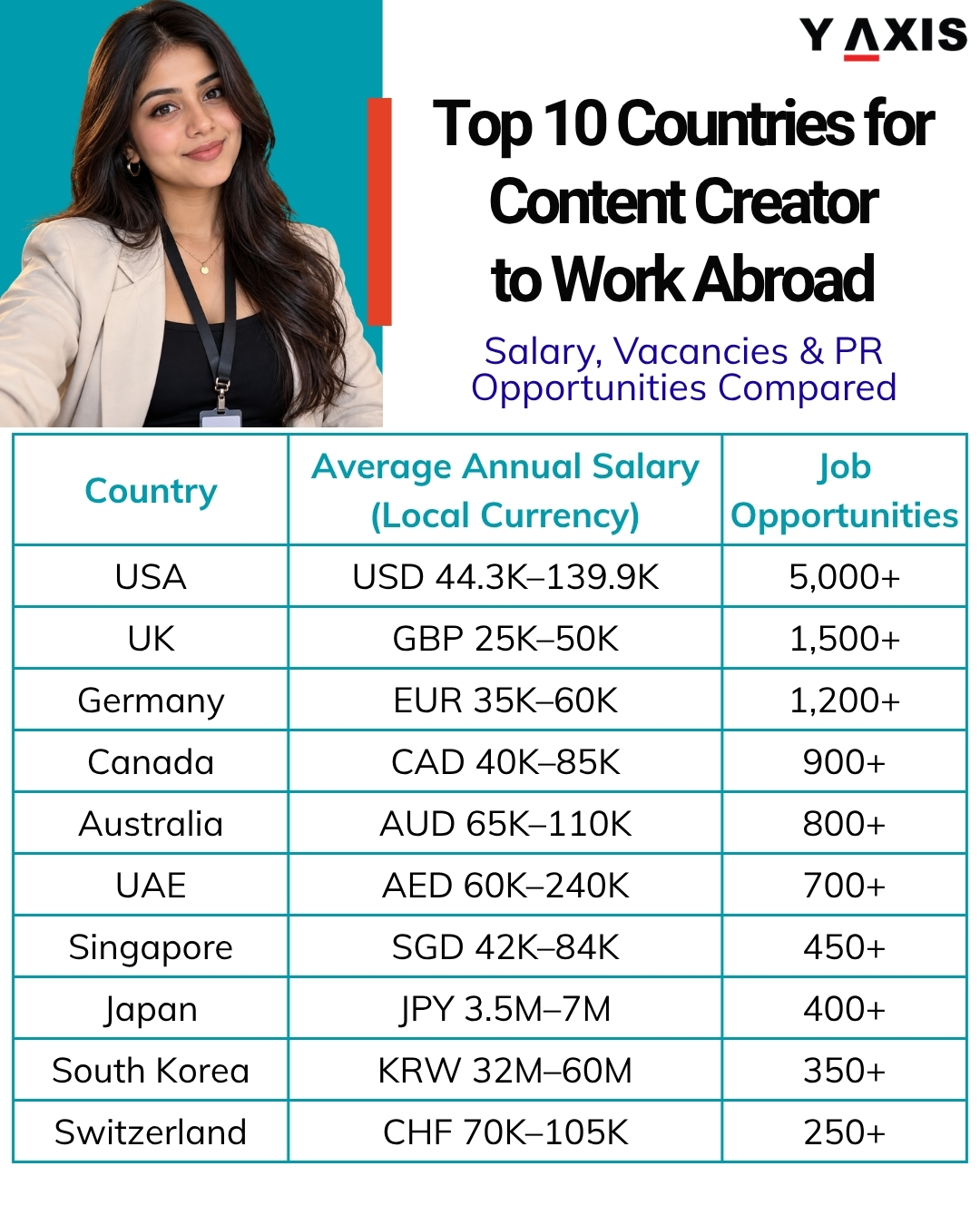
USA -- $44,310-$139,870+ per year (median $76,910, SOC 27-3043, BLS-aligned) |
|
Best PR + salary balance |
Canada -- CAD 40,000-85,000/year, classified under NOC 51111 (TEER 1), keeping Express Entry eligibility open |
|
Portfolio requirement |
Employers and visa sponsors expect a portfolio of published work with performance data, not just follower counts |
|
Fastest points-tested PR |
Canada -- Express Entry accepts NOC 51111 without mandatory employer sponsorship |
|
Tax-free income route |
UAE -- no personal income tax, plus a 10-year Golden Visa for content creators through Creators HQ |
*Want to find Content Creator jobs abroad? Sign up with Y-Axis for end-to-end assistance.
Top 10 Countries for Content Creators: Quick Comparison
Content Creators are in demand due to rising investment in video, social media, and brand content worldwide. The top countries offer strong salaries and clear visa routes.
Top 10 countries to migrate abroad as a Content Creator are as follows:
|
Country |
Average Annual Salary |
Work visa |
PR pathway |
Estimated job openings |
|
$44,310-$139,870 |
H-1B (specialty occupation) / O-1B for extraordinary creative talent |
EB-1A / EB-2 / EB-3 Green Card |
5,000+ |
|
|
£25,000-£50,000 |
Skilled Worker Visa / Global Talent Visa |
ILR (earned settlement rules) |
1,500+ |
|
|
CAD 40,000-85,000 |
Employer-Sponsored Work Permit, PNP |
Express Entry (NOC 51111) / PNP |
900+ |
|
|
AED 60,000-240,000 |
Employment Visa / Golden Visa |
Golden Visa (10-year renewable) |
700+ |
|
|
EUR 35,000-60,000 |
EU Blue Card / Skilled Worker / Freelance Visa |
PR after 21 months (Blue Card) or 3 years |
1,200+ |
|
|
AUD 65,000-110,000 |
Skills in Demand (Subclass 482) under ANZSCO 225114 |
Subclass 186 / 190 / 491 |
800+ |
|
|
SGD 42,000-84,000 |
Employment Pass (COMPASS) / ONE Pass |
PR (discretionary scheme) |
450+ |
|
|
South Korea |
KRW 32,000,000-60,000,000 |
E-7-1 (Professional) / E-6 Visa |
F-5 PR after 5 years |
350+ |
|
Japan |
JPY 3,500,000-7,000,000 |
Engineer/Specialist in Humanities Visa |
PR after 10 years (or faster via points system) |
400+ |
|
Switzerland |
CHF 70,000-105,000 |
L/B Permit (quota-based) |
C Permit after 10 years |
250+ |
*Estimated using current job board listings and industry reports; actual openings vary by year and role.
Which Country Is Best for You? Content Creators' Decision Table
The best country for Content Creators depends on factors like career goals, salary expectations, and available immigration pathways.
|
Your goal |
Best country |
Why |
|
Highest Salary |
USA |
Median pay for SOC 27-3043 is $76,910/year. Senior creators at platforms and studios clear $130,000+. |
|
Dedicated Occupation Code |
Australia |
ANZSCO 225114 Content Creator (Marketing) is on the Core Skills Occupation List, opening the 482 and 186 routes. |
|
Best PR and Immigration Access |
Canada |
NOC 51111 (TEER 1) lists “content creator – writing” and “blogger” as job titles, keeping Express Entry open. |
|
Tax-Free Income |
UAE |
No personal income tax, plus a 10-year Golden Visa for content creators endorsed through Creators HQ. |
|
Freelance-Friendly Route |
Germany |
The Freelance Visa lets self-employed creators work with several clients in Berlin, Hamburg, and Munich. |
|
Global Talent Route |
UK |
The Global Talent Visa covers arts and culture, next to London's BBC and global agency scene. |
|
K-Content Hub |
South Korea |
CJ ENM, HYBE, and SANDBOX Network drive demand for content made for global audiences. |
|
Best Work-Life Balance |
Switzerland |
High salaries, strong labour protections, and multilingual content roles at global headquarters. |
*Want to work abroad? Let Y-Axis guide you with the process.
1. USA: The World's Largest Creator Economy
The USA job market leads the global creator economy. YouTube, Meta, and Netflix have their primary base in the country. High-paying jobs in USA pay writers and content professionals a median of $76,910/year (SOC 27-3043, BLS). Many creators with large audiences use the O-1B visa instead of the H-1B to migrate to the US.
|
Average Salary |
$44,310-$139,870+ per year (median $76,910, SOC 27-3043, BLS). |
|
Top Cities |
Los Angeles, New York, San Francisco, Austin, and Miami. |
|
In-Demand Roles |
Content Creator, Video Content Producer, Social Media Content Manager, Content Strategist, and Podcast Producer. |
|
Work Visa |
H-1B (employer-sponsored; the role must need a degree to pass specialty-occupation review) or O-1B for creators with extraordinary ability in the arts. |
|
PR Pathway |
EB-2 or EB-3 Green Card through employer sponsorship, or EB-1A for extraordinary ability. |
|
Why Choose USA |
The world's largest creator economy, the highest content salaries, and platforms like YouTube, Meta, and Netflix. |
*Want to apply for a USA work visa? Let Y-Axis guide you with the steps.
2. UK: London's Global Media and Creator Hub
The UK job market is centred on London, home to the BBC, LADbible Group, and major WPP agencies. High-paying jobs in UK include social media managers under SOC 2493 (Public relations professionals).
|
Average Salary |
£25,000-£50,000 per year (senior social media and content leads earn more). |
|
Top Cities |
London, Manchester, Bristol, Brighton, and Birmingham. |
|
In-Demand Roles |
Content Creator, Social Media Manager, Content Producer, Copywriter, and Video Editor. |
|
Work Visa |
Skilled Worker Visa (e.g., SOC 2493 for social media managers), employer-sponsored, with a general salary threshold of £41,700; or the Global Talent Visa for leaders in arts and culture. |
|
PR Pathway |
Indefinite Leave to Remain (ILR) under the earned settlement rules, which set a longer baseline for most routes. |
|
Why Choose UK |
London's status as a global media capital, plus a Global Talent visa pathway for recognised creatives. |
*Want to apply for a UK work visa? Let Y-Axis guide you with the steps.
3. Canada: A Clear Express Entry Route via NOC 51111
Canada's job market has a growing digital media scene in Toronto, Vancouver, and Montreal, with employers like Shopify and Hootsuite. In-demand jobs in Canada include NOC 51111 (Authors and writers), which lists content creator and blogger as job titles.
|
Average Salary |
CAD 40,000-85,000 per year (Toronto and Vancouver pay toward the higher end). |
|
Top Cities |
Toronto, Vancouver, Montreal, and Calgary. |
|
In-Demand Roles |
Content Creator, Content Writer, Social Media Specialist, Video Producer, and Blogger. |
|
Work Visa |
Provincial Nominee Programs (PNP) or Employer-Sponsored Work Permit (LMIA-based). |
|
PR Pathway |
Express Entry (NOC 51111, TEER 1) or Provincial Nominee Program. Marketing-focused roles may fit NOC 11202 (TEER 1). |
|
Why Choose Canada |
A clear Express Entry pathway under NOC 51111, plus a fast-growing digital media and tech scene. |
*Want to apply for a Canada work visa? Let Y-Axis guide you with the steps.
4. UAE: A Golden Visa Built for Content Creators
The UAE's job market is concentrated in Dubai, home to Creators HQ and the 1 Billion Followers Summit. In-demand jobs in UAE pay tax-free salaries. Eligible creators can get a 10-year Golden Visa through Creators HQ.
|
Average Salary |
AED 60,000-240,000 per year, tax-free. |
|
Top Cities |
Dubai, Abu Dhabi, and Sharjah. |
|
In-Demand Roles |
Content Creator, Social Media Manager, Influencer Marketing Specialist, Video Producer, and Bilingual Content Writer. |
|
Work Visa |
Employer-sponsored Employment Visa, a free zone freelance permit, or the Golden Visa for content creators endorsed by Creators HQ. |
|
PR Pathway |
Golden Visa works as long-term residency; standard visas renew with continued sponsorship. |
|
Why Choose UAE |
Zero personal income tax, a dedicated creator Golden Visa, and Dubai Media City's fast-growing ecosystem. |
*Want to apply for a Dubai work visa? Let Y-Axis guide you with the steps.
5. Germany: Europe's Freelance-Friendly Route for Creators
Germany's job market is strong in Berlin, Hamburg, Munich, and Cologne. Axel Springer, ProSiebenSat.1, and Studio71 hire content talent. In-demand jobs in Germany are open via the EU Blue Card, and self-employed creators can use the Freelance Visa.
|
Average Salary |
EUR 35,000-60,000 per year (Berlin, Hamburg, and Munich pay above average). |
|
Top Cities |
Berlin, Hamburg, Munich, and Cologne. |
|
In-Demand Roles |
Content Creator, Social Media Manager, Content Marketing Manager, Video Editor, and Copywriter. |
|
Work Visa |
EU Blue Card (current standard threshold of EUR 50,700), Skilled Worker Visa, or Freelance Visa (Freiberufler) for self-employed creators. |
|
PR Pathway |
Niederlassungserlaubnis in 21 months (Blue Card, with B1 German) or after 3 years on the Skilled Worker route. |
|
Why Choose Germany |
Europe's largest economy, major media groups, and a dedicated visa route for freelance creators. |
*Want to apply for a Germany work visa? Let Y-Axis guide you with the steps.
6. Australia: A Dedicated Content Creator Occupation Code
Australia's job market is growing across brand, social, and video content, led by Sydney and Melbourne. In-demand roles in Australia include ANZSCO 225114 Content Creator (Marketing). It sits on the Core Skills Occupation List, which opens employer-sponsored routes.
|
Average Salary |
AUD 65,000-110,000 per year (content leads and strategists earn more). |
|
Top Cities |
Sydney, Melbourne, Brisbane, and Perth. |
|
In-Demand Roles |
Content Creator (Marketing), Social Media Specialist, Copywriter, Video Producer, and Content Strategist. |
|
Work Visa |
Skills in Demand Visa (Subclass 482), Core Skills stream, under ANZSCO 225114. Salary must meet the Core Skills Income Threshold, currently AUD 79,423. |
|
PR Pathway |
Employer Nomination Scheme Subclass 186, or state-nominated Subclass 190/491 where the occupation is on a state list. |
|
Why Choose Australia |
One of the few countries with a dedicated content creator code, plus Canva and major media groups in Sydney. |
*Want to apply for an Australia work visa? Let Y-Axis guide you with the steps.
7. Singapore: Asia's Regional Hub for Platforms and Brands
Singapore job market hosts the Asia-Pacific offices of TikTok, Google, and Meta. In-demand jobs in Singapore are open via the Employment Pass under the COMPASS framework.
|
Average Salary |
SGD 42,000-84,000 per year. |
|
Top Cities |
Singapore (roles concentrated in the central business district and one-north media cluster). |
|
In-Demand Roles |
Content Creator, Social Media Manager, Video Producer, Content Strategist, and Community Manager. |
|
Work Visa |
Employment Pass (minimum qualifying salary SGD 5,600/month, subject to COMPASS), or ONE Pass for creators with outstanding achievements in arts and culture. |
|
PR Pathway |
Permanent Residence via the discretionary PR scheme. |
|
Why Choose Singapore |
Asia's leading hub for global platforms and brands, with strong demand for regional content. |
*Want to apply for a Singapore work visa? Let Y-Axis guide you with the steps.
8. South Korea: The Home of the Global K-Content Wave
South Korea's job market is centred on Seoul, home to CJ ENM, HYBE, Naver, and Kakao. In-demand jobs in South Korea span video, webtoon, and social content made for global fans.
|
Average Salary |
KRW 32,000,000-60,000,000 per year. |
|
Top Cities |
Seoul, Busan, Incheon, and Seongnam (Pangyo). |
|
In-Demand Roles |
Content Creator, Video Content Producer, Social Media Marketer, Content Localisation Specialist, and Content Planner. |
|
Work Visa |
E-7-1 (Professional) Visa, employer-sponsored, salary-assessed; E-6 (Arts and Entertainment) Visa for performers and entertainers. |
|
PR Pathway |
F-5 permanent residence after 5 years. |
|
Why Choose South Korea |
CJ ENM, HYBE, and creator network SANDBOX Network lead an industry riding the global K-content wave. |
*Want to apply for a South Korea work visa? Let Y-Axis guide you with the steps.
9. Japan: Anime, VTubers, and a Booming Digital Content Scene
Japan's job market is home to VTuber agencies Cover Corp (hololive) and ANYCOLOR (NIJISANJI), and YouTuber network UUUM. In-demand jobs in Japan include social, video, and localisation content for global audiences.
|
Average Salary |
JPY 3,500,000-7,000,000 per year (senior roles earn more). |
|
Top Cities |
Tokyo, Osaka, Fukuoka, and Nagoya. |
|
In-Demand Roles |
Content Creator, Social Media Marketer, Video Editor, Localisation Content Writer, and Community Manager. |
|
Work Visa |
Engineer/Specialist in Humanities/International Services Visa, employer-sponsored; the Artist visa suits recognised independent creative work. |
|
PR Pathway |
Permanent residence after 10 years of residence, or as little as 1-3 years under the Highly Skilled Professional points system. |
|
Why Choose Japan |
Global demand for anime, gaming, and VTuber content, plus Tokyo's large media and advertising industry. |
*Want to apply for a Japan work visa? Let Y-Axis guide you with the steps.
10. Switzerland: High Salaries and Top Work-Life Balance
Switzerland's job market needs multilingual content for global headquarters like Nestlé, Roche, and UBS. High-paying jobs in Switzerland reward content professionals with strong salaries and quality of life.
|
Average Salary |
CHF 70,000-105,000 per year. |
|
Top Cities |
Zurich, Geneva, Basel, and Lausanne. |
|
In-Demand Roles |
Content Manager, Social Media Manager, Content Marketing Specialist, and Video Producer. |
|
Work Visa |
Non-EU/EFTA L or B Permit (quota-based, employer and cantonal approval required). |
|
PR Pathway |
Settlement permit (C Permit) after 10 years of continuous residence, or 5 years for treaty countries. |
|
Why Choose Switzerland |
Some of Europe's highest salaries, multilingual corporate content roles, and an excellent standard of living. |
*Want to apply for a Switzerland work visa? Let Y-Axis guide you with the steps.
What Skills Do Content Creators Need to Work Abroad?
Employers consistently look for the following skills while recruiting Content Creators:
- Video Production & Editing: Short-form and long-form video using Adobe Premiere Pro, Final Cut Pro, and CapCut
- Writing & Storytelling: Scripts, captions, blogs, and brand stories that hold attention
- Platform & Algorithm Knowledge: YouTube, Instagram, TikTok, LinkedIn, and podcast formats
- Analytics & SEO: YouTube Studio, Meta Business Suite, Google Analytics, and keyword research
- Portfolio & Brand Collaboration: A portfolio with performance data and the ability to pitch brand partnerships
*Want to get your Content Creator profile assessed? Try Y-Axis Free Eligibility Assessment to evaluate your profile.
How to Migrate Abroad as a Content Creator?
The steps to apply for Content Creator jobs abroad are as follows:
Step 1: Check your country-wise eligibility based on qualifications, content experience, and English proficiency.
Step 2: Identify the correct occupation code for your target country (SOC 27-3043 in the USA, NOC 51111 in Canada, ANZSCO 225114 in Australia, or SOC 2493 in the UK), based on your actual duties.
Step 3: Build a strong portfolio of videos, posts, scripts, and blogs, with views and engagement data.
Step 4: Apply for overseas content roles across LinkedIn, Indeed, and brand or agency career pages.
Step 5: Secure a job offer after a portfolio review and content test or interview.
Step 6: Upon visa approval, relocate, complete local permits (such as the UAE Advertiser Permit), and begin working legally abroad.
Common Mistakes Content Creators Make When Applying for Jobs Abroad
- Showing follower counts instead of a portfolio with measurable results.
- Applying to Australia as a social media influencer, when ANZSCO 225114 covers marketing content creators and excludes influencers.
- Posting paid brand content on a visitor visa, or in the UAE without an Advertiser Permit.
- Accepting UK job offers below the £41,700 Skilled Worker general salary threshold.
- Assuming freelance or platform income counts as a job offer for employer-sponsored visas.
- Not checking tax rules on brand deals and platform income in the new country.
*Are you looking for step-by-step assistance with overseas immigration? Contact Y-Axis, the world's No. 1 overseas immigration consultancy, for end-to-end assistance!
FAQs
Which are the top 10 countries for Content Creators to work abroad?
The top 10 countries are the USA, the UK, Canada, the UAE, Germany, Australia, Singapore, South Korea, Japan, and Switzerland. The USA offers the highest salaries. Canada offers the clearest Express Entry route through NOC 51111. The UAE offers tax-free income and a Golden Visa for content creators.
Is there a dedicated occupation code for Content Creators?
In most countries, no. Content Creator roles map to writer or marketing codes, such as US SOC 27-3043 (Writers and Authors), UK SOC 2493 (Public relations professionals), and Canada NOC 51111 (Authors and writers). Australia is the main exception. It has ANZSCO 225114 Content Creator (Marketing), which is on the Core Skills Occupation List.
Which occupation code do Content Creators use for Canada's Express Entry?
Most Content Creators use NOC 51111 (Authors and writers, except technical), classified as TEER 1. It lists “content creator – writing” and “blogger” as job titles. Marketing-focused roles may fit NOC 11202, also TEER 1. Both are eligible for the Federal Skilled Worker Program without a job offer, if you meet the points threshold.
Can Content Creators get PR in Australia?
Yes, mainly through employer sponsorship. ANZSCO 225114 Content Creator (Marketing) is on the Core Skills Occupation List. This allows the Subclass 482 visa and the Subclass 186 permanent visa. The points-tested Subclass 189 is not available for this code. State-nominated 190/491 visas depend on each state's current list.
Which country offers the fastest PR for Content Creators?
Germany offers one of the fastest employer-sponsored routes through the EU Blue Card. Permanent residence is possible in 21 months for B1 German speakers. Canada's Express Entry can also move quickly once a Content Creator clears the CRS cut-off score under NOC 51111.
What is the average salary for a Content Creator in the USA?
Content writing roles in the USA fall under SOC 27-3043 (Writers and Authors). The median annual wage is $76,910, according to the latest BLS data. The lowest 10 percent earn under $44,310, while the top 10 percent earn over $139,870. BLS data does not include self-employed creators.
Can Content Creators move abroad without a job offer?
It is hard for most routes, since the H-1B, EU Blue Card, Skilled Worker Visa, and Employment Pass need a job offer. There are a few exceptions. Canada's Express Entry lets you compete on points. Germany's Freelance Visa suits self-employed creators. The UAE Golden Visa and UK Global Talent Visa suit recognised creators.
Can social media influencers get a work visa abroad?
Yes, but the route depends on your profile. Influencers with a strong track record can explore the US O-1B visa, the UK Global Talent Visa, or the UAE Golden Visa for content creators. Employer-sponsored routes need a real job offer. In Australia, ANZSCO 225114 excludes social media influencers.
What is the UAE Golden Visa for content creators?
It is a 10-year renewable residence visa for eligible content creators. You apply through Creators HQ, which reviews your profile and endorses your eligibility.The review can take four to ten weeks. After approval, you complete steps like the medical test to finalise the visa.
Do Content Creators need a permit to post paid content in the UAE?
Yes. The UAE Media Council requires an Advertiser Permit for anyone who posts promotional content on social media, whether paid, gifted, or unpaid. Residents get a one-year renewable permit, free for the first three years. Visitors get a three-month permit through a licensed agency.
Which visa should Content Creators apply for in the UK?
Most employed Content Creators apply for the Skilled Worker Visa. Social media managers fall under SOC 2493 (Public relations professionals). The employer must pay at least the £41,700 general threshold or the going rate, whichever is higher. Recognised creatives can also apply for the Global Talent Visa in arts and culture.
How much does a Content Creator earn in Germany?
Content Creators in Germany typically earn between EUR 35,000 and EUR 60,000 per year. Pay is higher in Berlin, Hamburg, and Munich. The EU Blue Card's current standard threshold of EUR 50,700 suits senior roles. Others can use the Skilled Worker Visa or the Freelance Visa.
What documents are required for a Content Creator's work visa abroad?
Typical requirements include a valid passport, a degree or diploma, a job offer, an updated resume, a content portfolio, and police clearance where needed. Some employers ask for a content test. Freelance and talent visas may need client contracts, press coverage, or audience data. Always confirm the exact checklist with the target country's immigration authority.
Can Content Creators bring their family when moving abroad?
In most countries on this list, sponsored work visas let you include your spouse and dependent children. This includes the USA, the UK, Canada, Germany, Australia, and the UAE. Spouses often get work rights too. Family inclusion in Switzerland and Singapore depends on salary level and permit type.
Is a portfolio required for content creation jobs abroad?
Yes, almost always. Employers and visa sponsors expect a curated portfolio of published videos, posts, blogs, or podcasts. Include views, engagement, and growth data for each project. A strong portfolio often matters more than your degree or follower count.
What skills do employers expect from Content Creators abroad?
Most employers expect video editing in Adobe Premiere Pro, Final Cut Pro, or CapCut. Strong writing and storytelling skills are essential. Employers also value platform knowledge across YouTube, Instagram, TikTok, and LinkedIn. Analytics and SEO skills help you prove results.
Is the O-1 visa an option for Content Creators in the USA?
Yes, for creators with a strong record. The O-1B visa is for people with extraordinary ability in the arts. Evidence can include awards, press coverage, major brand work, high earnings, or proven commercial success. It needs a US employer or agent to file the petition.
Can freelance Content Creators apply for these work visas?
Most employer-sponsored visas, including the H-1B, EU Blue Card, and Skilled Worker Visa, need an employment contract. Freelancers have other options. Germany offers a Freelance Visa for self-employed professionals. UAE free zones offer freelance permits. Always check the rules on working for foreign clients.
What is the difference between a Content Creator and a Content Writer for visa purposes?
Content Writers usually map cleanly to writer codes, such as NOC 51111 or SOC 27-3043. Video and social media creators may map to marketing codes instead, such as NOC 11202, UK SOC 2493, or Australia's ANZSCO 225114. Your actual duties decide the code, which can change your visa options.
Which are the fastest-growing content creator job markets right now?
The UAE, Singapore, and South Korea are seeing fast growth. Dubai is investing in creators through Creators HQ and a dedicated Golden Visa. Singapore hosts regional teams for global platforms. South Korea's K-content exports keep driving demand for video and social content.
Posted on September 25 2026
Top 10 Countries to Work Abroad as a Graphic Designer
Top 10 Countries to Work Abroad as a Graphic Designer
Global demand for skilled Graphic Designers continues to grow across branding, packaging, digital marketing, and advertising. Professionals skilled in visual identity, typography, and brand systems are in demand across the USA, UK, Germany, and UAE, among other countries.
This blog is for you if you are a Graphic Designer with:
- A recognised degree or diploma in graphic design, visual communication, or fine arts.
- Experience across branding, packaging, digital design, or advertising.
- Interested in relocating to a country with a strong creative or design industry.
- Mid-career or senior experience seeking better salaries and faster PR pathways.
- Profile of a Graphic Designer, Visual Designer, Brand Designer, Art Director, or UI/UX Designer.
|
Quick Facts |
Details |
|
Global demand |
Graphic design roles keep growing across branding, packaging, and digital marketing, led by agencies and in-house creative teams in the US, UK, Germany, and UAE |
|
US job growth |
SOC 27-1024 employment is projected to decline slightly through 2035, but about 16,000 openings a year are still projected, mostly from replacement needs |
|
Occupation code status |
Most target countries maintain a dedicated code for Graphic Designers (US SOC 27-1024, UK SOC 2142, Canada NOC 52120, Australia ANZSCO 232411) |
|
Highest salary |
USA -- $39,520-$104,910+ per year (median $62,960, SOC 27-1024, BLS-aligned) |
|
Best PR + salary balance |
Canada -- CAD 45,000-90,000/year, classified under NOC 52120 (TEER 2), keeping Express Entry eligibility open |
|
Portfolio requirement |
Nearly every employer and visa sponsor expects a strong professional portfolio, not just a design qualification |
|
Fastest points-tested PR |
Canada -- Express Entry accepts NOC 52120 without mandatory employer sponsorship, unlike Australia's STSOL-listed code |
|
Tax-free income route |
UAE -- no personal income tax, plus a Golden Visa track for exceptional creative talent |
*Want to find Graphic Designer jobs abroad? Sign up with Y-Axis for end-to-end assistance.
Top 10 Countries for Graphic Designers: Quick Comparison
Graphic Designers are in demand due to rising branding, packaging, and digital-content investment worldwide. The top countries offer strong salaries and clear visa routes.
Top 10 countries to migrate abroad as a Graphic Designer are as follows:
|
Country |
Average Annual Salary |
Work visa |
PR pathway |
Estimated job openings |
|
$39,520-$104,910 |
H-1B (specialty occupation) / O-1 for exceptional talent |
EB-2/EB-3 Green Card |
4,000+ |
|
|
Japan |
JPY 3,500,000-7,500,000 |
Engineer/Specialist in Humanities Visa |
PR after 10 years (or faster via points system) |
900+ |
|
EUR 38,000-70,000 |
EU Blue Card / Skilled Worker Visa |
PR after 21 months (Blue Card) or 4 years |
1,400+ |
|
|
South Korea |
KRW 35,000,000-70,000,000 |
E-7-1 (Professional) Visa |
F-5 PR after 5 years |
600+ |
|
Switzerland |
CHF 65,000-100,000 |
L/B Permit (quota-based) |
C Permit after 10 years |
350+ |
|
CAD 45,000-90,000 |
Employer-Sponsored Work Permit, PNP |
Express Entry (NOC 52120) / PNP |
1,100+ |
|
|
£28,000-£45,000 |
Skilled Worker Visa |
ILR after 5 years |
950+ |
|
|
SGD 40,000-80,000 |
Employment Pass (COMPASS) |
PR (discretionary, SC scheme) |
500+ |
|
|
AUD 48,000-140,000 |
Skills in Demand (Subclass 482) / State-Nominated 190/491 |
Subclass 190/491 or 482 -> 186 |
700+ |
|
|
AED 40,000-180,000 |
Employment Visa / Golden Visa |
Golden Visa (10-year renewable) |
550+ |
*Estimated using current job board listings and industry reports; actual openings vary by year and role.
Which Country Is Best for You? Graphic Designers' Decision Table
The best country for Graphic Designers depends on factors like career goals, salary expectations, and available immigration pathways.
|
Your goal |
Best country |
Why |
|
Highest Salary |
USA |
Median pay for SOC 27-1024 is $62,960/year, with senior designers and art directors at large agencies clearing $100,000+. |
|
Fastest EU Blue Card PR |
Germany |
Graphic Designers can access the EU Blue Card, unlocking PR in as little as 21 months near Berlin's and Munich's branding studios. |
|
Best State-Nominated PR Route |
Australia |
Graphic Designer (ANZSCO 232411) sits on the STSOL, so Subclass 190/491 state nomination is the fastest realistic PR route. |
|
Largest Global Branding Hub |
UK |
London is home to Pentagram, Wolff Olins, and Landor -- among the world's most influential branding and identity agencies. |
|
Best PR and Immigration Access |
Canada |
Graphic Designers fall under NOC 52120 (TEER 2), keeping Express Entry eligibility clear without mandatory employer sponsorship. |
|
Tax-Free Income |
UAE |
Dubai's and Abu Dhabi's growing creative and branding sector pays no personal income tax, with a Golden Visa for exceptional talent. |
|
Iconic Design Heritage |
Japan |
Home to Dentsu, Hakuhodo, and design studio Nendo, with a packaging and branding culture respected worldwide. |
|
Best Work-Life Balance |
Switzerland |
Strong labour protections and the historic home of the International Typographic Style make Switzerland attractive for long-term stability. |
*Want to work abroad? Let Y-Axis guide you with the process.
1. USA: The World's Largest Advertising and Branding Market
The USA job market runs the world's largest advertising and branding industry, home to agencies like Pentagram, IDEO, and Wieden+Kennedy. High-paying jobs in USA pay a median of $62,960/year for Graphic Designers (SOC 27-1024, BLS). Senior and creative-lead roles use the H-1B visa, though USCIS reviews graphic design duties closely for specialty-occupation status.
|
Average Salary |
$39,520-$104,910+ per year (median $62,960, SOC 27-1024, BLS). |
|
Top Cities |
New York, Los Angeles, Chicago, San Francisco, and Atlanta. |
|
In-Demand Roles |
Graphic Designer, Brand Designer, Art Director, Packaging Designer, and UI/Visual Designer. |
|
Work Visa |
H-1B (employer-sponsored; senior and creative-lead titles clear specialty-occupation review more easily) or O-1 for exceptional creative talent. |
|
PR Pathway |
EB-2 or EB-3 Green Card through employer sponsorship. |
|
Why Choose USA |
The world's largest advertising and branding industry, the highest design salaries, and agencies like Pentagram, IDEO, and Wieden+Kennedy. |
*Want to apply for a USA work visa? Let Y-Axis guide you with the steps.
2. Japan: Home to Iconic Branding and Product Design Studios
Japan's job market is anchored by advertising giants Dentsu and Hakuhodo, plus renowned design studio Nendo. In-demand jobs in Japan span branding, packaging, and product graphics, supported by the Engineer/Specialist in Humanities visa.
|
Average Salary |
JPY 3,500,000-7,500,000 per year (senior designers earn more). |
|
Top Cities |
Tokyo, Osaka, Nagoya, and Fukuoka. |
|
In-Demand Roles |
Graphic Designer, Branding Designer, Packaging Designer, and Art Director. |
|
Work Visa |
Engineer/Specialist in Humanities/International Services Visa, employer-sponsored. |
|
PR Pathway |
Permanent residence after 10 years of residence, or as little as 1-3 years under the Highly Skilled Professional points system. |
|
Why Choose Japan |
Home to Dentsu, Hakuhodo, and design studio Nendo, plus a packaging and branding culture respected worldwide. |
*Want to apply for a Japan work visa? Let Y-Axis guide you with the steps.
3. Germany: A Fast-Track Blue Card Route in Europe's Design Capital
Germany's job market is concentrated in Berlin (MetaDesign) and Munich (Bureau Borsche, KMS Team). In-demand jobs in Germany are accessible via the EU Blue Card, one of Europe's fastest PR routes.
|
Average Salary |
EUR 38,000-70,000 per year (Berlin and Munich pay above average). |
|
Top Cities |
Berlin, Munich, Hamburg, and Düsseldorf. |
|
In-Demand Roles |
Graphic Designer, Brand Designer, Art Director, and UI/UX Designer. |
|
Work Visa |
EU Blue Card (standard 2026 threshold of EUR 50,700) or Skilled Worker Visa for salaries below that level. |
|
PR Pathway |
Niederlassungserlaubnis in 21 months (Blue Card, with B1 German) or 4 years (Skilled Worker route). |
|
Why Choose Germany |
A dense network of branding studios in Berlin and Munich, plus one of Europe's fastest EU Blue Card routes to permanent residence. |
*Want to apply for a Germany work visa? Let Y-Axis guide you with the steps.
4. South Korea: A Fast-Growing Hub for K-Content Branding
South Korea's job market is centred on Seoul, home to Cheil Worldwide and Innocean Worldwide, two of Asia's largest advertising agencies. In-demand jobs in South Korea span branding, packaging, and digital content design.
|
Average Salary |
KRW 35,000,000-70,000,000 per year. |
|
Top Cities |
Seoul, Busan, Incheon, and Seongnam. |
|
In-Demand Roles |
Graphic Designer, Brand/Visual Designer, Packaging Designer, and UI/UX Designer. |
|
Work Visa |
E-7-1 (Professional) Visa, employer-sponsored, salary-assessed. |
|
PR Pathway |
F-5 permanent residence after 5 years. |
|
Why Choose South Korea |
Cheil Worldwide and Innocean Worldwide anchor a fast-growing branding and content-design industry riding the global K-content wave. |
*Want to apply for a South Korea work visa? Let Y-Axis guide you with the steps.
5. Switzerland: The Birthplace of the International Typographic Style
Switzerland's job market carries the legacy of the Swiss Style, taught at Basel's design schools and practised across studios in Zurich and Lucerne. High-paying jobs in Switzerland reward designers with strong salaries and quality of life.
|
Average Salary |
CHF 65,000-100,000 per year. |
|
Top Cities |
Zurich, Basel, Geneva, and Lausanne. |
|
In-Demand Roles |
Graphic Designer, Art Director, Brand Designer, and Packaging Designer. |
|
Work Visa |
Non-EU/EFTA L or B Permit (quota-based, employer and cantonal approval required). |
|
PR Pathway |
Settlement permit (C Permit) after 10 years of continuous residence, or 5 years for treaty countries. |
|
Why Choose Switzerland |
The historic home of the International Typographic Style, strong salaries, and one of Europe's highest standards of living. |
*Want to apply for a Switzerland work visa? Let Y-Axis guide you with the steps.
6. Canada: A Clear Express Entry Route via NOC 52120
Canada's job market is anchored by Toronto's and Montreal's advertising and branding studios, including Sid Lee. In-demand jobs in Canada are listed under NOC 52120 (Graphic designers and illustrators), which keeps Express Entry eligibility clear.
|
Average Salary |
CAD 45,000-90,000 per year (Toronto designers average toward the higher end). |
|
Top Cities |
Toronto, Vancouver, Montreal, and Calgary. |
|
In-Demand Roles |
Graphic Designer, Brand Designer, Packaging Designer, and UI/UX Designer. |
|
Work Visa |
Provincial Nominee Programs (PNP) or Employer-Sponsored Work Permit, including Ontario's skilled-worker stream. |
|
PR Pathway |
Express Entry (NOC 52120) or Provincial Nominee Program. |
|
Why Choose Canada |
A clear Express Entry pathway under NOC 52120, plus Toronto's and Montreal's growing branding and advertising scene. |
*Want to apply for a Canada work visa? Let Y-Axis guide you with the steps.
7. UK: Home to London's Global Branding and Advertising Agencies
The UK job market is concentrated in London, home to Pentagram, Wolff Olins, and Landor. High-paying jobs in UK fall under SOC 2142 (Graphic and multimedia designers).
|
Average Salary |
£28,000-£45,000 per year (median around £33,800). |
|
Top Cities |
London, Manchester, Bristol, and Birmingham. |
|
In-Demand Roles |
Graphic Designer, Brand Designer, Art Director, and Junior/Senior Designer. |
|
Work Visa |
Skilled Worker Visa (SOC 2142), employer-sponsored; on the Immigration Salary List at a reduced going rate of £33,400. |
|
PR Pathway |
Indefinite Leave to Remain (ILR) after 5 years on the Skilled Worker route. |
|
Why Choose UK |
London's status as a global branding capital, home to Pentagram, Wolff Olins, and Landor. |
*Want to apply for a UK work visa? Let Y-Axis guide you with the steps.
8. Singapore: Asia's Regional Advertising and Branding Hub
Singapore job market hosts the Asia-Pacific offices of major global agency networks. In-demand jobs in Singapore are accessible via the Employment Pass under the COMPASS framework.
|
Average Salary |
SGD 40,000-80,000 per year. |
|
Top Cities |
Singapore (roles concentrated in the central business district and one-north creative cluster). |
|
In-Demand Roles |
Graphic Designer, Brand/Visual Designer, UI/UX Designer, and Motion Designer. |
|
Work Visa |
Employment Pass (minimum qualifying salary SGD 5,600/month, subject to COMPASS). |
|
PR Pathway |
Permanent Residence via the discretionary PR scheme. |
|
Why Choose Singapore |
Asia's leading regional hub for advertising and brand design, anchored by the Asia-Pacific offices of major global agencies. |
*Want to apply for a Singapore work visa? Let Y-Axis guide you with the steps.
9. Australia: State-Nominated PR via a Thriving Creative Industry
Australia's job market is expanding across branding, packaging, and digital design, concentrated in Sydney and Melbourne. In-demand roles in Australia sit under ANZSCO 232411 (Graphic Designer), on the STSOL -- opening sponsored and state-nominated pathways rather than direct points-tested PR.
|
Average Salary |
AUD 48,000-140,000 per year (creative directors and studio leads pay at the higher end). |
|
Top Cities |
Sydney, Melbourne, Brisbane, and Perth. |
|
In-Demand Roles |
Graphic Designer, Brand Designer, Art Director, and UI/UX Designer. |
|
Work Visa |
Skills in Demand Visa (Subclass 482) or state/territory-nominated Subclass 190/491, since Graphic Designer sits on the STSOL rather than the MLTSSL. |
|
PR Pathway |
State-nominated Subclass 190 (direct PR), Subclass 491 (provisional), or employer-sponsored Subclass 186. |
|
Why Choose Australia |
A thriving branding and advertising scene in Sydney and Melbourne, with state-nominated PR routes open to Graphic Designers. |
*Want to apply for an Australia work visa? Let Y-Axis guide you with the steps.
10. UAE: A Tax-Free Route Through Dubai's Design District
The UAE's job market is concentrated in Dubai, home to Dubai Design District (d3), a dedicated hub for branding, packaging, and creative agencies. In-demand jobs in UAE pay tax-free salaries, with a Golden Visa track for exceptional creative talent.
|
Average Salary |
AED 40,000-180,000 per year, tax-free. |
|
Top Cities |
Dubai, Abu Dhabi, and Sharjah. |
|
In-Demand Roles |
Graphic Designer, Brand Designer, Art Director, and Motion/Creative Designer. |
|
Work Visa |
Employer-sponsored Employment Visa, or the Golden Visa for exceptional creative and cultural talent. |
|
PR Pathway |
Golden Visa functions as long-term residency; standard visas renew with continued sponsorship. |
|
Why Choose UAE |
Zero personal income tax, plus Dubai Design District's fast-scaling creative and branding ecosystem. |
*Want to apply for a Dubai work visa? Let Y-Axis guide you with the steps.
What Skills Do Graphic Designers Need to Work Abroad?
Employers consistently look for the following skills while recruiting Graphic Designers:
- Visual & Brand Design: Typography, layout, colour theory, and brand identity systems
- Design Software Proficiency: Adobe Photoshop, Illustrator, and InDesign, plus Figma
- UI/UX Fundamentals: Basic interface design and user-experience principles for digital projects
- Motion & Multimedia Design: After Effects, video editing, and social-first content creation
- Portfolio & Client Presentation: A strong, well-curated portfolio and the ability to pitch design concepts to clients
*Want to get your Graphic Designer profile assessed? Try Y-Axis Free Eligibility Assessment to evaluate your profile.
How to Migrate Abroad as a Graphic Designer?
The steps to apply for Graphic Designer jobs abroad are as follows:
Step 1: Check your country-wise eligibility based on qualifications, design experience, and English proficiency.
Step 2: Identify the correct occupation code for your target country (SOC 27-1024 in the USA, NOC 52120 in Canada, ANZSCO 232411 in Australia, or SOC 2142 in the UK), based on your actual duties.
Step 3: Build a strong portfolio showcasing branding, packaging, digital, and print work.
Step 4: Apply for overseas design roles across LinkedIn, Behance, Dribbble, and country-specific job boards.
Step 5: Secure a job offer after a portfolio review and design test or interview.
Step 6: Upon visa approval, relocate, complete any local registration formalities, and begin working legally abroad.
Common Mistakes Graphic Designers Make When Applying for Jobs Abroad
- Submitting a generic portfolio without tailoring work samples to the target market or industry.
- Applying to Australia expecting direct points-tested PR, when Graphic Designer (ANZSCO 232411) sits on the STSOL, not the MLTSSL.
- Underestimating how closely US immigration reviews graphic design duties for H-1B specialty-occupation status.
- Applying for work visas without first securing a valid job offer.
- Accepting salary offers that fall below visa eligibility thresholds, especially in Singapore and Germany.
- Not researching country-specific salary thresholds and creative-industry demand early enough.
*Are you looking for step-by-step assistance with overseas immigration? Contact Y-Axis, the world's No. 1 overseas immigration consultancy, for end-to-end assistance!
FAQs
Which are the top 10 countries for Graphic Designers to work abroad?
The top 10 countries are the USA, Japan, Germany, South Korea, Switzerland, Canada, the UK, Singapore, Australia, and the UAE. The USA offers the highest salaries, while Canada offers the clearest Express Entry route through NOC 52120.
Is there a dedicated occupation code for Graphic Designer?
Yes. Unlike many emerging tech roles, Graphic Designer has a dedicated code in most major destinations: US SOC 27-1024, UK SOC 2142, Canada NOC 52120 (Graphic designers and illustrators), and Australia ANZSCO 232411. This makes visa classification more straightforward than for newer creative-technology hybrid roles.
Which occupation code do Graphic Designers use for Canada's Express Entry?
Graphic Designers use NOC 52120 (Graphic designers and illustrators), classified as TEER 2. Since Express Entry accepts TEER 0 through TEER 3 occupations, Graphic Designers remain eligible for the Federal Skilled Worker Program without needing employer sponsorship, provided they meet the points threshold.
Can Graphic Designers get direct points-tested PR in Australia?
Not directly. Graphic Designer (ANZSCO 232411) sits on the Short-Term Skilled Occupation List (STSOL), not the MLTSSL, so the points-tested Subclass 189 visa is unavailable. Graphic Designers can still access state-nominated Subclass 190/491 visas or employer-sponsored Subclass 482 and 186 routes.
Which country offers the fastest PR for Graphic Designers?
Germany offers one of the fastest employer-sponsored routes through the EU Blue Card, with permanent residence possible in as little as 21 months for B1 German speakers. Canada's Express Entry can also move quickly once a Graphic Designer clears the CRS cut-off score for NOC 52120.
What is the average salary for a Graphic Designer in the USA?
Graphic Designers in the USA are classified under SOC 27-1024, with a median annual wage of $62,960, according to BLS data (May 2025). The lowest 10 percent earn under $39,520, while senior designers and art directors at large agencies often clear $100,000 or more.
Can Graphic Designers move abroad without a job offer?
It is difficult for most routes, since the H-1B, EU Blue Card, Skilled Worker Visa, and Employment Pass all require a confirmed job offer. Canada's Express Entry is the main exception, since NOC 52120 allows Graphic Designers to submit a profile and compete on points before securing employment.
Is Japan a good destination for Graphic Designers?
Yes. Japan's Engineer/Specialist in Humanities/International Services Visa covers design roles, and Tokyo hosts major branding, advertising, and product-design studios. Graphic Designers typically earn JPY 3,500,000 to 7,500,000 per year, and permanent residence is available after 10 years, or faster under the points-based system.
What is Singapore's role in the graphic design industry?
Singapore is a regional hub for advertising and brand design, hosting the Asia-Pacific offices of major global agency networks. The Employment Pass under the COMPASS framework requires a minimum qualifying salary, currently SGD 5,600 a month, which mid-level and senior designers meet more comfortably than entry-level applicants.
How much does a Graphic Designer earn in Germany?
Graphic Designers in Germany typically earn between EUR 38,000 and EUR 70,000 per year, with senior designers and art directors in Berlin and Munich earning more. The EU Blue Card's standard 2026 threshold of EUR 50,700 is realistic for mid-career and senior design roles.
Which visa should Graphic Designers apply for in the UK?
Most Graphic Designers apply for the Skilled Worker Visa under SOC 2142 (Graphic and multimedia designers), which sits on the Immigration Salary List with a reduced going rate of £33,400 per year. London, Manchester, and Bristol host the largest concentration of design and advertising employers.
What documents are required for a Graphic Designer's work visa abroad?
Typical requirements include a valid passport, a design degree or diploma, a job offer, an updated resume, a professional portfolio, and police clearance where applicable. Some countries also request work samples or a design test as part of the employer's sponsorship application. Requirements vary, so confirm the exact checklist with your target country's immigration authority.
Can Graphic Designers bring their family when moving abroad?
In most countries on this list -- the USA, Japan, Germany, South Korea, Canada, and Australia -- sponsored work visas let you include your spouse and dependent children, often with spousal work rights. Family inclusion in Switzerland and Singapore depends on salary level and permit type.
Is a portfolio required for graphic design jobs abroad?
Yes, almost universally. Employers and visa sponsors across all 10 countries expect a curated portfolio showing branding, packaging, digital, and print work. A strong portfolio often matters more to hiring managers than the specific design qualification listed on a resume.
What software skills do employers expect from Graphic Designers abroad?
Most employers expect proficiency in Adobe Photoshop, Illustrator, and InDesign, along with growing demand for Figma for UI/UX-adjacent work. Motion design skills in After Effects and familiarity with social-first content formats are increasingly valued across the USA, UK, Singapore, and UAE markets.
How competitive is the H-1B visa for Graphic Designers in the USA?
It can be competitive, since US immigration authorities scrutinise whether a graphic design role genuinely requires a bachelor's degree to qualify as a specialty occupation under H-1B rules. Senior, creative-lead, or brand-strategy titles with clearly specialised duties tend to fare better than generic entry-level design postings.
Which country pays Graphic Designers the highest tax-free salary?
The UAE offers the highest tax-free earning potential, with salaries ranging from AED 40,000 to AED 180,000 per year and no personal income tax. Senior designers and art directors in Dubai's growing branding and motion-design sector, including Dubai Design District, earn toward the top of that range.
Can freelance Graphic Designers apply for these work visas?
Most employer-sponsored visas, including the H-1B, EU Blue Card, and Skilled Worker Visa, require a confirmed employment contract rather than freelance status. Freelancers typically need to secure a full-time job offer first, though some countries offer separate freelance or self-employment permit categories worth exploring.
What is the difference between a Graphic Designer and a UX/UI Designer for visa purposes?
Most immigration systems still classify Graphic Designer and UX/UI Designer under different codes. In Canada, for example, a UX Designer may be assessed under NOC 21231 (software engineers and designers, TEER 1) instead of NOC 52120, which can change Express Entry points and eligibility significantly.
Which are the fastest-growing graphic design job markets right now?
South Korea and Singapore are seeing fast growth in brand and digital design roles, driven by K-content exports and regional advertising hubs. The UAE's Dubai Design District is also expanding quickly, adding demand for branding, packaging, and motion-design specialists across the Gulf region.
Posted on September 18 2026
Trending Article
Posted On October 16 2026
Life in Thailand for Immigrants: Jobs, Visas, Cost of Living & Residency