


Don't know what to do ?
Get Free Counseling
Last Updated 10 August 2026
Poland Job Market
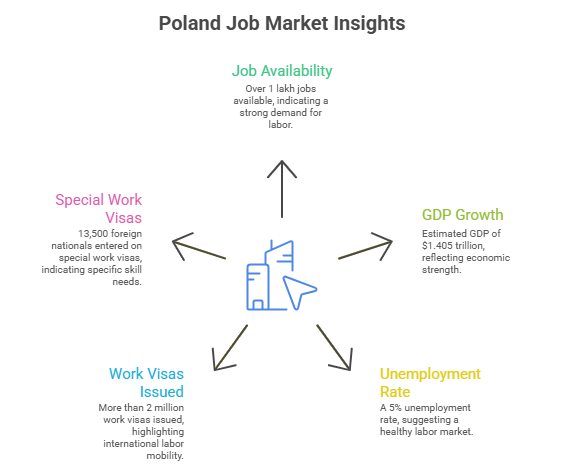
- Poland has over 120,000 active job vacancies (2024–2025 — GUS Poland / Eurostat), with demand concentrated in IT, engineering, healthcare, and logistics sectors.
- Poland's GDP is estimated at USD 842 billion (2024 nominal — IMF World Economic Outlook) or USD 1.405 trillion in purchasing power parity (PPP) terms
- Poland maintains one of the EU's lowest unemployment rates at approximately 3.0%
- Poland issued over 2 million work permits between 2021 and 2023, primarily to Ukrainian, Belarusian, and Indian nationals . In 2024, Poland remained one of the largest issuers of work permits in the EU, with hundreds of thousands of new permits processed annually
- 13,500 foreign nationals entered Poland on special work visas between January and September
Jump to: Job Outlook | In-Demand Industries | Job Vacancies | Work Visa for Indians | Salaries | Top Cities | Skills in Demand | Remote Work | Work Culture | Challenges
Planning to migrate overseas? Y-Axis will guide you in step by step process.
Job Outlook in Poland
Understanding the job outlook for job seekers and employers
The job outlook in Poland is promising and boasts a dynamic job market providing opportunities for skilled foreign workers with high paying salaries. Poland continues to attract both domestic and international investment, driving employment opportunities across various sectors. Poland's favorable job market within Europe makes it a prime destination for multinational companies looking to establish operations. The nation is also known for its robust benefits, way of living, high quality education, beautiful landscapes and innovative technology. Overall, Poland offers a wealth of opportunities for skilled foreign workers across various industries with high paying salaries.
General employment trends for the year
Poland has emerged as a dynamic player in the global economy, experiencing significant changes in its employment landscape. Industries such as information technology, finance, healthcare, and tourism, have witnessed substantial growth in employment opportunities creating a demand for skilled professionals. The need for flexible work arrangements has grown as more workers look to remote work for a work-life balance. By adjusting to the shifting dynamics and gaining in-demand skills, job seekers can stay competitive.
Factors influencing job creation or reduction
Job creation and reduction in Poland are influenced by many factors, ranging from economic conditions to government policies and global trends. Factors such as economic growth or downturns, changes in international markets, trade policies, on-going technological advancements, tax incentives, environmental sustainability economic, political, and other factors impact the overall job creation and reduction in Poland.
In-Demand Industries and Occupations in Poland
Most in demand occupations in Poland along with their salaries are given below:
| Occupation | Average Annual Salary (PLN) | Approx. Annual Salary (INR) |
|---|---|---|
| Healthcare (Doctors) | PLN 99,672 | ≈ ₹22–23 LPA |
| Accounting & Finance | PLN 90,000 | ≈ ₹20–21 LPA |
| IT & Software | PLN 120,000–240,000/year | ≈ ₹19–20 LPA |
| Marketing & Sales | PLN 84,000 | ≈ ₹19–20 LPA |
| Hospitality | PLN 80,246 | ≈ ₹18–19 LPA |
| Engineering | PLN 72,000 | ≈ ₹16–17 LPA |
| Teaching | PLN 69,600 | ≈ ₹15–16 LPA |
| Human Resource Management | PLN 64,500 | ≈ ₹14–15 LPA |
| Nursing | PLN 40,800 | ≈ ₹9–10 LPA |
Currency note: PLN = Polish Złoty. 1 PLN ≈ ₹22 (June 2026 — verify live rate at xe.com before financial planning).
Note: IT and software salaries in Poland vary by experience level (gross annual): Entry-level (1–3 years): PLN 60,000–110,000; Mid-level (3–5 years): PLN 110,000–170,000; Senior-level (5+ years): PLN 170,000–280,000+. Warsaw and Kraków typically pay 10–20% above smaller tech centres. Source: Levels.fyi, Next Level Jobs EU, 2026.
What Polish Salaries Mean for Indian Professionals
Poland offers tax-efficient salaries within the EU framework. Below is a quick reference for Indian professionals comparing Złoty earnings to Indian Rupee equivalents:
| Experience Level | Average Gross Annual Salary (PLN) | Approx. INR Equivalent |
|---|---|---|
| Entry-Level (0–2 years) | PLN 36,000–54,000 | ≈ ₹7.9–11.9 LPA |
| Mid-Level (3–7 years) | PLN 60,000–96,000 | ≈ ₹13.2–21.1 LPA |
| Senior-Level (8+ years) | PLN 108,000–180,000+ | ≈ ₹23.8–39.6 LPA |
Note:
1 PLN ≈ ₹22 (June 2026 — verify at xe.com)
Poland is an EU member — working in Poland may open pathways to mobility across the EU/Schengen zone.
Cost of living in Poland is significantly lower than Western Europe — Warsaw costs approximately 40% less than London for a comparable lifestyle.
Job Vacancy in Poland
Poland is creating more job opportunities due to strong economic growth and expansion in industries like IT, manufacturing, healthcare, logistics, and engineering. The country has become a major business and technology hub in Europe, attracting global companies to cities such as Warsaw, Kraków, and Wrocław. Large investments in manufacturing plants, logistics centers, digital services, and infrastructure projects are driving employment growth. Poland’s role as a key supply chain and production base for Europe is also increasing demand for skilled workers. These developments are expected to generate thousands of jobs by 2030 across both technical and service sectors.
The table below shows estimated job openings in Poland by 2030, based on current sectoral growth trends:
| Occupation | Estimated Number of Jobs by 2030 |
|---|---|
| Healthcare | 100,000 |
| Nursing | 80,000 |
| Hospitality | 50,000 |
| IT & Software | 50,000 |
| Engineering | 40,000 |
| Marketing & Sales | 30,000 |
| Teaching | 30,000 |
| Accounting & Finance | 15,000 |
| Human Resources & Management | 10,000 |
Note: 2030 projections based on current GDP growth trajectory, EU investment trends, and sectoral expansion data
Poland Work Visa for Indians — Key Pathways
Indian nationals require a valid work permit and national visa (Type D) to legally work in Poland. The main work authorisation pathways are:
| Visa/Permit Type | Who It's For | Validity |
|---|---|---|
| Work Permit (Zezwolenie na pracę) | Employed by a Polish company — most common route for Indians | Up to 3 years, renewable |
| EU Blue Card | Highly skilled professionals earning at least PLN 13,355.34 gross/month (effective 9 February 2026 — GUS President's Communiqué, February 2026) | Up to 3 years, renewable |
| Seasonal Work Permit | Agriculture, hospitality, tourism roles | Up to 9 months per year |
| Intra-Company Transfer (ICT) Permit | Employees transferred from a non-EU company to a Polish branch | Up to 3 years |
| Poland Business Visa (Type D) | Entrepreneurs and self-employed professionals | Up to 1 year |
Key facts for Indian applicants:
- Your Polish employer must apply for your work permit from the relevant Voivode (regional authority) before you apply for your visa at the Polish Embassy in India.
- Processing time: Work permit — 1–3 months; Visa stamping — 2–4 weeks.
- India is not a Schengen member — Indian nationals must apply for a Polish National Visa (Type D) for employment.
Workforce demands in the Poland
Details of the workforce demands and opportunities in Poland are given below:
Examination of job market in the Poland
Poland’s job market is diverse and thriving. The workforce demands across many cities in the nation are positive and offer ample opportunities in various fields for skilled professionals. Many cities are known for unique economic strengths, hub for finance, business services, technology and innovation, tourism industry, manufacturing, research, automotive, aerospace, and electronics, maritime trade and logistics. These factors contribute to increased demand for professionals across various fields.
Highlighting areas with notable job opportunities
Cities like Warsaw, Kraków, Wrocław, Poznań, Gdańsk, and Łódź offer ample employment opportunities across various sectors with high paying salaries. There is a high demand for professionals in the most in demand fields in Poland such as IT, Engineering, Healthcare, Nursing, Finance, Management, Human Resources, Marketing and Sales, Accounting, Hospitality etc. The country attracts both domestic and foreign talent due to its multicultural atmosphere, collaborative environment, dedication to sustainability, and cutting-edge innovations and breakthroughs that create a demand for high skilled individuals across numerous industries.
Top Cities for Indian Professionals in Poland
| City | Key Industries | Why Indians Choose It |
|---|---|---|
| Warsaw | Finance, IT, multinational HQs, law, consulting | Capital city; largest Indian expat community; major global company offices |
| Kraków | IT, BPO/shared services, tourism, education | Second-largest IT hub in Poland; strong English-speaking environment; lower living costs than Warsaw |
| Wrocław | IT, engineering, automotive, electronics | Major tech and manufacturing hub; growing startup ecosystem |
| Poznań | Logistics, automotive, manufacturing, finance | Key logistics corridor; strong German business ties |
| Gdańsk | Maritime, logistics, IT, gaming | Baltic Sea port city; growing tech sector; Tricity area development |
| Łódź | Logistics, e-commerce, fashion, manufacturing | Major Amazon and logistics hub; affordable living costs |
Most major Polish cities offer English-friendly work environments in multinational companies, though learning basic Polish significantly improves both daily life and career progression.
Willing to Work in Poland? Y-Axis will guide you in all the steps.
Impact of Technology and Automation in Poland
Poland job market has witnessed robust advancements in technology and automation; this drives a demand for skilled workers to fill job opportunities across various sectors:
Technological advancements and automation shaping the job market
Technological advancements and automation have been crucial in reshaping the job market in Poland—industrial automation, manufacturing technology, and the IT sectors. Technological advancements are creating opportunities across various sectors and skilled professionals in these sectors are high in demand in the nation. On the other hand, automation opens up new possibilities for innovation, productivity, and economic growth. By embracing technological change, investing in skills development, and fostering a culture of lifelong learning, Poland can harness the potential of automation to create a more inclusive and prosperous future for its workforce.
Potential opportunities and challenges for workers in the evolving landscape
Poland offers ample opportunities for foreign skilled workers across various in demand fields with high paying salaries. Technology in Poland is ever evolving and offers opportunities for workers in tech-related fields. The nation is also known for its well-developed infrastructure making it an attractive destination for business and investment. Apart from the tech field, the nation also has in demand industries and the need for workers in fields like STEM, healthcare, nursing, hospitality, teaching, management, human resources, marketing and sales, and finance. The growth of remote work gives employees more flexibility and gives employers access to a larger pool of talent. Reskilling and upskilling on a constant basis are necessary to keep up in Poland's rapidly changing job market.
Skills in-demand in Poland
Employers in Poland seek to hire candidates with certain skills and they are:
Key skills sought by employers in the Poland
- Digital Literacy
- Communication Skills (English and Polish)
- Problem-Solving and Analytical Thinking
- Adaptability and Resilience
- Teamwork and Collaboration
- Leadership and People Management
- Networking Skills
- Time Management
- Critical Thinking
- Language Skills (Polish language is an advantage for most roles)
Importance of up skilling or reskilling for job seekers
Job seekers in Poland must constantly upskill and reskill in order to advance their careers and achieve professional development. The nation's economy, the advancements of technical breakthroughs and more automation, and changing employment landscape drive a demand for adapting to these changes. Through ongoing learning, upskilling enables workers to acquire new abilities and enhance their effectiveness in their present roles. Employees can update their skill set and learn new ones through reskilling, which will help them transition into an entirely different career. This strategy not only benefits individuals but also fosters an environment of ongoing learning within organizations, promoting innovation and adaptability.
Remote Work and Flexible Arrangements
Remote work in Poland is provided by many firms in the nation in order to facilitate employees with work life balance and to work flexibly:
Exploration of the continuing trend of remote work
Remote work in Poland has become important with flexible work arrangements, allowing employees to choose where and when they work. This flexibility allows individuals to schedule their work leading to increased work life balance and job satisfaction. Employers have embraced flexible work arrangements as a means of attracting and retaining talent globally, recognizing the value it brings to employee well-being and productivity.
Implications for both employers and employees
The emergence of remote work in Poland has brought about significant impact for both employers and employees, altering traditional work dynamics and promoting a new era of flexibility and collaboration. Remote work offers employers the chance to reach a larger global talent pool. Employees benefit from a work-life balance when they work remotely, and organizations may ensure their wellbeing by encouraging diversity and inclusion.
Remotely working employees have more control over their daily schedules, a better work-life balance, and higher productivity levels. Additionally, working remotely improves overall job satisfaction and well-being and expands career options by enabling individuals to explore job opportunities globally.
Government Policies and Initiatives
Poland government is constantly making efforts in order to attract and retain skilled foreign workers in the nation:
Overview of Government Programs or policies Influencing Employment
Poland is one of the most sought-after destinations in Europe for immigrants looking for work. The country actively invests in making efforts to provide people with opportunities across various fields. Employers in Poland are actively looking to hire skilled foreign nationals to fill job vacancies across various industries. The government of Poland ensures to provide with the required support by creating initiatives which help migrants to settle and work in the nation.
Poland has issued more than 2 million work visas over the past three years. Poland's GDP reached approximately USD 842 billion in nominal terms in 2024 (IMF estimate), making it the sixth-largest economy in the European Union.
In Q1 2026, Poland issued 16,000 work visas to foreign nationals, reflecting the government's selective migration policy that prioritises skilled workers who bring tangible economic benefit. (Source: Polish Ministry of Interior and Administration, June 2026)
Poland has over 120,000 active job vacancies (2024–2025 — GUS Poland / Eurostat), with demand concentrated in IT, engineering, healthcare, and logistics sectors.
Analysis of how policy changes may impact the job market
Policy changes can have a profound impact on the job market in Poland which shapes the employment, labour, and overall business environment in the nation. These changes arise from various factors including government, regulatory reforms, and economic policies. Policy changes and initiatives such as labour laws, working regulations, wages, taxation policies, investment, training policies, economic growth and downturns, workforce development, social welfare policies and other related factors play an important role in having influence on the labour market in Poland.
Working and Living in Poland as an Indian Professional
Work Culture:
Polish workplaces are generally formal and hierarchical in structure, though multinational offices tend to be more flexible. Punctuality, direct communication, and strong work ethics are valued. Work hours are typically 8 hours/day, 40 hours/week, with a minimum of 20 days paid annual leave (increasing to 26 days after 10 years of employment).
Language:
English is widely spoken in multinational companies, IT firms, and shared service centres. For roles in government-linked projects, healthcare, or client-facing positions in local firms, Polish language skills are a strong advantage. Free and paid Polish language courses are available across major cities.
Indian Community:
Poland has a growing Indian expat community, particularly in Warsaw and Kraków, with Indian restaurants, cultural associations, and Diwali celebrations now common in major cities.
Cost of Living (approximate, 2025):
- Monthly rent (1-bedroom, city centre): PLN 2,500–4,500 (≈ ₹55,000–₹99,000)
- Monthly groceries: PLN 800–1,200 (≈ ₹17,600–₹26,400)
- Public transport (monthly pass): PLN 120–150 (≈ ₹2,600–₹3,300)
- Total estimated monthly living cost: PLN 4,000–7,000 (≈ ₹88,000–₹1,54,000) depending on city and lifestyle
Healthcare:
Employed workers in Poland are entitled to public healthcare through the ZUS (Social Insurance Institution) system. Private healthcare is also widely available and affordable by European standards.
Challenges and Opportunities for Job Seekers in Poland
Certain challenges are always faced by job seekers when it comes to finding employment. Below are some challenges that have been addressed and the tips and strategies for helping job seekers to navigate through the job market successfully:
Challenges faced by job seekers
- Keeping up to date resumes
- Being unclear and confused about application processes
- No proper job information
- Differences in skills
- Language and cultural differences
- Competitive job market
- Limited opportunities
- Feeling under confident
- Networking difficulties
Tips and strategies for navigating the job market successfully
- Create professional up to date resumes and cover letters for each application
- Stay updated and invest in continuous learning
- Improve your language skills, especially in Polish and English
- Acquire new skills and certifications
- Build a professional network
- Create a strong online presence on LinkedIn and other related platforms
- Engage with professionals through online platforms and events
- Be prepared for interviews
Summary of Poland Job Outlook
The job outlook in Poland is very promising and presents a wealth of opportunities for job seekers in various industries. The country boasts a strong economy and diverse job market and offers opportunities for career development. People living and working in Poland are subjected to many benefits provided by the nation such as low cost of living, EU membership, rich cultural heritage, employment opportunities, work life balance, well developed education system and many other benefits. Job seekers with in-demand skills and qualifications can expect to find rewarding employment opportunities and benefits in Poland's dynamic job market.
Looking for jobs in Poland? Talk to Y-Axis for expert guidance.
Y-Axis snapshot
1M
Successful applicants
1500+
Experienced counselors
25Y+
Expertise
50+
Offices
Don't know what to do ?
Get Free Counseling
Looking for Inspiration
Explore what Global Indians have to say about Y-Axis in shaping their future