


Editors Pick
Latest Article

Can I get a Switzerland work visa without a job offer?
Can I get a Switzerland work visa without a job offer?
No, it is generally not possible to get a work visa in Switzerland without a job offer. To get a Switzerland work permit, you must secure a job with an employment contract and a labour market test showing that no local candidates are available to fill the position. However, exceptions are allowed for EU/EFTA citizens, entrepreneurs, and highly qualified specialists (in some cases).
*Want to apply for a Switzerland work visa? Let Y-Axis guide you with the process.
Requirements to Apply for a Switzerland Work Visa
To apply for a Switzerland work visa as a non-EU/EFTA national, you need to secure a valid job offer from a Swiss employer, along with a legal employment contract. The Swiss employer must prove that no suitable local worker is available to fill the vacant position.
The requirements to apply for a work visa in Switzerland are as follows:
- Valid job offer with a legal employment contract
- Proof of approved work authorisation.
- Educational degree certificates/diplomas.
- Proof of work experience
- Updated resume/CV.
- Proof of a clean criminal record (Police Clearance Certificate).
- Copies of your recent passport-sized photos.
- A passport valid for at least 6 months.
- Filled and signed visa application form.
Also, read…
What are the questions asked in a Switzerland Work Visa interview?
How to get a job in Switzerland from India?
Looking for jobs in Switzerland from India requires you to apply for roles on various job platforms, targeting sectors aligned with your educational background/skills, and work experience. You must focus on high-demand job sectors such as IT, engineering, life sciences, and finance.
The steps to apply for a job in Switzerland from India are as follows:
Step 1: Search for job opportunities aligned with your field across job portals, company career pages, and international recruitment websites.
Step 2: Apply for highly skilled job roles in Switzerland, where employers can hire non-EU/EFTA professionals based on your educational qualifications, skills, field of interest, and work experience, and the labour market needs.
Step 3: Create a well-structured, comprehensive resume that outlines your work experience, skills, and qualifications, in line with Swiss resume standards.
Step 4: Write a clear, concise cover letter tailored to field-specific work positions.
Step 5: Upon being shortlisted for an interview, prepare for the evaluation questions.
Step 6: Once selected, you will receive the job offer letter with an official employment contract.
Step 7: Secure the proof of authorisation from the Swiss employer confirming no regional worker was available to fill the position.
Step 8: Apply for the Switzerland long-stay work visa (National D-Visa) once you receive your work authorization.
Step 9: Fly to Switzerland once your work visa is approved, and complete registration with the local authorities to begin working legally in the country.
*Are you looking for step-by-step assistance with overseas immigration? Contact Y-Axis, the world’s No. 1 overseas immigration consultancy, for end-to-end assistance!
FAQs
Can I move to Switzerland without a job?
Yes, you can move to Switzerland without a job offer only through limited pathways such as self-employment or business ownership. Non-EU nationals must demonstrate strong financial stability, pay significant taxes, secure Swiss health insurance, and prove that their presence benefits the Swiss economy. For most applicants, a job offer remains the primary route.
Do I need a job offer to apply for a Switzerland work visa?
Yes. A valid job offer with an employment contract is mandatory to apply for a Switzerland work visa. The Swiss employer must also prove that no suitable local or EU/EFTA worker was available for the position and initiate the permit approval process on your behalf.
Who is eligible for a work visa in Switzerland?
To be eligible for a Switzerland work visa, applicants must meet the following criteria:
- High educational qualifications or specialised skills
- Valid job offer with an employment contract
- Employer sponsorship for the work visa
- Successful Labour Market Test (employer-led)
- Approval under the annual work permit quota
- Sufficient financial resources
- Passport valid for at least 3 months
What are the requirements for obtaining a Switzerland work visa?
- Mandatory job offer with a signed employment contract
- High educational qualification
- Advanced or specialised professional training
- Labour Market Test approval
- Qualification under annual permit quotas
- Proof of accommodation in Switzerland
- Clear criminal background
What documents are required to apply for a Switzerland work visa?
- Valid passport
- Proof of sufficient funds (bank statements)
- Job offer letter or employment contract
- Labour Market Test proof
- Educational certificates or diplomas
- Updated resume/CV
- Work experience letters
- Recent passport-sized photographs
- Proof of accommodation (lease or rental agreement)
- Completed and signed visa application form
How can I get a Switzerland work visa without a job offer?
Obtaining a Switzerland work visa without a job offer is challenging. However, it may be possible through self-employment, business establishment that benefits the Swiss economy, family reunification permits, or student-to-work transition routes after studying in Switzerland.
What is the cost of applying for a Switzerland work visa?
The approximate visa application costs are:
| Fee Type | Approximate Fee (INR) | Approximate Fee (€) |
| Visa Fee (Adults) | INR 9,400 | €90 |
| Visa Fee (Children 6–12) | INR 4,700 | €45 |
| VFS Service Charge | INR 1,850 | €20 |
| Courier/Form Assistance (Optional) | INR 5,500 | €50 |
How long does it take to get a Switzerland work visa?
The processing time for a Switzerland long-term (D-type) work visa typically ranges from 8 to 12 weeks. Delays may occur during peak application periods or due to incomplete documentation.
Is it difficult to get a Switzerland work visa?
Switzerland has one of the most selective work visa systems in Europe. Approval depends on factors such as educational background, professional experience, employer sponsorship, Labour Market Test results, and annual permit quotas.
Is it difficult to get a job in Switzerland?
Finding a job in Switzerland is easier if you:
- Target in-demand sectors such as IT, Engineering, Healthcare, Life Sciences, and Finance
- Have a strong, Swiss-style CV
- Hold a high educational qualification
- Possess relevant professional experience
- Speak local languages (German, French, or Italian)
- Network actively within Switzerland
Posted on February 06 2026

How can I migrate to Japan as a Software Engineer?
How can I migrate to Japan as a Software Engineer?
You can migrate to Japan as a software engineer by securing a job offer that includes a visa sponsorship. Software engineers can migrate to Japan through immigration pathways such as the "Engineer/Specialist in Humanities/International Services" visa, the HSP (Highly Skilled Professional), and the J-Skip Visa. You must have a relevant qualification (bachelor's/master's) in software engineering, with advanced certifications and Japanese language proficiency (N2-N1 level), which is not mandatory but preferred.
*Want to work in Japan? Let the Y-axis guide you with the process.
Immigration Pathways in Japan for Software Engineers
Immigration pathways in Japan for software engineers include the "Engineer/Specialist in Humanities/International Services" visa, the HSP (Highly Skilled Professional) Visa, and the J-Skip Visa. Software engineers migrating to Japan should have a bachelor's/master's degree in a related field or at least 10 years of professional work experience, in the absence of a degree.
The following are the immigration pathways in Japan for software engineers:
Engineer/Specialist in Humanities/International Services Visa
The Engineer/Specialist in Humanities/International Services visa (Engineer visa) is the most common immigration pathway in Japan for software engineers. You can apply for an Engineer visa to work in the IT and engineering sectors of Japan, with long-term employment support and rapid career growth. Software engineers with prior work experience (10+ years) in technical or professional roles such as software development, system engineering, and IT consulting, or those with a valid Bachelors or Master’s degree can migrate to Japan through an Engineer visa. The visa is valid for up to 1-5 years, allowing you to work and stay in Japan, and can be renewed for future work requirements.
How it works: You need to secure a job offer with visa sponsorship from a Japanese company to initiate the visa application process and obtain a Certificate of Eligibility (CoE), which is an employer-mediated process.
Benefits: Software engineers from abroad can engage in full-time employment in software and IT roles with a renewable work permit and family reunification benefits.
Pathway to PR: Software engineers working in Japan on an Engineer/Specialist in Humanities/International Services visa can transition to PR status in 3 to 5 years through the Highly Skilled Professional points system.
Also, read…
Highly Skilled Professional (HSP) Visa
Software engineers with high educational qualifications, salary, and work experience can apply for a Highly Skilled Professional (HSP) Visa to migrate to Japan. An HSP Visa works on a point-based system, where a high score is granted to software engineers with an exceptional educational background (Master’s/PhD), prior work experience, and globally recognised achievements, high salaries and qualifications. Software engineers need to secure at least 70 points or more under Japan’s points system for HSP visa approval, valid for 5 years.
How it works: Points are calculated based on salary, work experience, education, age, and skills under Japan’s point-based system. You need at least 70 points and a valid job offer to qualify for an HSP visa, which is fast-tracked compared to standard work visas in Japan.
Benefits: Foreign software engineers receive preferential immigration treatment through an HSP visa, which also permits the spouses of visa holders to engage in full-time employment in the country.
Pathway to PR: Software engineers migrating to Japan on an HSP Visa can be eligible to apply for PR within 3 years, and within 1 year for candidates with 80+ points, provided they meet the required criteria.
Also, read…
What are the fast-track hiring options in Japan for Skilled Professionals?
J-Skip Visa (Special Highly Skilled Professional)
The J-Skip Visa is a fast-track immigration pathway for software engineers with top-tier educational qualifications and work experience. Highly paid and experienced software engineers can expedite entry into Japan for long-term work and residence with a simplified PR transition. A J-Skip Visa is issued for 5 years, but can be renewed if the work is extended.
How it works: Software engineers with advanced education/skills and a high salary threshold qualify for a fast-tracked J-Skip visa, provided they have a high-paying job offer in a Japanese organisation.
Benefits: The process of applying for a J-Skip visa as a software engineer is simplified to enable fast-track entry and work in Japan’s skilled-shortage sectors.
Pathway to PR: A J-Skip Visa makes you eligible for Japan PR after 1 year of continuous residence in Japan.
Also, read…
What are the most in-demand jobs in Japan for the next 10 years?
Eligibility Criteria for Software Engineers to Migrate to Japan
To migrate to Japan as a software engineer, you need to secure a job offer from a Japanese employer with valid visa sponsorship. Software engineers migrating to Japan must have a relevant educational qualification (Bachelor’s/Master's) and at least 10 years of professional work experience. The following are the eligibility criteria for software engineers to migrate to Japan:
- Standard university degree in engineering (Bachelor’s/Master’s).
- At least 10 years of professional work experience. (in the absence of a degree)
- IT examinations under the ITPEC (Information Technology Professional Examination Council) framework (if a university degree is absent).
- Valid job offer with visa sponsorship.
- Minimum salary requirement (must be higher than that of a Japanese national in an equivalent role).
- Certificate of Eligibility (COE).
- Japanese language proficiency (N2-N1 level). (optional)
- Police Clearance record.
- Valid passport.
*Interested in software engineer jobs abroad? Sign-up with Y-Axis for assistance in every step.
How to Apply for Japan Immigration as a Software Engineer?
Software engineers can migrate to Japan by securing a job from a Japanese company that is willing to offer visa sponsorship (for a Specialist in Humanities/International Services visa). You should have relevant educational qualifications, work experience, and proficiency in Japanese to migrate to Japan as a software engineer.
The steps to migrate to Japan as a software engineer are as follows:
Step 1: Check eligibility for different Japan immigration pathways for software engineers (Engineer/Specialist in Humanities/International Services or Highly Skilled Professional visa)
Step 2: Select a suitable immigration pathway in Japan for a software engineer based on educational qualification, work experience, language proficiency, and skills.
Step 3: Secure a valid job offer from a Japanese employer with visa sponsorship.
Step 4: The Japanese employer applies for a Certificate of Eligibility (CoE) on your behalf after job confirmation.
Step 5: Upon receiving the CoE, submit the visa application with the necessary documents, including the CoE, a work experience letter, educational documents, etc.
Step 6: Fly to Japan after visa approval.
Step 7: Receive a Residence Card upon arriving in Japan, confirming your Status of Residence (SOR).
*Are you looking for step-by-step assistance with overseas immigration? Contact Y-Axis, the world’s No. 1 overseas immigration consultancy, for end-to-end assistance!
FAQs
How can I migrate to Japan as a software engineer?
You can migrate to Japan as a software engineer by securing a job with visa sponsorship from a Japanese employer. Applicants should have relevant educational qualifications (Bachelor’s or Master’s degree in engineering or IT), typically 10+ years of work experience, and Japanese language proficiency (JLPT N2 or N1 preferred). Popular immigration pathways include the Engineer/Specialist in Humanities/International Services visa, the Highly Skilled Professional (HSP) visa, and the J-Skip Visa.
What are the immigration pathways in Japan for software engineers?
Japan offers several immigration pathways for software engineers, including the Engineer/Specialist in Humanities/International Services visa, the Highly Skilled Professional (HSP) visa, and the J-Skip Visa. These pathways generally require a relevant degree, professional experience (often 10 years or more), a minimum salary threshold, and adequate language proficiency.
Are software engineers in demand in Japan?
Yes, software engineers are in high demand in Japan due to labour shortages and an ageing population. The country is actively recruiting foreign IT professionals for roles in AI, cloud computing, cybersecurity, data science, and full-stack development, supported by fast-track visa options.
What documents are required to migrate to Japan as a software engineer?
The key documents required include:
- Certificate of Eligibility (CoE)
- Job offer letter from a Japanese employer
- Proof of employer visa sponsorship
- University degree or diploma in engineering or IT
- Work experience letters
- Japanese language proficiency certificates (JLPT, if applicable)
- Valid passport
Is a job offer mandatory to migrate to Japan as a software engineer?
Yes, a job offer is mandatory. A Japanese employer must sponsor your visa and apply for the Certificate of Eligibility (CoE) on your behalf. The CoE is a compulsory document for submitting your work visa application.
What is the average salary of software engineers in Japan?
The average annual salary of a software engineer in Japan ranges between ¥5 million and ¥12 million. Salaries vary based on experience, qualifications, company type, and location. Senior professionals in cities like Tokyo can earn around ¥10 million or more annually.
What is the relocation cost to move to Japan as a software engineer?
The total relocation cost typically ranges from ¥1 million to ¥2 million, covering travel, visa fees, and initial settlement expenses. Housing deposits in cities like Tokyo may range from ¥300,000 to ¥500,000, with an additional ¥200,000–¥500,000 required for furnishing.
How can I apply for permanent residency in Japan after working as a software engineer?
To apply for permanent residency (PR) in Japan, you generally need to live and work in the country for at least 10 years. Software engineers must complete a minimum of 5 years on a standard work visa, while those under the Highly Skilled Professional (HSP) points system may qualify within 1–3 years, subject to points, stable income, and good conduct.
Are there language proficiency requirements for software engineers migrating to Japan?
Japanese language proficiency is not mandatory, especially for international IT roles, but it greatly enhances job prospects and career growth. JLPT N2 or N1 level proficiency is strongly recommended for long-term employment and integration.
Can I apply for a Japanese work permit online as a software engineer?
Yes, the Certificate of Eligibility (CoE) application can be submitted online, but the process must be initiated by your Japanese employer. Once approved, you can apply for the work visa through the Japanese embassy or consulate in your home country.
Posted on January 31 2026

What are the fast-track hiring options in Italy for Skilled Professionals?
What are the fast-track hiring options in Italy for Skilled Professionals?
Fast-track hiring options in Italy for skilled professionals include the EU Blue Card, the ICT Permit, and the Italy Startup Visa. Companies in Italy can also sign the "Protocollo di Intesa" (Protocol Agreement) with the Ministry of the Interior to hire qualified foreign skilled workers through expedited pathways that eliminate time-consuming Local Labour Board procedures. Skilled professionals can apply for fast-track hiring options in Italy to work in sectors experiencing labour shortages, such as IT, engineering, operations, and healthcare. Accelerated visa processing enables foreign skilled professionals to bypass labour market checks for specific high-demand roles in the country.
*Want to work in Italy? Let Y-Axis guide you with the steps.
Fast-track Hiring Options in Italy for Skilled Workers
Foreign skilled professionals can apply for fast-track hiring options in Italy via expedited immigration pathways such as the EU Blue Card, Startup Visa, ICT (Intra-company transfer) Permit, and the Protocollo di Intesa (MOU). Italian companies with a Protocollo di Intesa (MOU) can hire skilled professionals from abroad through expedited pathways that do not require lengthy labour-market verifications.
The following are the fast-track hiring options in Italy for skilled professionals:
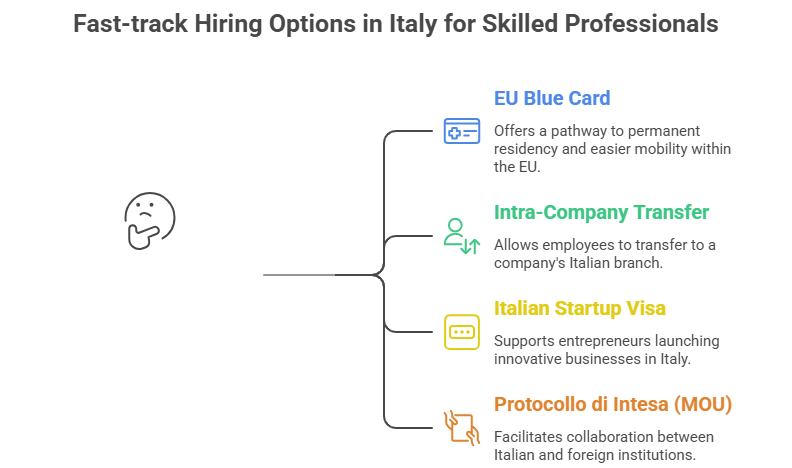
EU Blue Card
An EU Blue Card offers a fast-track work and residence permit in Italy, designed to attract highly qualified foreign workers. Professionals with high educational qualifications, work experience, and advanced skills can work in labour-shortage sectors of Italy through the EU Blue Card as an Italian immigration pathway. The EU Blue Card bypasses quota requirements and streamlines the visa approval process for skilled workers with specialised technical knowledge.
Eligibility requirements for the EU Blue Card:
- Valid job offer with an employment contract.
- Minimum salary threshold (approx. €35,000+ annually).
- Proof of work experience.
- Recognised university degree (Master’s/PhD).
- Declaration of Value (DOV) for validation of a foreign degree. (if required)
- Proof of accommodation.
- Health insurance.
- Valid passport.
*Want to apply for the EU Blue Card? Let Y-Axis guide you with the process.
Protocollo di Intesa (MOU)
A Protocollo di Intesa (MOU) is a special contract between an Italian company and the Ministry of the Interior that initiates fast-track hiring of skilled professionals abroad. This visa pathway is available only via Italian employers that have a pre-approved Protocollo di Intesa with the Ministry of the Interior. The agreement bypasses Local Labour Board procedures that can delay recruitment of qualified workers in shortage sectors. A Memorandum of Understanding (MOU) simplifies Italy's immigration processes for skilled professionals applying through pre-approved companies with a Protocollo di Intesa to work in skilled jobs.
Eligibility requirements for Protocollo di Intesa (MOU):
- Valid job offer from an Italian company with an MOU.
- Employer sponsorship.
- High educational qualification.
- Work experience letter.
- Minimum salary threshold.
- Health insurance.
- Proof of accommodation.
- Valid passport.
Also read…
Intra-Company Transfer (ICT)
An Intra-company transfer (ICT) permit allows multinational companies to transfer a skilled employee, such as a senior manager or executive, to their branch in Italy to conduct an urgent task. Skilled professionals from abroad can migrate to Italy on an ICT permit to temporarily live and work in the country. The process is fast-tracked for highly qualified employees, expediting labour market tests and quota restrictions.
Eligibility requirements for ICT:
- Managerial, specialist, executive, or trainee role.
- At least 3 consecutive months of work in the same company.
- Assignment/contract letter from the employer.
- Proof of company relationship (parent branch or subsidiary in Italy).
- High educational qualification.
- Authorization (Nulla Osta) to legally work in the Italy branch.
- Health insurance.
- Valid passport.
Also read…
Italy to grant 500,000 work visas in 2026-28. Apply now!
Italian Start-up Visa
The Italian Start-up Visa is a fast-track immigration pathway for skilled professionals in Italy, permitting innovative entrepreneurship. Foreign skilled professionals can enter Italy to establish a start-up venture or work in a start-up company. An Italian Start-up Visa is suitable for technically advanced, skilled workers to explore the country's technological and innovation sectors.
Eligibility requirements for the Italian Start-up visa:
- Proof of a comprehensive start-up business plan.
- Sufficient financial resources (minimum €50,000).
- Income Proof (at least €8,500).
- Start-up requirements (the company should not be more than 5 years old).
- Innovation requirements (at least 15% of investment in Research & Development (R&D), 1/3 of the team consists of PhD students/researchers, 2/3 of Master’s, ownership of a registered patent or software).
- Approval from the Italian Start-up Visa Committee.
- Certificate of no impediment (Nulla Osta).
- Proof of accommodation.
- Health insurance.
- Valid passport.
*Looking for jobs abroad? Sign-up with Y-Axis for end-to-end assistance.
Steps to Apply for Fast-track Hiring Options in Italy
The steps to apply for fast-track hiring options in Italy for skilled workers are as follows:
Step 1: Check eligibility for different fast-track hiring options in Italy for skilled professionals.
Step 2: Select a suitable fast-track hiring option based on educational qualification, work experience, job offer, and minimum salary requirements.
Step 3: Secure a valid job offer from an Italian employer (mandatory for the MOU and the EU Blue Card).
Step 4: The employer registers with the Italian Ministry of the Interior to bypass labour market tests.
Step 5: The employer submits a fast-track request for Nulla Osta (work authorization) on your behalf.
Step 6: Upon approval of the nulla osta, apply for an Italy work visa at the Italian Consulate/Embassy in your home country.
Step 7: Upon work visa approval, fly to Italy.
Step 8: Within one week of arrival, visit the local Immigration Office to sign a contract of stay and apply for the Residence Permit (permesso di soggiorno).
Step 9: Live and work legally in Italy as a skilled worker!
*Are you looking for step-by-step assistance with overseas immigration? Contact Y-Axis, the world’s No. 1 overseas immigration consultancy, for end-to-end assistance!
FAQs
What are fast-track hiring options in Italy for skilled professionals?
Fast-track hiring options in Italy for skilled workers include immigration pathways such as the EU Blue Card, the ICT permit, and the Italian Startup Visa. Foreign skilled professionals can also apply to Italian companies through a prioritized Protocollo d'Intesa (MOU) agreement for an expedited hiring process that eliminates lengthy labour market tests. These pathways permit highly qualified professionals to seek job opportunities in Italy's skill-shortage sectors, such as IT, healthcare, engineering, and construction.
Can Indian professionals apply for fast-track jobs in Italy?
Yes, Indian professionals can apply for fast-track jobs in Italy through expedited visa pathways and a Memorandum of Understanding (MOU). The Protocollo d'Intesa (MOU) is a special agreement between an Italy-based company and the Ministry of Interior that allows the company to hire foreign skilled professionals without having to follow labour market procedures, enabling faster recruitment for roles in skill shortage areas.
Who is eligible for fast-track work visa programs in Italy?
Fast-track visa programs in Italy are available for non-EU nationals with high educational qualifications, advanced training, and work experience. Foreign skilled workers are hired through an expedited immigration pathway to address Italy's labor shortages in sectors such as IT, engineering, AI, healthcare, nursing, operations, and construction.
What is Protocollo di Intesa (MOU) for fast-track hiring in Italy?
The Protocollo di Intesa, also known as the Memorandum of Understanding (MOU), is an agreement between Italy's Ministry of the Interior and a company seeking to hire foreign professionals through fast-tracked immigration pathways. Highly qualified professionals can migrate to Italy via fast-track pathways such as the ICT permit or the EU Blue Card, which exclude labour market tests and expedite the recruitment process.
What skills are currently in demand in Italy?
The most in-demand skills in Italy are digital transformation, engineering, and healthcare. There is also high demand for skilled professionals in AI, cybersecurity, and data analysis due to Italy's growing tech industry. Industries like manufacturing and specialized engineering face a serious talent shortage in the country, increasing the need for foreign skilled workers.
How long does fast-track visa processing take in Italy?
Fast-track visa processing in Italy generally takes about 5-7 working days for urgent recruitment of overseas skilled workers. The standard Italian work visa takes 15-30 days for approval, which can be accelerated through priority processing to address urgent labour gaps for certain skilled roles.
Which industries benefit most from fast-track hiring in Italy?
The industries in Italy that benefit most from fast-track hiring include IT, healthcare, engineering, construction, and tourism. Significant labour and skill shortages in these industries compel the country to offer expedited immigration pathways to hire skilled workers from abroad.
Do fast-track hiring options in Italy allow family members to join?
Yes, specific fast-track hiring options in Italy, such as an EU Blue Card or a specialized intra-company transfer (ICT) permit, allow family members/dependents to join the worker abroad. Family members, such as spouses, parents, and children, can apply for an Italian residence permit through the "accompanying family member" pathway to live with the worker in Italy.
What documents are required for a fast-track visa application in Italy?
Fast-track hiring options and priority processing of work visas in Italy require documents such as a job offer, employment contract, work authorisation, proof of accommodation, insurance, and a passport, among others.
The documents needed for fast-track hiring options in Italy for skilled professionals are as follows:
- Valid job offer with an employment contract.
- Work experience letter.
- Proof of minimum salary.
- Proof of Purpose/Invitation letter.
- Education degree certificate.
- Declaration of Value (DOV) for validation of a foreign degree.
- Certificate of no impediment (Nulla Osta).
- Proof of accommodation.
- Health insurance.
- Valid passport.
Can fast-tracking work visas in Italy lead to long-term residence?
Posted on January 24 2026

What are the fast-track hiring options in Austria for Skilled Professionals?
What are the fast-track hiring options in Austria for Skilled Professionals?
The fast-track hiring options in Austria for skilled professionals include the Red-White-Red Card (RWR Card), Job Seeker visa, and the EU Blue Card. The Red-White-Red Card is one of the main residence and work permit pathways for highly skilled professionals, for those in skill-shortage occupations, and for other qualified skilled workers, generally requiring a valid job offer. The Austria Job Seeker visa, on the other hand, does not require a job offer, allowing highly skilled professionals to enter Austria to seek employment for up to 6 months. Some in-demand occupations in Austria currently seeking skilled professionals include IT, healthcare, and engineering.
*Want to work in Austria? Let the Y-axis guide you with the steps.
Fast-track hiring options in Austria for Skilled Workers
Some of the fast-track hiring options in Austria for skilled workers include the Red-White-Red Card (RWR Card) for professionals in engineering, IT, and healthcare, based on a points-based system, and the Job Seeker visa for highly skilled and qualified individuals seeking employment for 6 months.
Given below are the fast-track hiring options in Austria for skilled professionals:
Red-White-Red Card (RWR Card)
The Red-White-Red Card (RWR Card) is one of the fast-track hiring options in Austria. Through the RWR Card, skilled workers can get fast-tracked work and a residence permit in Austria, provided they have a verified employment offer from a registered Austrian employer and meet the minimum points threshold. The RWR Card serves as a fast-track hiring pathway to bring skilled foreign workers into areas with skills shortages, such as IT, engineering, healthcare, and skilled trades.
Skilled professionals can apply under different categories, including skilled workers in shortage occupations, highly qualified workers, and graduates of Austrian universities. The selection for the RWR Card depends on factors such as age, language skills, work experience, and education. It offers both residence and employment benefits for up to 2 years upon selection.
Requirements for the Austria Red-White-Red Card
- Job offer from an Austrian employer
- Score the minimum points required (as per the chosen category)
- Recognized and verified educational qualifications
- Prior work experience
- Language proficiency skills (German/English)
- Meet the minimum salary threshold and meet the labour market compliance requirements
- Have a valid health insurance
- Sufficient funds to support your stay in Austria
- Have an original and valid passport
Also, read…
What are the differences between an EU Blue Card and a Red-White-Red Card?
Austria Job Seeker Visa (D Visa)
The Job Seeker Visa (D Visa) is a fast-track hiring option for highly qualified and skilled professionals with no job offer in hand. To qualify for Austria’s job seeker visa, you must score a minimum of 70 points through the official points-based system. The job-seeker visa allows you to enter Austria without a job offer and to look for employment for up to 6 months. You can successfully transition from a job-seeker visa to an RWR Card during our stay in Austria once you have secured a job offer. The Job seeker visa is a fast-track hiring option to Austria, allowing skilled professionals to enter the Austrian job market without a job offer.
Requirements for the Austria Job Seeker Visa
- Score at least 70 points in the points-based system
- Have educational qualifications of at least university-level
- Have prior work experience
- Have sufficient funds to sustain yourself in Austria
- Meet the required language proficiency level
- Have a valid medical insurance
- Have a police clearance certificate
- An original passport
*Want to apply for an Austria Job Seeker visa? Let Y-Axis assist you with the process.
EU Blue Card
The EU Blue Card is one of the fast-track hiring options for highly skilled professionals with specialised skills and advanced educational qualifications. To be eligible for an EU Blue Card in Austria, you must have a verified job offer and an employment contract that fulfils the minimum salary threshold. The EU Blue Card is ideal for IT specialists, senior managers, engineers, and researchers employed in high-demand sectors. You can obtain both work and residency benefits for up to 2 years, with long-term residence and renewal options.
Requirements for the EU Blue Card
- Higher educational qualifications of at least 3 years or equivalent work experience in specific job roles
- Have a job offer and an employment contract from an Austrian employer
- Meet the minimum salary threshold as per the Austrian law
- Have a valid medical insurance
- Proof of language proficiency in German or English (as required)
- Proof of sufficient funds
- Original and valid passport
*Want to apply for an EU Blue Card? Let the Y-axis guide you with the steps.
Steps to Apply for Fast-Track Hiring Options in Austria
You can follow the steps given below to apply for fast-track hiring in Austria:
Step 1: Check if you are eligible to apply for the fast-track hiring options in Australia, as per your qualification and profile (RWR Card, EU Blue Card, or the Job Seeker Visa)
Step 2: Choose a fast-track hiring pathway that best fits your profile (according to your educational qualifications, work experience, points, and job offer)
Step 3: Obtain a valid job offer and an employment contract from a verified Austrian employer (if required for your selected fast-track hiring pathway)
Step 4: Gather the required documents, including an original passport, copies of your latest passport-sized photographs, educational qualifications, work experience, PCC, proof of funds, language proficiency, and medical insurance.
Step 5: Submit your visa application at the nearest Austrian embassy or consulate or via a residence authority in Austria (depending on your profile)
Step 6: Complete the labour market assessment, which is generally conducted by Austria’s Labour Market Service (AMS). (If required)
Step 7: Fly to Austria, upon approval, and complete the post-registration formalities.
*Are you looking for step-by-step assistance with Austria immigration? Contact Y-Axis, the world’s No. 1 overseas immigration consultancy, for end-to-end assistance!
FAQs
What are the fast-track hiring options in Austria for skilled workers?
Fast-track hiring options in Austria include the Red-White-Red (RWR) Card and the Job Seeker Visa (Visa D), which are designed to attract skilled professionals in shortage occupations. The RWR Card provides a combined residence and work permit for qualified professionals in sectors such as IT, engineering, logistics, technology, and healthcare. The Job Seeker Visa allows highly qualified individuals to enter Austria without a job offer and search for employment. Additionally, the EU Blue Card enables skilled workers to migrate quickly and work in labour-shortage sectors.
What skills are in demand in Austria?
Austria is experiencing a significant skills shortage across multiple sectors, leading to high demand for foreign professionals. In-demand occupations include:
- Information Technology: Cybersecurity specialists, AI experts, data scientists
- Healthcare: Nurses, midwives, doctors, surgeons, therapists
- Engineering: Mechanical engineers, software engineers, civil engineers
- Skilled Trades: Logistics professionals, warehouse managers, factory executives
Why does Austria have a need for skilled workers?
Austria requires skilled workers from abroad due to rapid digital transformation, economic growth, and an ageing population. Industries such as IT, engineering, healthcare, and construction are expanding and modernising, creating labour shortages that cannot be met solely by the domestic workforce.
How long does fast-track hiring take in Austria for foreign workers?
Fast-track hiring in Austria generally takes between 4 and 8 weeks, depending on the visa category and individual case. In urgent recruitment situations, employer-supported fast-track schemes can reduce processing time to as little as 1 to 4 weeks.
Which work visas allow fast-track hiring in Austria?
The main visas that support fast-track hiring in Austria include the Red-White-Red Card, the Job Seeker Visa, and the EU Blue Card. The RWR Card targets highly qualified professionals with work experience, the Job Seeker Visa allows a six-month stay to find employment, and the EU Blue Card supports fast recruitment for skilled professionals with recognised qualifications.
Which industries in Austria offer fast-track hiring for skilled professionals?
Industries offering fast-track hiring in Austria include IT, engineering, healthcare, skilled trades, and construction. These sectors face ongoing labour shortages driven by technological advancement, infrastructure development, and demographic changes.
Can Indian professionals apply for fast-track jobs in Austria?
Yes, Indian professionals can apply for fast-track jobs in Austria through the Red-White-Red Card, Job Seeker Visa, and EU Blue Card programs. Austrian employers actively recruit skilled Indian professionals and support expedited visa processing for eligible candidates.
Do IT and engineering professionals get priority processing in Austria?
Yes, IT and engineering professionals often receive priority processing in Austria. Roles such as software engineers, data scientists, AI specialists, and civil engineers are listed as shortage occupations and benefit from faster processing under the RWR Card, EU Blue Card, and Job Seeker Visa pathways.
What documents are required for fast-track hiring in Austria?
Applicants must submit key documents to qualify for fast-track hiring in Austria, including:
- Educational degree certificates
- Valid job offer and employment contract (not mandatory for Job Seeker Visa)
- Work experience letters
- Language proficiency proof (Goethe, IELTS, TOEFL)
- Police clearance certificate
- Health insurance coverage
- Proof of sufficient funds
- Accommodation proof (rental agreement or lease)
- Valid passport
Can fast-track work visas in Austria lead to permanent residence?
Yes, fast-track work visas in Austria can lead to permanent residence. Skilled workers can transition from temporary permits to long-term residence by meeting requirements such as minimum salary thresholds, continuous legal residence, and German language proficiency.
Posted on January 16 2026

What are the fast-track hiring options in the Philippines for Skilled Professionals?
What are the fast-track hiring options in the Philippines for Skilled Professionals?
The fast-track hiring options in the Philippines for skilled workers are available through employer-sponsored work visa pathways, such as the 9(g) Pre-Arranged Employment Visa (long-term) and the Special Work Permit (SWP) (short-term). For a fast-track hiring process through these pathways, you will generally require an employer sponsorship, along with an Alien Employment Permit (AEP) (for 9(g) visa applicants). Some of the other fast-track hiring options in the Philippines also include Skilled foreign workers who are employed or hired by PEZA-registered companies, may be eligible for the Special Non-Immigrant Visas (SNIV). At the same time, the Section 47(a)(2) visas are restricted for project-based employment or government-approved projects. Faster visa processing in the Philippines is based on the documentation submitted, the involvement of your employer, and meeting the Bureau of Immigration regulations.
*Want to apply for a Philippines work visa? Contact Y-Axis for end-to-end assistance.
Fast-track hiring options in the Philippines for skilled workers
Some of the main fast-track hiring options in the Philippines for skilled professionals are as follows:
9(g) Pre-Arranged Employee Visa
The 9(g) Pre-Arranged Employment Visa is one of the most common long-term work visa options in the Philippines. While the visa itself is not a direct fast-track visa, it does have faster processing, provided the employment is pre-arranged, and the Philippines’ employer sponsors your visa application. The 9(g) Pre-Arranged Employment Visa is employer-sponsored and is valid for the duration of your employment, with the possibility of renewal. The employers in the Philippines coordinate with the Bureau of Immigration and the Department of Labor and Employment (DOLE) to work towards streamlining and fast-tracking the hiring process for qualifying skilled workers.
Requirements for the 9(g) Pre-Arranged Employment Visa:
- A valid job offer from an employer in the Philippines
- Proof of job contract and endorsement from the company
- Employer compliance with DOLE and Bureau of Immigration requirements
- An approved Alien Employment Permit (AEP)
- Police clearance certificate
- Proof of medical fitness
- Valid and original passport
Special Work Permit (SWP)
The Special Work Permit (SWP) is designed for skilled professionals visiting the Philippines for short-term purposes or work assignments. The SWP offers faster work authorization as compared to the regular long-term visa options in the Philippines, as it is specifically issued for foreign workers to stay in the country temporarily. The Special Work Permit (SWP) in the Philippines is ideal for auditors, technical experts, project-based specialists, consultants, and trainers, among others. It is generally issued for a period of 3 months, which can later be extended upon eligibility. Through SWP, employers in the Philippines can address urgent business requirements without having to undergo a complete work visa approval, making it a fast-track hiring option for skilled workers.
Requirements for the Philippines Special Work Permit (SWP)
- You can apply if you are attending short-term projects or for urgent business engagement
- Sponsorship from a local company in the Philippines
- Employer invitation or endorsement letter from your company in the Philippines
- Evidence that the job role is temporary and cannot be converted to long-term employment
- A fully-filled Completed Bureau of Immigration application form
- Additional identification documents
- Police clearance certificate (if required)
- Valid passport
Philippines 47(a)(2) Visa
The Section 47(a)(2) visa is highly restricted and is generally only issued to foreign professionals who are employed for special assignments or government-related projects. The visa is valid for the duration of the project and can be renewed based on the assignment (if extended). While the Section 47(a)(2) visa is not a direct fast-track visa, it does offer faster processing for selected skilled professionals hired for priority or strategic projects backed by government agencies in the Philippines. The Section 47(a)(2) visa holders can get multiple entries, provided they have an approval from the Bureau of Immigration, and if they fulfil the project requirements.
Requirements for the Philippines 47(a)(2) Visa
- Must be employed for a government-approved or endorsed project
- Have an official and legal endorsement from a relevant and registered Philippine government agency
- Proof of employment contract or invitation for the assignment
- Valid and original passport
- Additional supporting documents (as requested by the Bureau of Immigration)
Philippines Special Non-Immigrant Visa (SNIV)
The Special Non-Immigrant Visa (SNIV) is issued to foreign executives, investors, and senior technical professionals whose employment contributes to the economic growth in the Philippines. The visa is generally granted for government-endorsed programs or under special laws. The SNIV is commonly used by BOI-registered or PEZA-enterprises. While the Special Non-Immigrant Visa (SNIV) in the Philippines is not a direct, fast-track hiring option, it offers streamlined processing compared to regular work visas.
Requirements for the Philippines Special Non-Immigrant Visa (SNIV)
- Must be a foreign investor, executive, or senior technical professional
- Have an endorsement from a relevant Philippine government agency
- Submit proof of investment or have an employment invitation from an eligible Philippine enterprise
- A fully-filled and completed Bureau of Immigration application form
- Police Clearance Certificate (if requested)
- Valid passport
*Want to apply for jobs in the Philippines? Avail Y-Axis Resume Marketing services to find the right one.
Steps to apply for fast-track hiring options in the Philippines
The following are the step-by-step ways to apply for fast-track hiring options in the Philippines:
Step 1: Check if you are eligible for the fast-track hiring options in the Philippines.
Step 2: Select the best fast-track option in the Philippines based on your requirements, qualifications, work experience, job role, and the duration of your employment.
Step 3: Get a valid job offer, along with an employer sponsorship, and an endorsed project agreement if applying for the Section 47(a)(2) visas.
Step 4: Your employer in the Philippines initiates and sponsors your visa application at the Department of Labour and Employment (DOLE) and the Bureau of Immigration, while an endorsement from PEZA, the Board of Investments (BOI), or another registered government agency is required for Section 47(a)(2) visas.
Step 5: Apply for an Alien Employment Permit (AEP), provided you are exempt under specific visa categories.
Step 6: Arrange and submit the documents required for your selected visa.
Step 7: Apply for the fast-track hiring option at the Bureau of Immigration or the nearest Philippine consulate.
Step 8: Fly to the Philippines once you receive the visa or an entry authorization approval.
*Are you looking for step-by-step assistance with overseas immigration? Contact Y-Axis, the world’s No. 1 overseas immigration consultancy, for end-to-end assistance!
FAQs
What are the fast-track hiring options in the Philippines for skilled workers?
Fast-track hiring options in the Philippines include 9(g) Pre-Arranged Employment Visa and the Special Work Permit (SWP) for short-term roles for foreign nationals. Professionals, such as healthcare experts, IT specialists, and engineers, can apply for job roles in skill shortage sectors in the Philippines and migrate through expedited visa processing. Candidates hired in government-sponsored organisations like BOI/PEZA-registered firms can also apply through the Special Non-Immigrant Visa (47(a)(2)) as a faster route of approval.
Which work visas allow fast-track hiring in the Philippines?
The main fast-track hiring options in the Philippines include 9(g) Pre-Arranged Employment Visa for a long-term engagement of up to a year, which can be renewed for an extended work period. Other fast-track visa pathways for skilled professionals include Special Work Permit (SWP) for short-term projects and Special Non-Immigrant Visa (47(a)(2)) for government-sponsored firms like BOI/PEZA-registered organisations.
How does employer sponsorship enable faster hiring of skilled workers in the Philippines?
Employer sponsorship speeds up processing time for skilled workers in the Philippines by acting as a bridge between the candidate and the immigration organisation. Professionals can apply for a necessary work permit to join jobs in skills shortage sectors via visa options, such as the 9(g) Pre-Arranged Employment Visa, which includes employer sponsorship as an essential criterion for approval. This provides access to a larger global talent pool by leveraging services like Employer of Record (EOR), which eliminates the need for several local setups, resulting in faster recruitment.
How long does fast-track hiring take in the Philippines for foreign workers?
Fast-track hiring options in the Philippines can take up to 6 to 10 weeks for approval. The authorization process itself takes about 10 weeks, beginning from the AEP application to the complete approval of the 9(g) visa. However, candidates with a job offer in PEZA-registered companies can expedite the visa approval time to 4 to 6 weeks for urgent migration to the Philippines.
Is fast-track processing available for the Alien Employment Permit (AEP) in the Philippines?
The fast-tracking of Alien Employment Permit (AEP) applications can be expedited for candidates joining any PEZA-registered organisation. The processing time for such applicants is reduced through streamlined approval procedures. However, the duration of approval may vary for different professionals, depending on the accuracy of documentation and the complexity of the application.
Which industries in the Philippines offer fast-track hiring for skilled professionals?
Skill shortage sectors in the Philippines enable the fast-tracking of hiring foreign professionals through expedited pathways and visas. These include Business Process Outsourcing (BPO), Information Technology (IT), Healthcare, and Construction/Engineering, which face a critical labour shortage, welcoming highly qualified foreign nationals to contribute to the country’s talent pool.
Can Indian professionals apply for fast-track jobs in the Philippines?
Yes, Indian professionals with relevant work experience and high qualifications can apply for job roles in the Philippines' skill shortage industries. Several fast-track pathways exist for quick entry of foreign nationals through a Provisional Work Permit (PWP). The PWP will allow the applicant to live and work in the Philippines while the 9(g) Visa is still under processing. However, the AEP (Alien Employment Permit) remains essential and must be applied for in advance through the Department of Labor and Employment (DOLE).
Do IT and engineering professionals get priority processing in the Philippines?
The job market in the Philippines has high demand for professionals with IT and engineering backgrounds, resulting in faster recruitment. The Philippine government aims to bring in more foreign workers with high qualifications via 9(g) visa, SWP, and (47(a)(2)) pathways to contribute to the country’s economy.
What documents are required for fast-track hiring in the Philippines?
The essential documents for fast-track hiring options in the Philippines include mandatory government and company-specific documents for standard pre-employment screening. The necessary documents required for fast-track hiring pathways in the country are as follows:
- Social Security System (SSS) ID/Number.
- PhilHealth ID/Number from the Philippine Health Insurance Corporation.
- Pag-IBIG (HDMF) ID/Number of (Home Development Mutual Fund).
- TIN (Taxpayer Identification Number) and BIR Form 1902 or stamped TIN Verification Slip.
- Proof of NBI Clearance.
- Medical fitness certificates.
- PSA (Philippine Statistics Authority)Birth Certificate (NSO-issued certificates are no longer applicable).
- Certificate(s) of Employment (COE).
- Marriage Certificate/Birth Certificate for spouses and children ( if applicable).
Can fast-tracking work visas in the Philippines lead to long-term residence?
Posted on January 07 2026
Trending Article
Posted On February 06 2026
Can I get a Switzerland work visa without a job offer?