


Migrate to Singapore
Sign up for a free expert consultation

Don't know what to do?
Get Free Counseling
Last Updated 05 August 2026
Why Migrate to Singapore?
Singapore is one of the best countries to live, work, and live with your family. Singapore has always topped the list of destinations for international migrants for those wishing to migrate to other parts of the world to start a new chapter.
Key Work Visas: Employment Pass (S$5,600+/month), S Pass (S$3,300+/month), ONE Pass (S$30,000+/month, no job offer needed) │ COMPASS: 40-point minimum for EP approval │ PR Route: PTS Scheme (~2-3 years employment) or GIP (SGD 10M+ investment) │ Dependent Pass: requires sponsor salary of S$6,000+/month
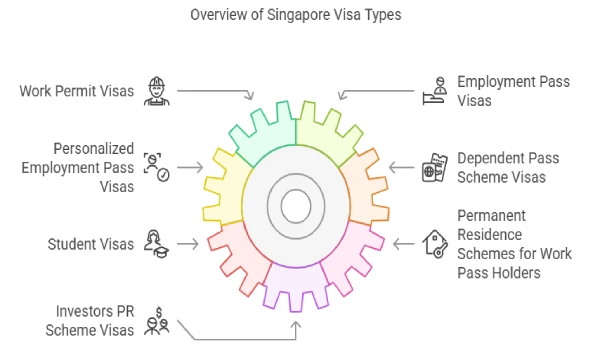
Types of Singapore visas
Y-Axis offers you a wide range of services to avail various types of visas to Singapore that include Working permit visas, Employment Pass visas, Personalized Employment Pass visas, Dependent Pass Scheme visas, Student visas, Permanent Residence Schemes for Work Pass Holders visas, and Investors PR Scheme visa.
Singapore has always maintained an open-door policy towards migrants and continues to do so. The number of immigrants in this country continues to rise every year. Immigrants account for a major percentage of the population here.
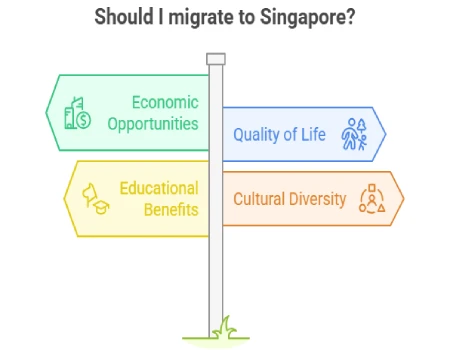
Reasons to migrate to Singapore are a strong economy, low cost of living, and high quality of life. There are various reasons to migrate to Singapore, some migrate for work, and others migrate to reunite with their families. Some of them move here on long-term visit visas while others seek permanent residency.
Foreign professionals can choose between three different work visas to migrate to Singapore. An immigrant’s spouse, children, and parents can come to Singapore with a Dependent’s Pass and a Long-Term Visit Pass.
Overseas Networks & Expertise (ONE) Pass: Singapore's newest top-tier pass, designed for top business leaders, established professionals, and experts across sectors, allowing them to work, start a business, or serve on boards in Singapore — without needing a prior job offer. Eligibility generally requires a fixed monthly salary of at least SGD 30,000 in the last 1-2 years, or demonstrated outstanding achievement in the applicant's field (arts, sports, academia, research, or business). Valid for 5 years and renewable, and holders can concurrently take on multiple roles across different Singapore entities.
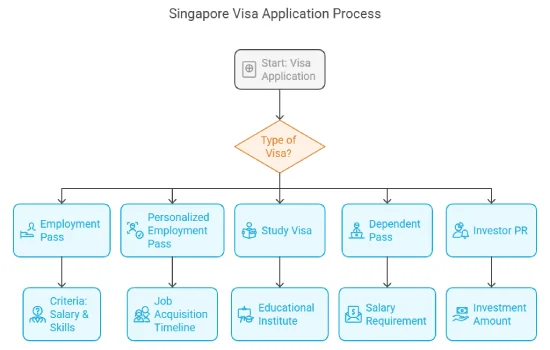
How to apply for a Singapore visa?
The applicants who wish to process their Working permit visa to Singapore must have an employment offer from a firm in Singapore. Applicants who want to get Employment Pass are subject to some minimum pay requirement, as well as COMPASS (the Complementarity Assessment framework). Prior to getting the pass, the potential employees have to take a points-based test that operates based on different factors like their salary, qualification, national workforce diversity, and local employment encouragement they provide, along with two additional factors.
The applicants of a Personalized Employment Pass visa have a period of 6 months to get a job in Singapore after they arrive in the country.
The immigrant students who wish to apply for a Study visa in Singapore must have an offer letter for a seat in a preferred educational institute in Singapore. The applicants who wish to process their Dependent Pass must be a spouse or unmarried child under 21 years of an Employment Pass, S Pass, EntrePass, or Personalised Employment Pass holder in Singapore whose sponsor earns a minimum fixed monthly salary of S$6,000. Sponsoring parents requires a higher minimum of S$12,000/month under the Long-Term Visit Pass.
The Global Investor Programme (GIP), administered by Singapore's Economic Development Board, requires a minimum investment of SGD 10 million in a new or expanding Singapore business, OR SGD 25 million in a GIP-approved investment fund, OR a single family office structure with at least SGD 200 million in assets under management (of which SGD 50 million must be deployed in specified investments). Applicants also need at least 3 years of entrepreneurial/business experience and, for the business route, a company generating at least SGD 200 million in annual turnover. Spouse and children under 21 can apply for PR alongside the main applicant; parents and children over 21 may apply for a renewable 5-year Long-Term Visit Pass instead.
Fair Consideration Framework: What Your Employer Must Do First
As per the Fair Consideration Framework of MOM, your employer in Singapore needs to post an advertisement of the position on MyCareersFuture.gov.sg for at least 14 continuous days before applying for Employment Pass or S Pass for you. This is a mandatory requirement of MOM; your application will not be accepted if the job advertisement posted by your employer does not comply with the Fair Consideration Framework.
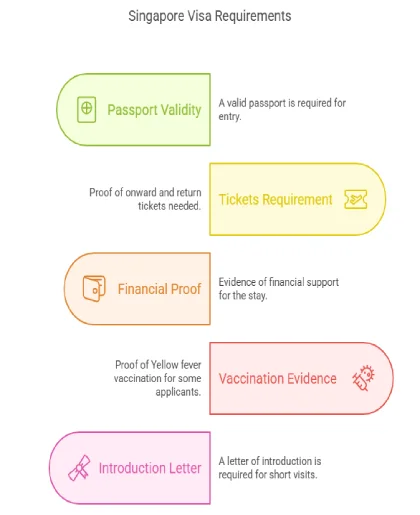
Requirements for Singapore visa
- The applicants for a Singapore visa require a passport that has a validity of six months beyond their stay in Singapore.
- They must have onward and return tickets if it applies to their visa type.
- They must give proof of ability to financially support their stay in Singapore.
- Applicants of certain nations must give evidence of being vaccinated for Yellow fever if it applies to them.
- Applicants who are on a short-term visit to Singapore for tourism or social visits must give a letter of introduction from their contact person in Singapore.
Singapore immigration process
For Professionals (PASS Category):
- Employment Pass: For foreign professionals, managers and executives. As of 2026, candidates need to earn at least S$5,600/month for most sectors (S$6,200/month for financial services), with the required salary rising progressively with age (up to S$10,700-S$11,800/month for those 45+). Applicants must also clear COMPASS (Complementarity Assessment Framework), a points-based test scoring salary competitiveness, qualifications, workforce diversity, and support for local employment — a minimum of 40 points is required. From January 2027, minimum salaries rise further to S$6,000/S$6,600.
- Personalized Employment Pass: For high-earning existing Employment Pass holders or overseas foreign professionals.
For Skilled and Semi-Skilled Workers (Pass Category):
- S Pass: For mid-level skilled staff. As of 2026, candidates need to earn at least S$3,300/month for most sectors (S$3,800/month for financial services), rising progressively with age. S Pass holders are also subject to a quota (Dependency Ratio Ceiling) and a monthly foreign worker levy paid by the employer. From January 2027, minimums rise to S$3,600/S$4,000.
- Work Permit for foreign worker: For semi-skilled foreign workers in the construction, manufacturing, marine shipyard, process or services sector
- Work Permit for foreign domestic workers: For foreign domestic workers (FDWs) to work in Singapore.
Work permit eligibility requirements
- All applicants must have a current passport.
- Applicants must be at least 18 years old.
- The applicant is only allowed to work within the parameters of the work permits provided by the authorities.
- It usually takes three weeks for online applications to be processed and eight weeks for manual applications to be processed after they are received.
Dependent visa
Individuals who come to Singapore on a work permit are allowed to bring their dependents with them. This must be applied for by the organization that paid for the EP, PEP, or S Pass visa for the person who wishes to bring his or her dependents. Depending on whether the EP, PEP, or S Pass visa is still valid, it can last up to two years.
Singapore Permanent Residency
There are three ways to get permanent residency in Singapore:
- Professional, Technical Personnel and Skilled Workers Scheme (PTS scheme)
- Global Investor Program Scheme (GIP Scheme)
- Foreign Artistic Talent Scheme (ForArts)
The following groups of foreigners are eligible to apply for permanent residency under the PTS and GIP Schemes:
- Spouses and unmarried children of PR visa holders or Singapore citizens
- Citizen’s aged parents
- Immigrants on an employment pass or S pass
Investors or entrepreneurs under the GIP scheme
Typical PR Timeline: Employment Pass and S Pass holders are generally eligible to apply for PR under the PTS Scheme after approximately 2-3 years of continuous employment in Singapore, though approval is discretionary and based on factors including salary, qualifications, family ties, and economic contribution. GIP applicants can typically obtain PR within about 12 months of their final investment approval. There is no fixed automatic timeline — Singapore's Immigration and Checkpoints Authority (ICA) assesses each application individually.
Job trends in Singapore
Top Industries: Information Technology, Engineering & Manufacturing, Finance & Accounting, Healthcare & Life Sciences, Sales and Marketing, Human Resources and Logistics.
Jobs in Demand: Developers, Software Engineers, Data Scientists, Financial Controllers, Senior Accountants, Auditors, Sales/Business Development Managers, Logistics Managers, Sales Managers, Digital Marketing Managers.
| Occupation | Annual Salary Range (SGD) |
|---|---|
| Financial Controller | SGD 100,000–150,000 |
| Marketing Manager | SGD 100,000–168,000 |
| Application Development Manager | SGD 110,000–170,000 |
| IT Manager | SGD 90,000–180,000 |
| Internal Auditor | SGD 65,000–110,000 |
| Software Developer | SGD 50,000–140,000 |
| Sales Manager | SGD 50,000–145,000 |
| Digital / Ecommerce Marketing Manager | SGD 50,000–200,000 |
| Business Development Manager | SGD 55,000–170,000 |
Y-Axis snapshot
1M
Successful applicants
1500+
Experienced counselors
25Y+
Expertise
50+
Offices
Looking For Inspiration
Explore what Global Indians have to say about Y-Axis in shaping their future