

Study in USA

Don't know what to do?
Get Free Counseling
Last Updated: 25-08-2026
Study in USA for Indians: Top Universities, Fees, Scholarships & Visa
The USA is one of the most preferred study destinations for Indian students because of its strong universities, wide choice of courses, research facilities, and career opportunities. More than 1.17 million international students studied in the USA during the 2025/26 academic year. Indian students formed the largest international student group, with around 363,000 students. Students can choose from thousands of programmes at undergraduate, postgraduate, doctoral, and professional levels. Popular study areas include computer science, engineering, business, data science, healthcare, finance, and other STEM fields. US universities also give students opportunities to take part in research, internships, practical projects, and industry activities.
The cost of studying in the USA depends on the university, course, and location. Students should plan for tuition fees, accommodation, food, health insurance, transportation, and other living expenses. Scholarships, assistantships, and other financial aid options can help reduce the overall cost. Before applying to study in USA, students should check the university's academic requirements, English language requirements, application deadlines, tuition fees, and financial requirements. After receiving admission and the required documents from the university, eligible students can apply for the F-1 student visa.
The USA also provides opportunities to gain work experience after graduation. Eligible international students can use Optional Practical Training (OPT), while qualifying STEM graduates may be eligible for an additional 24-month STEM OPT extension.
MS | MBA | B.Tech | BS | Scholarships
Why Study in USA?
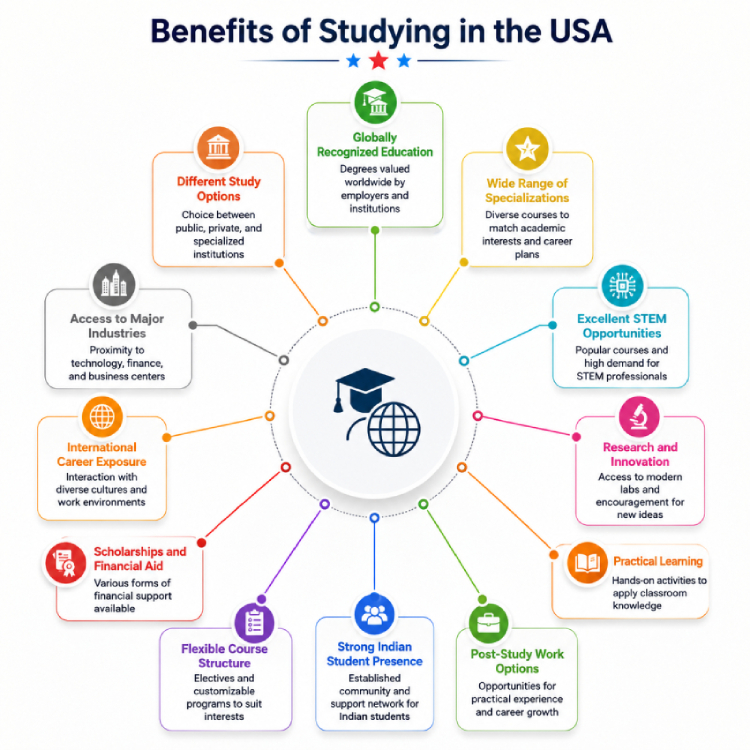
The USA offers students a mix of academic learning, practical experience, and international exposure. Some of the key benefits include:
- Globally Recognised Education: US universities are known for their academic quality and offer degrees that are recognised by employers and institutions around the world.
- Large Choice of Specialisations: Students can select from a wide range of subjects and specialisations. This makes it easier to find a course that matches their academic interests and career plans.
- Excellent STEM Opportunities: Computer science, engineering, mathematics, data science, and other STEM courses are among the most popular choices for international students. The USA also has strong demand for professionals in several technology-related fields.
- Research and Innovation: Students can access modern laboratories, research centres, and advanced technology. Many universities encourage students to work on research projects and develop new ideas.
- Practical Learning: Many courses include projects, internships, laboratory work, presentations, and other activities that help students apply what they learn in the classroom.
- Post-Study Work Options: F-1 students who meet the requirements can use OPT to gain practical experience related to their course. Students from eligible STEM fields may also qualify for the 24-month STEM OPT extension.
- Strong Indian Student Presence: Indian students make up a large part of the international student population in the USA. This gives new students access to an established Indian community in many university cities.
- Flexible Course Structure: Many US universities allow students to select elective subjects and build their course around their interests. Some programmes also provide options to change or add specialisations.
- Scholarships and Financial Aid: Universities offer different forms of financial support, including scholarships, grants, assistantships, and other aid. Availability and eligibility vary by university and course.
- International Career Exposure: Studying in the USA gives students the opportunity to interact with people from different countries and understand different work cultures.
- Access to Major Industries: Many universities are located close to major technology, finance, healthcare, and business centres. Students can benefit from internships, networking events, career fairs, and connections with employers.
- Different Study Options: Students can choose between public universities, private universities, colleges, community colleges, and specialised institutions depending on their academic goals and budget.
Top Universities in USA for Indian Students
Choosing the right university is an important step for Indian students planning to study in USA. The country has a large higher education system with public universities, private universities, colleges, community colleges, and specialised institutions.
More than 1.17 million international students studied in the USA during the 2024/25 academic year. Indian students were the largest international student group, with around 363,000 Indian students studying in the USA. This shows the strong interest among Indian students in American universities.
The USA has many top-ranked universities known for quality education, research, technology, and career opportunities. Students can choose universities based on their course, budget, location, and career plans. Popular study areas include computer science, engineering, business, data science, healthcare, finance, and other STEM courses.
The table below lists some of the top universities in the USA and their approximate annual tuition fees:
| Name of the University | QS World Ranking 2026 | Approx. Annual Tuition Fee |
|---|---|---|
| Massachusetts Institute of Technology (MIT) | 1 | US$60,000–US$65,000 |
| Stanford University | 3 | US$60,000–US$70,000 |
| Harvard University | 5 | US$55,000–US$65,000 |
| California Institute of Technology (Caltech) | 10 | US$60,000–US$65,000 |
| University of Chicago | 13 | US$60,000–US$70,000 |
| University of Pennsylvania | 15 | US$60,000–US$65,000 |
| Cornell University | 16 | US$60,000–US$70,000 |
| University of California, Berkeley | 17 | US$45,000–US$65,000 |
| Yale University | 21 | US$60,000–US$70,000 |
| Johns Hopkins University | 24 | US$60,000–US$65,000 |
Public vs Private Universities in USA
The USA has both public and private universities. Public universities receive funding from state governments, while private universities mainly depend on tuition fees, donations, and other sources of funding. For Indian students, the cost of study can be different between public and private universities. International students studying at public universities generally pay out-of-state tuition fees. Private universities usually charge similar tuition fees to students regardless of their state.
The main differences between public and private universities are given below:
| Aspect | Public Universities | Private Universities |
|---|---|---|
| Tuition Fees | Usually more affordable than private universities. International students generally pay out-of-state tuition fees. | Usually more expensive, with tuition often ranging from US$40,000 to US$70,000 or more per year. |
| University Size | Many public universities have large campuses and a large number of students. | Many private universities have smaller student populations. |
| Course Options | Offer a wide range of courses in engineering, science, business, arts, healthcare, and other fields. | Offer many courses, with strong programmes in areas such as business, technology, medicine, and research. |
| Admission | Admission requirements vary by university and course. Top universities can be very competitive. | Admission requirements vary. Highly ranked private universities can also be very competitive. |
| Class Size | Some courses, especially basic courses, may have larger classes. | Some courses have smaller classes and more interaction with teachers. |
| Research | Many public universities have strong research centres and industry connections. | Many private universities also have strong research facilities and research programmes. |
| Scholarships | Scholarships may be available, but options for international students vary. | Some private universities offer scholarships and financial aid to international students. |
| Examples | University of California, Berkeley, University of Michigan, University of Texas at Austin | Harvard University, Stanford University, MIT, Yale University |
Popular Courses to Study in USA
The USA offers courses in almost every major field. Indian students commonly choose computer science, engineering, business, data science, healthcare, and STEM-related courses. During 2024/25, around 26% of international students in the USA studied mathematics and computer science, while around 18% studied engineering. Business and management were also popular fields.
The table below shows some popular courses for international students:
| Name of the Programme | Typical Duration | Popular Courses / Specialisations |
|---|---|---|
| Engineering | 4 years (Bachelor's), 1–2 years (Master's) | Mechanical Engineering, Electrical Engineering, Civil Engineering, Aerospace Engineering, Chemical Engineering, Industrial Engineering |
| Computer Science & IT | 4 years (Bachelor's), 1–2 years (Master's) | Computer Science, Artificial Intelligence, Data Science, Cybersecurity, Software Engineering, Information Technology |
| Business & Management | 4 years (Bachelor's), 1–2 years (Master's/MBA) | Business Administration, Finance, Marketing, International Business, Business Analytics, Supply Chain Management |
| Data Science & AI | 1–2 years (Master's) | Data Analytics, Machine Learning, Artificial Intelligence, Big Data, Business Analytics |
| Healthcare & Life Sciences | 2–4+ years depending on programme | Public Health, Biotechnology, Biomedical Sciences, Nursing, Pharmacy, Health Administration |
| Natural Sciences | 4 years (Bachelor's), 1–2 years (Master's) | Physics, Chemistry, Biology, Environmental Science, Mathematics |
| Social Sciences | 3–4 years (Bachelor's), 1–2 years (Master's) | Psychology, Sociology, Economics, Political Science, International Relations |
| Humanities & Arts | 3–4 years (Bachelor's), 1–2 years (Master's) | English, History, Communication, Media Studies, Fine Arts, Literature |
| Law | 3 years (JD), 1 year (LLM) | Corporate Law, International Law, Business Law, Intellectual Property Law |
| Medicine & Medical Sciences | Varies by programme | Medicine, Dentistry, Public Health, Biomedical Sciences, Medical Research |
Note: Course duration can vary between universities and programmes. A bachelor's degree in the USA usually takes four years, while most master's degrees take one to two years. An associate degree at a community college usually takes around two years.
Cost of Studying in USA
The cost of studying in USA depends on the university, course, and city you choose. Public universities are usually more affordable than private universities, while living expenses are higher in cities like New York, Boston, and San Francisco. Students should plan for tuition fees, accommodation, food, health insurance, transportation, and other daily expenses before applying.
Tuition Fees at Public and Private Universities
Tuition fees in the USA vary based on the type of university. Public universities usually have lower fees for international students than private universities, while MBA and professional programmes are generally the most expensive.
| University Type | Tuition Fee Range | Notes |
|---|---|---|
| Public Universities | US$20,000–US$40,000 per year | Lower tuition compared to private universities |
| Private Universities | US$35,000–US$70,000 per year | Fees depend on the university and course |
| MBA Programmes | US$40,000–US$90,000 (total) | Top business schools usually charge higher fees |
Student Fees and Health Insurance
Apart from tuition fees, students also pay additional university charges each year. These may include student activity fees, campus facilities, library services, technology fees, and health insurance. The average additional cost is:
- Student fees: US$500–US$2,000 per year
- Health insurance: US$1,000–US$3,000 per year
Cost of Living in USA
Living expenses depend on the city and your lifestyle. Students living in smaller cities usually spend less than those living in major metropolitan areas.
Average Monthly Expenses
| Expense | Average Monthly Cost |
|---|---|
| Accommodation | ₹60,000–₹1,20,000 |
| Food & Groceries | ₹20,000–₹35,000 |
| Health Insurance | ₹8,000–₹20,000 |
| Transportation | ₹6,000–₹12,000 |
| Mobile, Internet & Other Expenses | ₹10,000–₹20,000 |
Estimated Living Cost
| Expense | Estimated Cost |
|---|---|
| Monthly Living Cost | ₹1.1 lakh–₹2.1 lakh |
| Annual Living Cost | ₹13 lakh–₹25 lakh |
Financial Proof for F-1 Student Visa
Students applying for an F-1 student visa must show that they have enough funds to pay for their first year of tuition fees and living expenses. The required amount depends on the university and is mentioned in the Form I-20 issued after admission.
Estimated Total Cost to Study in USA
| Study Level | Estimated Annual Cost (Tuition + Living) |
|---|---|
| Bachelor's Degree | ₹30 lakh–₹55 lakh |
| Master's Degree | ₹28 lakh–₹50 lakh |
| MBA | ₹40 lakh–₹80 lakh |
Tip: Students can reduce their overall expenses by applying for scholarships, choosing public universities, sharing accommodation, and taking part-time jobs allowed under F-1 visa rules.
Scholarships for Indian Students to Study in USA
The USA offers many scholarships and financial aid options for international students, including Indians. Scholarships are offered by universities, private organisations, foundations, and government-supported programmes. Some scholarships cover part of the tuition fee, while others may cover tuition, living costs, or other study expenses. Scholarships are available for Bachelor's, Master's, MBA, and PhD programmes. The eligibility rules are different for each scholarship. Academic performance, leadership skills, extracurricular activities, financial need, and other achievements may be considered.
Below are some popular scholarships and financial aid options for Indian students:
| Scholarship Name | Scholarship Amount | Eligibility |
|---|---|---|
| Fulbright-Nehru Master's Fellowships | Tuition support, living expenses, airfare, health insurance, and other benefits | Indian students with a Bachelor's degree and professional experience who want to pursue a Master's degree in the USA |
| Fulbright-Nehru Doctoral Research Fellowships | Financial support for research, living expenses, airfare, and health insurance | Indian PhD students who want to conduct research in the USA |
| Hubert H. Humphrey Fellowship | Covers tuition, living expenses, travel, and other programme costs | Mid-career professionals from selected countries, including India; mainly for professional development rather than a degree |
| Stanford University Scholarships | Financial aid can cover a large part or all of demonstrated financial need | Students admitted to eligible Stanford programmes; financial aid rules vary by programme |
| Harvard University Financial Aid | Need-based financial aid based on the student's financial situation | International students admitted to eligible Harvard programmes |
| Yale University Scholarships | Need-based financial aid; amount depends on financial need | International students admitted to eligible Yale undergraduate programmes |
| University of Chicago Scholarships | Merit-based and need-based financial support | International students applying to eligible undergraduate programmes |
| Cornell University Financial Aid | Need-based financial aid for eligible international students | International students admitted to eligible undergraduate programmes |
| AAUW International Fellowships | Up to US$50,000 depending on the programme and level | Women who are not US citizens or permanent residents and are applying for graduate or postgraduate study in the USA |
| Aga Khan Foundation International Scholarship | Provides financial support for tuition and living costs; normally structured as a grant and loan | High-achieving students from selected countries who have limited financial resources and are pursuing postgraduate study |
Admission Process and Eligibility Criteria to Study in USA
Understanding the admission process is important before applying to a US university. Requirements vary by university and course. Indian students should start preparing early.
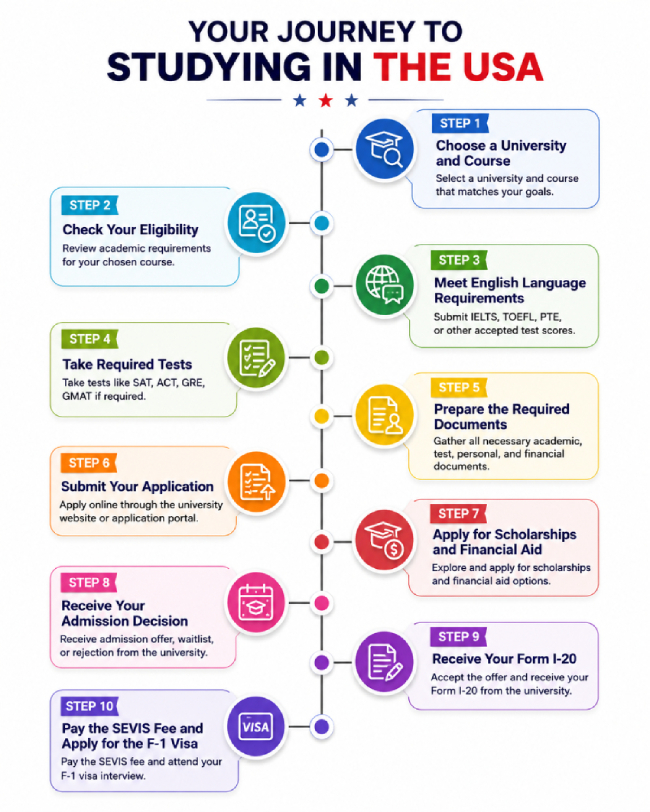
Step 1: Choose a University and Course
Choose a university and course based on your academic background, career goals, budget, and preferred location. Check the course details, fees, ranking, requirements, and deadlines.
Step 2: Check Your Eligibility
For a Bachelor's degree, students usually need to complete Class 12 or an equivalent qualification. For a Master's degree, a recognised Bachelor's degree is generally required. Some courses may also need specific subjects, work experience, tests, or a portfolio.
Step 3: Meet English Language Requirements
Most US universities require proof of English skills. IELTS, TOEFL, PTE, or other accepted tests may be required. Some universities may waive this requirement in certain cases.
Step 4: Take Required Tests
Some universities may require SAT, ACT, GRE, GMAT, or other tests. Requirements depend on the course and university. Check the requirements before taking a test.
Step 5: Prepare the Required Documents
Prepare a checklist of documents, including academic certificates and transcripts, passport, English test scores, standardised test scores (if required), SOP, LORs, resume/CV, portfolio (if required), work experience proof, and financial documents.
Step 6: Submit Your Application
Apply through the university website or an accepted application platform. Application fees vary by university. Upload all documents correctly and submit your application before the deadline.
Step 7: Apply for Scholarships and Financial Aid
Check scholarship and financial aid options while applying. Some scholarships need a separate application. Apply early, as scholarship deadlines may be earlier than admission deadlines.
Step 8: Receive Your Admission Decision
The university may send an admission offer, conditional offer, waitlist decision, or rejection. If you receive an offer, check the conditions, fees, scholarship details, and acceptance deadline.
Step 9: Receive Your Form I-20
After accepting the offer and meeting all requirements, the university issues the Form I-20. You need this document to apply for an F-1 student visa. You must also show enough funds for your tuition and living expenses.
Step 10: Pay the SEVIS Fee and Apply for the F-1 Visa
Pay the SEVIS I-901 fee after receiving your I-20. Then complete the F-1 visa application process. Indian students generally need to attend a visa interview. Carry your passport, I-20, financial documents, academic records, and other required documents.
Step 11: Arrange Accommodation and Travel
After getting your visa, arrange accommodation and book your flight. Keep your admission, visa, and other important documents with you while travelling.
Step 12: Start Your Studies in USA
After arriving in the USA, report to your university on time. Complete enrolment and orientation. Follow all F-1 student visa rules during your studies.
USA Student Visa for Indians
Indian students planning to study in the USA usually need an F-1 student visa for full-time academic programmes. Students must first get admission to a SEVP-certified university and receive a Form I-20. They then need to pay the SEVIS fee, complete the DS-160 form, book a visa appointment, and attend the visa interview. Students should prepare their academic, financial, and visa documents carefully and apply well before their course starts.
USA Student Visa Requirements for Indians
The USA student visa is an important part of the process for Indian students planning to study in the country. Most Indian students who want to pursue full-time academic studies in the USA need an F-1 student visa. Students must first get admission to a SEVP-certified university or college and receive a Form I-20 before applying for the visa.
Documents Required for USA Student Visa Application
Students should prepare a checklist of documents such as valid passport, DS-160 confirmation page, Form I-20, SEVIS fee receipt, visa appointment confirmation, passport-size photograph, university admission letter, academic certificates and transcripts, English language test scores, standardised test scores if required, financial documents, and proof of scholarship or education loan if applicable.
Steps to Apply for USA Student Visa
Step 1: Apply to a SEVP-certified university or college and receive your admission offer.
Step 2: After accepting the admission offer and meeting the university's requirements, the institution will issue Form I-20. This document is required for the F-1 visa application.
Step 3: Pay the required SEVIS I-901 fee before applying for the visa. Keep the payment receipt for your visa interview.
Step 4: Fill out the online DS-160 nonimmigrant visa application form with accurate personal, academic, and travel information.
Step 5: Pay the required US student visa application fee and keep the payment receipt.
Step 6: Schedule your visa appointment at a US Embassy or Consulate in India after completing the required steps.
Step 7: Keep your passport, DS-160 confirmation, I-20, SEVIS fee receipt, appointment confirmation, admission documents, academic records, test scores, and financial documents ready.
Step 8: Attend the interview at the scheduled US Embassy or Consulate. You may be asked about your course, university, study plans, finances, and plans after completing your studies.
Step 9: The visa officer will decide whether your application can be approved. Some applications may need additional administrative processing.
Step 10: After receiving your visa, arrange your travel and accommodation. F-1 students can generally enter the USA up to 30 days before the programme start date mentioned on the I-20.
USA Student Visa Fee
Students applying for an F-1 student visa need to pay the required visa and SEVIS fees.
- F-1 visa application fee: US$185.
- SEVIS I-901 fee: US$350 for most F-1 students.
- The amount paid in Indian Rupees depends on the applicable exchange rate.
- Additional service or appointment-related charges may apply depending on the visa service used.
- Visa and SEVIS fees are generally non-refundable.
USA Student Visa Processing Time
The processing time for a US student visa can vary depending on the embassy or consulate, appointment availability, application details, and whether additional administrative processing is required.
- Students should apply well before their course start date.
- The visa interview appointment wait time can change depending on demand and location.
- Some applications may take longer because of additional checks or document verification.
- After visa approval, passport return time also depends on the location and delivery method selected.
Important: Students should not make final travel plans until their visa has been approved and they have received their passport with the visa.
USA Study Intakes: Fall, Spring & Summer
The USA has three main study intakes: Fall, Spring, and Summer. The Fall intake is the largest and offers the widest choice of courses and universities. Indian students should start preparing early because applications, test scores, financial documents, scholarships, and the F-1 visa process can take time.
Fall Intake (Starts in August/September)
The Fall intake is the most popular intake for international students.
- University Application Deadline: Usually between November and May, depending on the university and course. Some universities have earlier deadlines.
- English Language Tests: Complete IELTS/TOEFL or other required tests by September–November of the previous year.
- Standardised Tests: Complete GRE, GMAT, SAT, or ACT if required by the selected university.
- University Applications: Submit applications between October and January for many competitive universities.
- Admission Decisions: Most universities send decisions between December and April.
- Financial Planning: Arrange education loans, scholarships, and other funds after receiving admission.
- F-1 Visa: Receive the I-20 and start the visa process after meeting the university requirements.
- Travel to USA: Plan to arrive before the programme starts. F-1 students can generally enter the USA up to 30 days before the programme start date.
Spring Intake (Starts in January)
The Spring intake is a good option for students who miss the Fall deadline.
- University Application Deadline: Usually between July and November of the previous year.
- English Language Tests: Complete IELTS/TOEFL and other required tests before submitting the application.
- University Applications: Apply between August and October for many universities.
- Admission Decisions: Usually received between October and December.
- Financial Planning: Arrange funds and complete the required financial formalities.
- F-1 Visa: Apply after receiving the I-20 and completing the required visa steps.
- Travel to USA: Plan to travel in December or early January, depending on the university's orientation and course start date.
Summer Intake (Starts in May/June)
The Summer intake is available at fewer universities compared with Fall and Spring.
- University Application Deadline: Usually between January and March.
- Course Availability: Fewer courses are available compared with the Fall intake.
- English Language Tests: Complete the required English language test before applying.
- University Applications: Apply as early as possible because course options can be limited.
- F-1 Visa: Start the visa process after receiving the I-20 and completing the required steps.
- Travel to USA: Plan to arrive before the course start date.
Month-by-Month Plan for USA
- January–March: Research universities, courses, tuition fees, scholarships, and admission requirements.
- April–June: Prepare for IELTS/TOEFL and other required entrance tests.
- July–September: Shortlist universities and prepare your SOP, LORs, resume, transcripts, and other documents.
- October–December: Submit applications for the next Fall intake and apply for scholarships where required.
- January–April: Receive admission decisions and compare universities.
- April–June: Accept the offer, arrange funds, receive the I-20, and prepare for the F-1 visa.
- June–August: Complete the visa process, arrange accommodation, book flights, and prepare for travel.
- August–September: Travel to the USA and attend university orientation and classes.
Part-Time Jobs in USA for Indian Students
Part-time jobs can help Indian students manage some of their daily expenses and gain work experience while studying in the USA. However, F-1 students have specific rules for employment and cannot freely work in any off-campus job. During the academic year, F-1 students are generally allowed to work up to 20 hours per week on campus. During official university breaks, eligible students may work up to 40 hours per week on campus. Common on-campus jobs include working in the university library, cafeteria, computer centre, bookstore, administrative office, or as a student assistant. Students should always check with their Designated School Official (DSO) before starting any job.
Types of Part-Time Jobs in USA
Part-time wages vary depending on the university, location, job type, and experience. Many student jobs pay around the applicable local or state minimum wage, while specialised positions may pay more.
| Job Type | Average Salary (Approx.) |
|---|---|
| University Library Assistant | US$12–US$18 per hour |
| Campus Cafeteria Staff | US$12–US$17 per hour |
| University Bookstore Assistant | US$12–US$18 per hour |
| Administrative Assistant | US$14–US$20 per hour |
| Computer Lab Assistant | US$15–US$22 per hour |
| Research Assistant | US$15–US$25 per hour |
| Teaching Assistant | US$15–US$25 per hour |
| IT / Technical Assistant | US$16–US$25 per hour |
Note: These are approximate pay ranges for planning purposes. Actual wages vary by university, state, job role, and experience. Students should not take an off-campus job without proper authorisation. Unauthorised employment can affect their F-1 visa status.
Post-Study Work and Career Opportunities in USA
The USA offers international students several options to gain practical work experience after completing their studies. This is one of the reasons why many Indian students choose US universities for higher education.
Post-Study Work Options in USA
After completing their studies, eligible F-1 students can apply for Optional Practical Training (OPT). OPT allows students to work in a job related to their field of study.
- Students can generally get up to 12 months of OPT after completing an eligible programme.
- Students who complete an eligible STEM degree may qualify for an additional 24-month STEM OPT extension.
- This can provide eligible STEM graduates with up to 36 months of total OPT work authorisation.
- The job should be related to the student's area of study.
- Students need approval from the relevant authorities before starting OPT employment.
- Students should plan their OPT application carefully because there are specific application periods and eligibility rules.
After gaining work experience, some graduates may move to other employment-based visa options if they meet the requirements and find an employer willing to sponsor them.
Path to Permanent Residency (PR) in USA
Getting permanent residency in the USA after studying is not automatic. Completing a degree or working through OPT does not directly give students a Green Card. International graduates need to qualify for a separate immigration route.
A common path for international students is:
- Complete your degree in the USA.
- Use OPT to gain work experience related to your course.
- Eligible STEM graduates may get an additional 24 months of STEM OPT, giving them up to 36 months of OPT in total.
- Find an employer who is willing to sponsor you for an eligible work visa or employment-based Green Card.
- After meeting the requirements, you may apply for permanent residency through an employment-based Green Card category.
- The time taken to get a Green Card depends on the visa category, employer, country of birth, and availability of immigrant visas.
Important: There is no fixed rule in the USA that allows students to get PR after working for two years. The process depends on the immigration category and the individual's eligibility.
Top Cities to Study in USA
The USA has many cities that are popular among international students. Students can choose a city based on the university, course, living costs, weather, and career opportunities.
- New York: New York has many universities and a large international student community. It is also a major centre for finance, business, media, and technology. However, living costs are high.
- Boston: Boston is a popular student city with many well-known universities and colleges. It is strong in education, healthcare, research, and technology. Accommodation can be expensive.
- San Francisco: San Francisco and the nearby Bay Area are well known for technology companies and startups. It is a good option for students interested in computer science, technology, and business. Living costs are high.
- Los Angeles: Los Angeles has several universities and offers opportunities in technology, business, entertainment, and media. It also has a large international community.
- Chicago: Chicago is home to several well-known universities and has a strong job market. Students can find opportunities in finance, business, technology, and healthcare. Living costs can be lower than in New York and San Francisco.
- Dallas: Dallas is becoming popular among international students because of its growing technology and business sectors. Accommodation can be more affordable compared with some larger US cities.
How can Y-Axis help you?
Y-Axis provides complete support for Indian students planning to study in USA. Our team helps students at different stages, from choosing the right university to preparing for the student visa process.
Our services include:
- Free eligibility assessment for US universities
- Expert guidance on course and university selection
- IELTS/PTE/TOEFL coaching and test preparation
- SOP, LOR, resume, and application assistance
- Guidance on scholarships and financial planning
- Support with US university applications and document preparation
- USA student visa documentation and interview preparation
- Guidance on F-1 visa requirements and application process
- Support with pre-departure planning for students travelling to the USA
Related Articles:
- Best Universities in the USA for MS
- Engineering Colleges in the USA for Indian Students
- Colleges for Bachelor's Degree in the USA
- University of California Berkeley Master's Programs
- Berkeley Master's Programs
- Boston University Acceptance Rate
- Universities in New York for Masters
- University of California San Diego Master's Programs
- MS in the USA
Ready to study in the USA? Contact Y-axis Study Abroad Consultants today for expert guidance on admissions, visas, scholarships, and more. Start your journey now!
Looking for Inspiration
Explore what global Indian have to say about Y-Axis in shaping their future