

Estonia Digital Nomad Visa
Down Arrow
Down Arrow
Down Arrow

I accept the Terms & Conditions

Don't know what to do
Don't know what to do ?

Get Free Counseling

Last Updated 07 July 2026

Estonia Digital Nomad Visa — Eligibility, Requirements & Step-by-Step Application Guide for Indians

  • Live and work remotely in Estonia for one year
  • Get visa-free travel benefits across the Schengen Area
  • Estonia has a highly advanced digital infrastructure with nearly 99% online public services
  • Bring your family with you
  • Enjoy an affordable lifestyle with low monthly expenses

*Want to apply for an Estonia Digital Nomad Visa? Sign up with Y-Axis to help you with the process.


Jump to: Eligibility | Benefits | Documents | Apply from India | Fees 2026 | Processing Time | Cost of Living | FAQs


Estonia Digital Nomad Visa

The Estonian Digital Nomad visa is for remote workers, freelancers, and entrepreneurs to reside and work remotely in Estonia for up to one year, during which they can be employed remotely for foreign clients and companies. To qualify for Estonia’s digital nomad visa, you must fulfil income requirements, have sufficient funds, proof of remote work, medical insurance, and a clear criminal record. With a digital nomad visa in Estonia, you can enjoy benefits such as the ability to travel to the Schengen area, flexibility to bring your family, and access to a highly digitalized society.
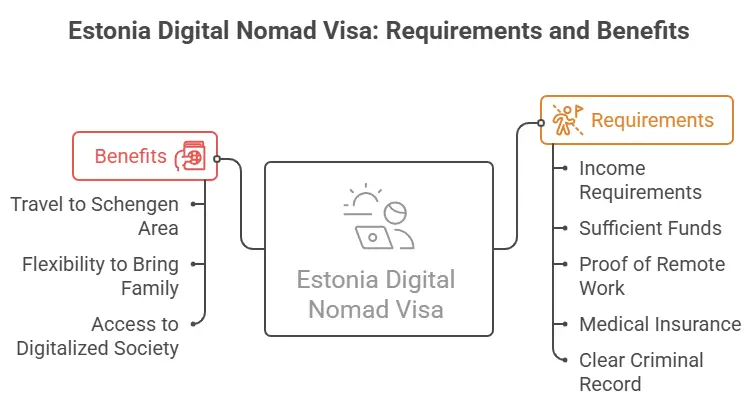
Estonia Digital Nomad Visa

There are two types of Estonian Digital Nomad visas:

  • Estonia Short Stay Visa (Type C): This temporary Visa allows digital nomads to reside in Estonia for up to 90 days.
  • Estonia Long-Stay Visa (Type D): This is a long-term stay visa that allows digital nomads to reside in the country for up to a year.

Also, read…

World's Most Digital Country, Estonia. 99% Government Services are Online.


Eligibility Criteria for Estonia Digital Nomad Visa

To qualify for an Estonia Digital Nomad visa, you must meet certain eligibility criteria, such as proof of remote work, sufficient funds, valid medical insurance, no criminal history, and the intent to leave the country after your permitted stay, along with other requirements.

You can be eligible for an Estonia digital nomad visa if you:

  • Are at least 18 years of age.
  • Are a remote worker, freelancer, or entrepreneur working remotely for companies or clients outside Estonia.
  • Work for a company that is registered in a foreign country along with a work contract with the employer.
  • Run business activities for a company that is registered in a foreign country where you are either a business partner or a shareholder of that company.
  • Perform consulting services or freelance work for clients who have their head offices in a foreign land.
  • Submit evidence of a minimum monthly income of at least €4,500 (approximately ₹4.1 lakh/month at April 2026 rates: ~₹91/€), and must demonstrate this income consistently for the 6 months immediately preceding the application. Evidence: bank statements and salary slips for employed remote workers; client invoices, contracts, and 6 months of bank statements for freelancers. Income must come exclusively from non-Estonian sources.Have no criminal record or history.
  • Have a valid medical insurance worth €30,000.
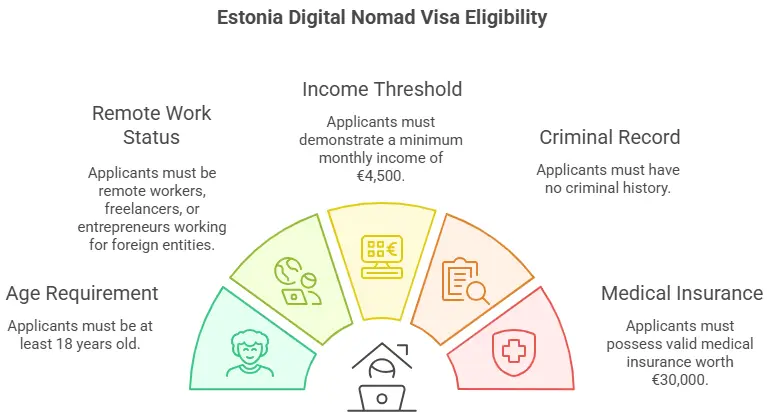
Who is eligible for Estonia Digital Nomad Visa?

Benefits of the Estonia Digital Nomad Visa

  • Work remotely while staying in Estonia.
  • Stay up to one year in Estonia
  • Travel across Schengen Area
  • Move along with family
  • Free internet access across the nation with a speed of 103.48MBps
  • Optionally combine your DNV stay with Estonian e-Residency to run your own EU company online — note: the DNV does not permit working for Estonian employers or serving Estonian clients directly.

Note: While your Type D DNV permits up to 12 months residence in Estonia, travel to other Schengen countries outside Estonia is subject to the standard Schengen rule — maximum 90 days in any 180-day period. Indian DNV holders planning extended travel to Germany, France, Italy, or other Schengen states must carefully track their non-Estonia Schengen days to avoid overstaying. 

Also, read…

What is a Digital nomad visa?


Requirements for Estonia Digital Nomad Visa

The Estonia digital nomad visa requirements are as follows:

  • Proof of remote work outside Estonia
  • Evidence of a monthly income of €4,500
  • A valid health insurance
  • A valid passport with at least 3 months validity beyond your intended stay in Estonia and at least 2 blank pages for visa stamps
  • A clear criminal record


The documents required to submit your Estonia Digital Nomad Visa application are as follows:

  • Passport
  • Application Form
  • Offer letter/ Employment Contract
  • Bank Statement
  • Proof of accommodation
  • A no objection form from the Police – a clean/no criminal record
  • Health insurance that is valid in Estonia with a coverage of €30.000
  • Educational Certificates

Also, read…

What are the Digital nomad visas with low-income requirements?


Steps to Apply for Estonia Digital Nomad Visa

To apply for an Estonia Digital Nomad Visa, you must check your eligibility for the visa, including the proof of funds, minimum monthly income, and arrange other visa-related documents. After this, you can submit your Estonia digital nomad visa application at the nearest Estonian embassy or consulate.

Here is a step-by-step process to apply for an Estonia Nomad Visa:  

Step 1: Check your eligibility for the Nomad visa

Step 2: Gather all the required documents

Step 3: Apply for the Visa at the nearest Estonian embassy in your home country

Step 4: Schedule a visa appointment

Step 5: Attend the visa appointment and submit the requirements

Step 6: Get the visa decision and fly to Estonia.

Also, read…

What are the Digital nomad visas for Indians?


Estonia Digital Nomad Visa Cost

The cost of applying for the Estonia Digital Nomad Visa ranges from €80 to €100.

Type of Estonia Digital Nomad Visa Visa Fee
Type C Digital Nomad Visa €80 (approximately ₹7,300)
Type D Digital Nomad Visa €100 (approximately ₹9,100)

 INR equivalents approximate at April 2026 exchange rate (~₹91/€). Verify current rate before application. VFS Global service fee for Indian applicants: approximately ₹2,000 (additional, payable at VFS Global centre).

Also, read…

How much does a nomad visa cost?


Estonia Digital Nomad Visa Processing Time

The processing time for Estonia Digital Nomad Visa takes 15 to 30 days, on average. The time taken to process the Estonian Digital Nomad Visa may also extend up to 60 days in cases of complex applications or when applied during peak seasons. It is always recommended to apply for the nomad visa at least 8–12 weeks before travel.

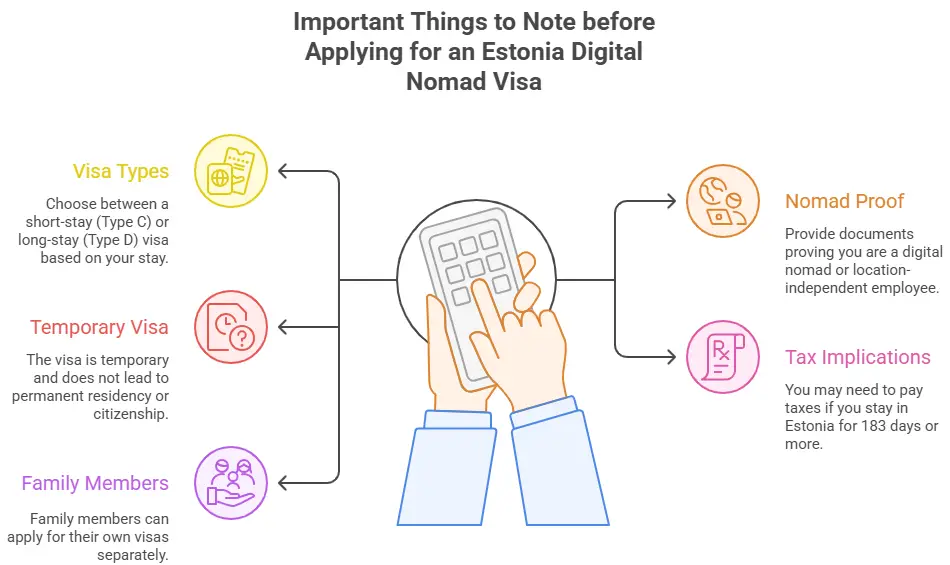
Important Things to Note before Applying for an Estonia Digital Nomad Visa

  • You can apply for an Estonian short-stay (Type C) or a long-stay (Type D) visa, depending on your stay duration.
  • Along with the list of general digital nomad visa documents, you must provide documents to prove that you are a digital nomad or location-independent employee.
  • The Estonian Nomad Visa does not provide a direct pathway to permanent residency or citizenship in Estonia; it is a temporary visa issued to remote workers for a maximum duration of 12 months.
  • Tax implications: If you stay in Estonia for more than 183 days in a 12-month period, you become an Estonian tax resident and your worldwide income may be subject to Estonian income tax (20%). India and Estonia have a Double Taxation Avoidance Agreement (DTAA) — if you stay beyond 183 days, consult a qualified tax advisor regarding your obligations under both Indian and Estonian tax law. Most Indian digital nomads plan their stay under 183 days to remain non-resident of Estonia for tax purposes.
  • You can bring your family members with an Estonia digital nomad visa; however, they must apply for their own visas separately.

Important: The Estonia Digital Nomad Visa cannot be extended or renewed. Maximum validity: 12 months (Type D). After expiry, you must return to India and explore other visa categories or reapply for a new DNV after meeting eligibility requirements. Plan your 12-month stay carefully, especially around the 183-day tax residency threshold.

Cost of Living in Tallinn for Indian Digital Nomads 2026

Estonia is one of Europe's most affordable digital nomad destinations. The table below shows approximate monthly costs in Tallinn for a single professional.

Expense Monthly Cost (EUR) Approx. Cost (INR)
1-bedroom Apartment — City Centre €600–€800 ₹54,600–₹72,800
1-bedroom Apartment — Outside City Centre €450–€600 ₹40,950–₹54,600
Food & Groceries €300–€400 ₹27,300–₹36,400
Public Transport Free for Registered Residents Free
Coworking Space (LIFT99, Spring Hub, Workland) €100–€160 ₹9,100–₹14,560
Internet €100–€150 ₹9,100–₹13,650
Health Insurance (Minimum DNV Requirement) Varies — Minimum €30,000 Coverage Minimum ₹27.3 lakh Coverage
Total Estimated Monthly Expenses Approximately €1,200–€1,500 Approximately ₹1.1–₹1.35 lakh

At the minimum DNV income of €4,500/month (~₹4.1 lakh), an Indian professional in Tallinn retains approximately €3,000/month (~₹2.7 lakh) after estimated living expenses — making Estonia one of Europe's highest-value digital nomad destinations for Indian professionals. INR equivalents approximate at April 2026 exchange rate (~₹91/€). Verify current rate before financial planning.

Estonia e-Residency vs Digital Nomad Visa — Key Differences for Indians

Feature Estonia e-Residency Estonia Digital Nomad Visa (DNV)
Purpose Digital identity that allows you to establish and manage an EU-based company online. Long-stay visa that allows remote workers to live in Estonia while working for employers or clients outside Estonia.
Physical Presence Required No — you can manage your business remotely from anywhere in the world. Yes — permits you to reside in Estonia for up to 12 months.
Schengen Travel Rights None Yes — travel within the Schengen Area for up to 90 days in any 180-day period, subject to Schengen rules.
Income Requirement No minimum income requirement. Minimum monthly income of €4,500, with proof covering the previous six months.
Can Be Combined Yes — can be held together with an Estonia Digital Nomad Visa. Yes — can be held together with Estonia e-Residency.

Key point for Indian IT professionals: The two can be combined. An Indian professional can hold Estonian e-Residency (to run an EU company) AND a Digital Nomad Visa (to physically live in Estonia) simultaneously. The DNV does not permit working for Estonian employers or clients — e-Residency is for running your own EU-registered company.
Estonia Digital Nomad Visa Guide

How Can Y-Axis Help You?

Y-Axis, the world’s best overseas immigration consultancy, provides unbiased immigration services for every client. With 26 years of experience, we can assist you with the Estonian Digital Nomad Visa application process.

Sign up with Y-Axis to avail of our services, including:

  • Resume Marketing Services to find relevant jobs abroad.
  • Expert assistance with the visa documentation and checklist process.
  • Dedicated advisors to help you with the visa process.

WhatsApp Now

Y-Axis snapshot

1M

Successful applicants

1500+

Experienced counselors

25Y+

Expertise

50+

Offices

Sign up for a free expert consultation
Down Arrow
Down Arrow
Down Arrow

I accept the Terms & Conditions

Don't know what to do
Don't know what to do ?

Get Free Counseling

Frequently Asked Questions

What is the Estonia Digital Nomad Visa?
plus

The Estonia Digital Nomad Visa (DNV) is a temporary residence visa allowing remote workers, freelancers, and entrepreneurs to live in Estonia for up to 12 months while working exclusively for employers or clients based outside Estonia. It comes in two types: Type C (up to 90 days, €80) and Type D (up to 12 months, €100 or approximately ₹9,100). It grants Schengen travel rights and is ideal for Indian IT professionals, consultants, and digital entrepreneurs earning remotely. The DNV cannot be extended or renewed after expiry.

Who is eligible for the Estonia Digital Nomad Visa?
plus

You are eligible if you are at least 18 years old, work remotely as an employee, freelancer, or entrepreneur for companies or clients based outside Estonia, earn a minimum gross monthly income of €4,500 (approximately ₹4.1 lakh) consistently for the 6 months immediately before your application, hold health insurance with at least €30,000 (approximately ₹27.3 lakh) coverage valid in Estonia, have a clean criminal record, and hold a valid passport with at least 3 months' validity beyond your intended stay and at least 2 blank pages for visa stamps.

Can Indian citizens apply for the Estonia Digital Nomad Visa?
plus

Yes. Indian citizens can apply for the Estonia Digital Nomad Visa. Applications are submitted through VFS Global Visa Application Centres in India — in New Delhi, Mumbai, Bengaluru, Chennai, Hyderabad, Kolkata, Ahmedabad, Pune, and Jalandhar. However, the Estonia visa rejection rate for Indian applicants is approximately 27.2%, higher than the 18% Schengen average. The most common rejection reasons are incomplete 6-month income documentation and unclear proof of remote work for non-Estonian employers. Thorough documentation and professional guidance significantly improve approval chances.

How do Indian citizens apply for the Estonia DNV via VFS Global?
plus

Complete the online application form at visa.applicants.ee, then book an appointment at your nearest VFS Global Estonia centre in India (New Delhi, Mumbai, Bengaluru, Chennai, Hyderabad, Kolkata, Ahmedabad, Pune, or Jalandhar). Attend in person for document submission and biometric collection. Pay the visa fee — €80 for Type C (approximately ₹7,300) or €100 for Type D (approximately ₹9,100) — plus the VFS Global service charge of approximately ₹2,000. Apply at least 8–12 weeks before your planned travel date to allow adequate processing time.

What is the income requirement in INR for the Estonia Digital Nomad Visa?
plus

The Estonia Digital Nomad Visa requires a minimum gross monthly income of €4,500 — approximately ₹4.1 lakh per month at current exchange rates (approximately ₹91 per euro as of April 2026). You must prove this income consistently for the 6 months immediately before your application date. Evidence required: salary slips and employment contract for employed remote workers; client invoices, client contracts, and 6 consecutive months of bank statements for freelancers. All income must come from non-Estonian sources. Verify current INR/EUR exchange rates before application.

What is the 6-month income proof requirement?
plus

Applicants must demonstrate that they have earned the minimum €4,500 per month (approximately ₹4.1 lakh) consistently for the 6 months immediately preceding the application date — not just at the time of application. This is one of the most common failure points for Indian applicants. Evidence: bank statements showing consistent deposits for employed workers; for freelancers, client invoices and contracts covering the 6-month period plus corresponding bank statements. A remote worker who recently reached €4,500 per month but lacks 6 months of history will typically be rejected.

Can I work for an Estonian company on the Estonia Digital Nomad Visa?
plus

No. The Estonia Digital Nomad Visa explicitly requires holders to work for employers or clients based outside Estonia. Working for an Estonian company or serving Estonian clients directly is a violation of the visa conditions and can result in visa cancellation. If you want to manage an Estonian-registered company, Estonian e-Residency is a separate programme that allows you to run an EU company online from anywhere — but e-Residency does not give you the right to live in Estonia or work for Estonian clients.

What is the difference between Estonian e-Residency and the Digital Nomad Visa?
plus

registered company online from anywhere in the world — it does not grant the right to live in Estonia or work for Estonian clients. The Digital Nomad Visa is a physical residence visa allowing you to live in Estonia for up to 12 months while working remotely for non-Estonian employers. The two can be combined simultaneously — an Indian professional can hold e-Residency and a DNV at the same time.

What documents are required for the Estonia Digital Nomad Visa?
plus

Required documents include: valid passport with at least 3 months' validity beyond intended stay and 2 blank pages for visa stamps; completed visa application form; signed employment contract or offer letter (employees) or client contracts and invoices (freelancers); bank statements for the 6 months immediately before application showing consistent minimum €4,500 monthly income; proof of accommodation in Estonia; Police Clearance Certificate (clean criminal record); health insurance with minimum €30,000 coverage valid in Estonia; and educational certificates. Freelancers must provide additional evidence of non-Estonian client relationships.

What are the visa fees for the Estonia Digital Nomad Visa?
plus

The Estonia Digital Nomad Visa fees are: Type C (up to 90 days) — €80, approximately ₹7,300; Type D (up to 12 months) — €100, approximately ₹9,100. Indian applicants applying through VFS Global also pay an additional VFS Global service charge of approximately ₹2,000 at the centre. INR equivalents are approximate based on the April 2026 exchange rate of approximately ₹91 per euro. Verify the current rate before your application. These fees are non-refundable regardless of the visa decision.

How long does the Estonia Digital Nomad Visa take to process?
plus

The standard processing time for the Estonia Digital Nomad Visa is 15 to 30 days. In complex cases or during peak application seasons, processing can extend up to 60 days. For Indian applicants applying through VFS Global, additional time should be factored in for appointment availability. It is strongly recommended to begin the application process at least 8–12 weeks before your planned travel date. Applications with missing documents or unclear income proof may face further delays. Track your application status online after submission.

Can the Estonia Digital Nomad Visa be extended or renewed?
plus

No. The Estonia Digital Nomad Visa cannot be extended or renewed. The maximum validity is 12 months for the Type D visa. After expiry, you must leave Estonia and return to India. You may reapply for a new DNV from India after meeting the eligibility requirements again, including the 6-month income documentation period. Plan your 12-month stay carefully, particularly around the 183-day tax residency threshold. Most Indian digital nomads plan their stay under 183 days to avoid becoming an Estonian tax resident.

What is the Schengen travel rule for Estonia DNV holders?
plus

The Estonia Digital Nomad Visa (Type D) allows you to reside in Estonia for up to 12 months. However, travel to other Schengen countries outside Estonia is subject to the standard Schengen rule: a maximum of 90 days in any 180-day period. An Indian DNV holder planning extended travel to Germany, France, Italy, or other Schengen states must carefully track their non-Estonia Schengen days to avoid overstaying. Days spent in Estonia on your DNV do not count toward the 90-day Schengen limit for other member states.

What are the tax implications of staying in Estonia on the DNV?
plus

If you stay in Estonia for more than 183 days in a 12-month period, you become an Estonian tax resident and your worldwide income may be subject to Estonian income tax at 20%. India and Estonia have a Double Taxation Avoidance Agreement (DTAA) — if you exceed 183 days, consult a qualified tax advisor regarding your obligations under both Indian and Estonian tax law. Most Indian digital nomads plan their stay under 183 days to remain non-resident of Estonia for tax purposes and simplify their tax obligations.

Can I bring my family on the Estonia Digital Nomad Visa?
plus

Yes. You can bring family members to Estonia on the Digital Nomad Visa; however, each family member must apply for their own separate visa. Dependants do not automatically receive a visa based on the primary applicant's DNV. Each family member must submit their own application with individual documentation. There is no specific income threshold for family sponsorship stated in the Estonian DNV programme — the primary applicant's income and accommodation proof should be sufficient to demonstrate support for dependants. Contact the Estonian Embassy or VFS Global for current family visa requirements.

What is the cost of living in Tallinn for Indian digital nomads?
plus

Tallinn is one of Europe's most affordable capitals for digital nomads. A one-bedroom apartment in the city centre costs approximately €600–€800 per month (approximately ₹54,600–₹72,800). Groceries cost approximately €300–€400 per month. Public transport is free for registered residents. A coworking space at LIFT99, Spring Hub, or Workland costs approximately €100–€160 per month (approximately ₹9,100–₹14,560). Total monthly expenses are approximately €1,200–€1,500 (approximately ₹1.1–₹1.35 lakh). At the minimum DNV income of €4,500, an Indian professional retains approximately €3,000 per month in savings.

What are the best coworking spaces in Tallinn for Indian digital nomads?
plus

Tallinn has a well-developed coworking ecosystem ideal for Indian IT professionals, consultants, and entrepreneurs. Top options include LIFT99 — Tallinn's most renowned coworking and startup community, known for its active tech network; Spring Hub — modern, centrally located, suitable for focused individual work; Workland — multiple Tallinn locations with flexible membership plans; and UMA Workspace — design-forward with a collaborative atmosphere. Monthly memberships typically range from €100 to €160 (approximately ₹9,100–₹14,560). Most spaces offer day passes. Estonia's national internet infrastructure ensures speeds averaging 103 Mbps across the country.

What is the Estonia visa rejection rate for Indians and how can I improve my chances?
plus

The Estonia visa rejection rate for Indian applicants is approximately 27.2% — significantly higher than the 18% Schengen average. The three most common reasons for rejection are: incomplete 6-month income documentation (bank statements must show consistent €4,500 per month for 6 consecutive months before the application date); unclear proof of remote work for non-Estonian employers; and insufficient ties to India demonstrating intent to return. Submitting complete documentation from the outset, demonstrating strong India ties, and working with an experienced immigration consultant significantly improve approval odds.

Does the Estonia Digital Nomad Visa provide a pathway to permanent residency?
plus

No. The Estonia Digital Nomad Visa does not provide a direct pathway to permanent residency or Estonian citizenship. It is a temporary visa issued for a maximum duration of 12 months and cannot be extended or renewed. After the DNV expires, you must return to India and explore other visa categories if you wish to continue living in Estonia — such as a work permit or study visa. Estonian e-Residency, which can be combined with the DNV, also does not grant the right to live in Estonia or lead to citizenship.

How can Y-Axis help me apply for the Estonia Digital Nomad Visa?
plus

Y-Axis Overseas Careers has 26 years of experience assisting Indian professionals with overseas visa applications, including digital nomad visas. Y-Axis can assist with a free eligibility assessment to confirm whether you meet the income, documentation, and employment requirements; preparation of the 6-month income documentation package; guidance on the VFS Global India application process across 9 cities; document review and checklist verification; and application tracking and follow-up support. With an Indian rejection rate of approximately 27.2% for Estonia visas, professional guidance significantly improves your approval probability. Call +91-7670800000 or visit y-axis.com.