


Don't know what to do ?
Get Free Counseling
Last Updated 14-May-2026
About Japan
Japan, an East Asian island nation and the world's 5th-largest economy (GDP ~USD 4.28 trillion), is a global hub for technology, innovation, and skilled employment. With its aging population and declining local workforce, Japan is actively inviting foreign professionals through structured work visa programs to address labor shortages.
The Japanese government has announced plans to attract around 1 million foreign workers by 2040 to sustain economic growth. In addition, the Specified Skilled Worker (SSW) program aims to bring approximately 805,700 foreign professionals over a five-year period across 19 designated shortage sectors.
Key demand sectors include IT, engineering, healthcare, construction, manufacturing, hospitality, agriculture, education, and logistics, offering stable career paths and competitive salaries. The country’s disciplined work culture, technological leadership, and high living standards make it a top destination for skilled talent worldwide.
Japanese is not always mandatory to apply for a Japan Work Visa, especially for certain international and technical roles, making it easier for skilled professionals to explore opportunities in one of the world’s largest economies.
Capital: Tokyo | Population: ~125 million | Language: Japanese | Currency: Yen (¥) ≈ ₹0.58.
Japan–India Treaty
Under the India-Japan Human Resource Exchange Partnership signed in August 2025, both countries aim to exchange 500,000 personnel over 5 years in both directions, including 50,000 skilled professionals and potential talents from India to Japan. This bilateral framework directly opens Japan's SSW, HSP, and Engineer visa pathways to Indian applicants across key sectors such as IT, engineering, healthcare, construction, and manufacturing. With no mandatory Japanese language requirement for many work visa categories, this treaty strengthens economic collaboration and career mobility between the two nations. (Source: PIB India, pib.gov.in, August 29, 2025; MOFA Japan, mofa.go.jp) Y-Axis helps professionals leverage this opportunity through expert evaluation, job search assistance, and end-to-end visa support.
Why Work in Japan?
- World's 5th-largest economy (IMF WEO 2025) with steady and growing demand for skilled talent.
- High need in IT, engineering, healthcare, and manufacturing.
- Over 800,000 active job vacancies across SSW-designated industrial sectors
- A growing community of over 4.1 million foreign residents
- Easy pathway for permanent residence in Japan
- Full-time workers can earn up to ¥4.6 million per year
*Willing to migrate to Japan? Sign up with Y-Axis for complete immigration assistance!
Benefits of Working in Japan
- Stable Jobs & Good Pay: Secure jobs with competitive salaries across many industries.
- Skill Enhancement: Opportunity to learn advanced technical skills and gain international work experience.
- Quality Lifestyle: Access to good healthcare, reliable public transport, and quality education.
- Universal Health Insurance: Japan’s Kokumin Kenko Hoken system covers medical expenses, where employees usually pay only 30% of treatment costs.
- Pension Benefits: Workers contribute to Japan’s pension system, and the India–Japan Social Security Agreement (since 2012) helps avoid double contributions.
- Paid Leave: Employees receive at least 10 days of paid leave per year as per Japanese labor law.
- Free Education for Children: Public education is free for children living in Japan.
- Government Support: Free Japanese language classes, job counseling, and settlement support for foreign workers.
- Tax Benefits: The India–Japan tax treaty helps prevent double taxation.
- Safe Living Environment: Japan is known for high personal safety and very low crime rates.
- Company Benefits: Many tech and corporate companies offer housing allowances and commute reimbursement for employees.
- Future Settlement: Long-term workers may apply for Permanent Residency (PR) in Japan.
- Global Mobility: Japanese passport holders have visa-free or visa-on-arrival access to 190+ countries.
- Child Allowance: Eligible foreign workers can receive ¥10,000 to ¥15,000 per child every month as government support.
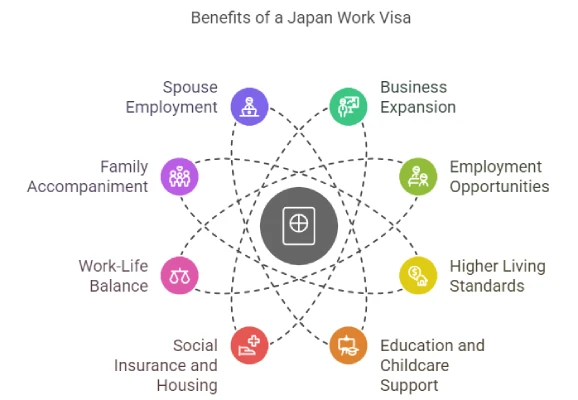
*Willing to work in Japan? Y-Axis is here to provide complete assistance!
Types of Japan Work Visa
Japan offers several work visa options for foreign professionals based on their skills, education, and job roles. The most common work visas include the Specified Skilled Worker (SSW-II), Highly Skilled Professional (HSP), and Engineer / Specialist in Humanities / International Services (E/SH/IS) visas. Each visa type has different requirements related to education, work experience, language ability, and job eligibility. The table below explains the key differences between these three major Japan work visas.
| Particulars | SSW (ii) | HSP | E/SH/IS |
|---|---|---|---|
|
Visa Type |
Specified Skilled Worker (Advanced Level) |
Highly Skilled Professional (HSP) |
Engineer / Specialist in Humanities / International Services |
|
Education |
No fixed degree requirement; based on advanced technical skills proven by exams and experience |
Bachelor/Master/PhD preferred; must achieve 70+ points based on degree, experience, salary, etc. |
University degree in relevant field or ~10 years professional experience for some roles |
|
Japanese Language |
No language requirement for SSW (ii) |
Not mandatory; JLPT N1/N2 adds extra points toward 70-point threshold |
No fixed JLPT requirement; depends on job (client-facing roles often expect it) |
|
Eligibility |
Pass SSW (ii) skill assessment and secure a job in designated field; typically supervisory/advanced roles |
Score 70+ points in HSP system; evaluated on education, experience, income, research, etc. |
Job offer in Japan in science/engineering/humanities/international fields; duties must match qualifications |
|
Typical Professions |
Supervisors, advanced technical roles in skilled industries like construction, shipbuilding, etc. |
Researchers, engineers, IT professionals, business managers, financial experts, etc. |
Engineers, software developers, analysts, accountants, translators, international marketing, etc. |
|
Visa Fees (Embassy) |
JPY 3,000 (single-entry), JPY 6,000 (multiple-entry); local rates apply |
JPY 3,000 (single-entry), JPY 6,000 (multiple-entry); varies by nationality |
JPY 3,000 (single-entry), JPY 6,000 (multiple-entry); varies by nationality |
HSP Sub-Categories: J-Skip and J-Find
J-Skip Visa (Specially Highly Skilled Professional) For top-earning professionals earning ¥20 million or more annually. J-Skip holders are immediately eligible to apply for Permanent Residency without the standard 1–3 year HSP waiting period. No Japanese language requirement. Ideal for senior engineers, executives, and high-earning specialists.
J-Find Visa (Job Search Visa for Global University Graduates) For graduates of Japan Government-designated top global universities — the list includes IITs and IIMs among recognised Indian institutions. J-Find allows a 2-year job-search period in Japan with no prior Japanese language requirement. Once a job offer is secured, the holder transitions to a standard work visa (Engineer/HSP). Graduates of IITs, IIMs, IISc, and other NIRF top-ranked institutions may qualify for this pathway. (Source: Japan MHLW; Japan ISA)
SSW Food Service Sector Notice (April 13, 2026): Japan ISA has suspended new overseas SSW Type 1 applications for food service roles until April 2027. Candidates targeting food service employment should wait for the suspension to lift or consider alternative SSW sectors. Other SSW sectors are unaffected.
Major In-Demand Sectors in Japan
The Japanese labor market is defined by high employment rates, which result in excellent labor market performance. However, structural changes like technological progress and an increase in population are transforming the supply and demand for skills. This makes it difficult for employers to find workers with the right skills and for employees to find jobs that match their skills. The table below shows the list of high-demand jobs in Japan along with the annual average salaries in Japan:
| Occupations | Average Salaries per Year in Yen (¥) |
|---|---|
|
Software Developers & IT Engineers |
¥5,200,000 |
|
AI / Machine Learning Engineers |
¥7,200,000 |
|
Cybersecurity Specialists |
¥6,800,000 |
|
Nurses & Nursing Care Workers |
¥2,400,000 |
|
Civil & Mechanical Engineers |
¥5,000,000 |
|
Construction Workers & Supervisors |
¥3,200,000 |
|
Manufacturing / Automation Engineers |
¥4,600,000 |
|
Data Analysts |
¥5,400,000 |
|
English Language Teachers |
¥3,000,000 |
|
Hospitality & Food Service Managers |
¥3,600,000 |
*Read more…
Average Salary Levels in Japan
Salaries in Japan vary depending on experience, industry, and job role. Entry-level professionals generally earn lower salaries, while mid-level and senior professionals with more experience and specialized skills can earn significantly higher compensation. These salary ranges are common across sectors such as IT & Technology, Healthcare, Engineering, Construction, Manufacturing, and Hospitality, though highly specialized roles like AI engineers, cybersecurity experts, and senior IT professionals may earn higher salaries.
| Experience Level | Average Salary |
|---|---|
|
Entry Level |
¥3.0M – ¥4.0M per year (₹16–22 LPA) |
|
Mid Level |
¥4.6M – ¥6.5M per year (₹25–36 LPA) |
|
Senior Level |
¥8M – ¥15M+ per year (₹44–82 LPA) |
*Also, read…
What are the most in-demand jobs in Japan for the next 10 years?
Top Companies in Japan Hiring Indian Professionals
| Company | Industry | Why It's Good for International Talent |
|---|---|---|
|
Rakuten Group, Inc. |
E-commerce / Tech / Fintech |
Adopted English as workplace language in many teams; diverse tech roles and strong visa support. |
|
Toyota Motor Corporation |
Automotive / Manufacturing |
Globally recognised; roles in R&D, systems engineering and global operations for skilled foreigners. |
|
Sony Group Corporation |
Technology / Entertainment / Electronics |
High-profile global firm; attracts international engineers/designers in electronics, gaming and media. |
|
Amazon Japan G.K. |
E-commerce / Tech / Logistics |
Branch of global Amazon; tech, operations, data roles with sponsorship for foreign hires. |
|
LINE Corporation |
Tech / Mobile / Communications |
Japan's major "super-app" player; actively hiring foreign engineers and product professionals. |
|
Fujitsu Limited |
IT Services / Systems |
Large Japanese IT company with global operations; good for foreign professionals in systems/consulting. |
|
Panasonic Holdings Corporation |
Electronics / Technology / Energy |
Legacy tech company undergoing transformation; international hiring in IoT/energy/innovation. |
|
Nintendo Co., Ltd. |
Gaming / Entertainment / Tech |
Strong brand; foreign-talent friendly environment for design, development and global marketing roles. |
|
Shiseido Company, Limited |
Cosmetics / Retail / Tech |
Major global cosmetics firm based in Japan; good for international business, marketing, analytics roles. |
|
Apple Japan G.K. |
Technology / Consumer Electronics |
Global brand's Japanese branch; foreign professionals can join product, retail, marketing and tech teams. |
|
Uniqlo (Fast Retailing Co., Ltd.) |
Retail / Fashion / Global Ops |
International fashion retailer with strong overseas orientation; multilingual staff and foreign-employee presence. |
|
IBM Japan, Ltd. |
IT / Cloud / AI / Consulting |
Big international consultancy/tech firm in Japan; strong for Indian professionals in cloud, AI, consulting roles. |
|
Microsoft Japan Co., Ltd. |
Technology / Software / Cloud |
Global tech leader's Japan entity; good for developers, engineers, product managers among foreign talents. |
|
Tata Consultancy Services Japan, Ltd. |
IT Services / Consulting |
Indian origin company with Japan operations; value for Indian professionals looking to leverage India-Japan link. |
|
Accenture Japan Ltd. |
Consulting / IT / Transformation |
Global consulting firm; frequently hires abroad-trained professionals with global mobility. |
*Searching for jobs in Japan? Find the right one with the help of Y-Axis resume marketing services.
Key Tips for Indian Professionals
- Use the Japan External Trade Organization (JETRO) "Open for Professionals – OFP List" portal to identify companies interested in global talent.
- Confirm whether the company offers visa sponsorship and relocation/English-friendly working environment. Many listed companies are explicit about roles.
- Digital/tech, engineering, manufacturing, global business functions are strong demand areas.
- Japanese language skills still help (even if some roles are English-friendly) so consider improving to increase role options.
Market Background & Trends in Japan
- Rising Foreign Workforce: As of Oct 2024, Japan employed ~2.3 million foreign workers, a 12.4% annual increase, driven by severe labour shortages.
- Visa Expansion: The government expanded the Specified Skilled Worker (SSW) program to 19 industries, targeting 805,700 foreign workers over five years.
- India–Japan Partnership: Under the India-Japan Human Resource Exchange Partnership (August 2025), both countries aim to exchange 500,000 personnel in both directions over 5 years, including 50,000 skilled professionals and potential talents from India to Japan across IT, engineering, manufacturing, and healthcare.
- In-Demand Sectors: High demand in industries such as IT & Technology, Healthcare & Eldercare, Construction, Automotive & Manufacturing, Agriculture, Hospitality, Education, and Logistics, with strong hiring needs for roles in nursing care, construction, manufacturing, hospitality services, agriculture, IT, and logistics operations.
- Skilled Visa Categories: Key work visas include SSW-I & II, Engineer/Specialist in Humanities/International Services (E/SH/IS), and Highly Skilled Professional (HSP).
- Policy Reforms: Japan is replacing the Technical Intern Training Program (TITP) with the new Employment for Skill Development (ESD / Ikusei Shuro) program, launching FY2027. ESD allows structured 3-year training with a clear transition pathway to SSW Type 1. TITP will be fully phased out by 2030.
- Growing Opportunity: Government forecasts show a shortfall of 1 million workers by 2040, ensuring continued demand for foreign professionals.
- Fast-Track Residency: HSP visa holders can qualify for Permanent Residency within 1–3 years, reflecting Japan's push to attract global talent.
IMPORTANT UPDATE (April 13, 2026): Japan ISA has suspended new overseas SSW Type 1 applications for the food service sector for the remainder of FY2026 (until April 2027). This affects kitchen staff, server, and cleaning roles under the food service SSW category. All other 18 SSW sectors remain open for overseas applications.
Read more...
Japan Job Outlook in 2026-2030
Japan Work Visa Requirements
Basic Documents
- Valid passport
- Completed visa application form
- Passport-size photographs
- Signed employment contract
- Certificate of Eligibility / COE
Educational & Professional Documents
- Educational certificates: degree, diploma, or certified transcripts
- Professional experience letters from previous employers
- Documents proving qualifications match the visa category applied for
Employer / Sponsorship Documents
- Employer sponsorship documents
- Company's Registry Certificate
- Company's latest financial statements
- Business plan
Background & Medical Documents
- Police Clearance Certificate for certain visa types
- Medical fitness test results
Translation & Attestation
- All documents in a foreign language must be translated into Japanese
- Attestation of educational and professional certificates
Experience & Qualification Requirements
- Engineer / Specialist in Humanities / International Services (E/SH/IS): 3–5 years of relevant work experience OR a bachelor's degree in the related field
- Highly Skilled Professional (HSP): Points-based system such as age, education, experience, and salary are all scored. A degree plus points calculation is required
- Specified Skilled Worker (SSW-1): Must pass both a Japanese Language Test (JLPT N4 level) and a sector-specific skills test
Language Requirements
- Japanese language ability (JLPT N3 or N4 level) is strongly preferred for most roles
- English-only roles are available in IT companies and multinational corporations (MNCs)
- SSW-1 visa requires JLPT N4 as a minimum
- JLPT N4 test centres in India: New Delhi, Mumbai, Chennai, Bengaluru, Hyderabad, Ahmedabad, and Kolkata. Tests are held twice yearly (July and December). Some SSW sector-specific skills tests are accepted as an alternative to JLPT — check the relevant sector authority for details.
- Most SSW roles and higher-level positions prefer JLPT N2 or above
How to Apply for a Japan Work Visa
The steps to apply for a Japan work visa from India are as follows:
Step 1: Sign up for Resume Marketing Services: Register with Y-Axis to receive expert guidance and personalized job search assistance for opportunities in Japan.
Step 2: Receive a Job Offer: Y-Axis connects you with verified Japan-based employers offering visa sponsorship and suitable roles.
Step 3: Employer Issues COE: Your employer applies for the Certificate of Eligibility (CoE) in Japan, with full documentation support from Y-Axis.
Step 4: Apply for a Visa: Your employer will file your work visa application. Fill out your work visa application and submit your documents to your employer. Y-Axis will provide end-to-end assistance for documentation.
Step 5: Fly to Japan: Once your visa is approved, Y-Axis helps you prepare for relocation, travel, and post-arrival formalities in Japan.
Japan Work Visa Fees
The cost of applying for a Japan Work Visa varies depending on the visa type, relocation needs, and whether professional or agent services are used. Some costs are mandatory, while others depend on individual preparation such as language training and relocation arrangements.
| Cost Summary | SSW Type II | HSP | Engineer / Specialist |
|---|---|---|---|
|
Visa Fee (JPY) |
¥3,000–¥6,000 |
¥3,000–¥6,000 |
¥3,000–¥6,000 |
|
Visa Fee (INR approx.) |
₹1,740–₹3,480 |
₹1,740–₹3,480 |
₹1,740–₹3,480 |
|
COE Application |
Free (by employer) |
Free (by employer) |
Free (by employer) |
|
Agent / Professional Fee |
₹50,000–₹1,50,000 |
₹50,000–₹1,50,000 |
₹50,000–₹1,50,000 |
Additional Costs
- Medical Examination Fee: ¥3,000–¥8,000 (≈ ₹1,600–₹4,500)
- Document Translation & Notarization: ¥5,000–¥15,000 (≈ ₹2,800–₹8,500)
- Language Training (JLPT Preparation): ₹20,000–₹80,000
- Relocation & Initial Setup in Japan: ₹1.5–₹3 Lakhs
- National Health Insurance (NHI): ¥1,500–¥2,500 per month (≈ ₹825–₹1,375)
- Airfare to Japan: ₹35,000–₹60,000 (average one-way ticket)
Japan Work Visa Processing Time
The processing time for a Japan Work Visa mainly depends on the type of visa and how quickly the Certificate of Eligibility (COE) is approved by the Immigration Services Agency of Japan. The COE confirms that the applicant meets the eligibility requirements to work in Japan. Once the COE is issued, applicants can proceed with the visa application at the Japanese embassy or consulate in their home country.
| Visa Type | SSW Type II | HSP | Engineer / Specialist |
|---|---|---|---|
|
COE Processing |
1–3 months |
10 days – 2 months |
1–3 months |
|
Visa Stamp |
5–10 days |
5–10 days |
5–10 days |
|
Total Timeline |
1.5–3.5 months |
2 weeks – 2.5 months |
1.5–3.5 months |
*Also read…
What are the fast-track hiring options in Japan for Skilled Professionals?
Family Sponsorship and Dependent Visa Rules in Japan
Japan allows many foreign workers to bring their family members and live together in the country. However, the rules depend on the type of work visa the applicant holds. Some visa categories allow dependents such as spouse and children, while others may have restrictions.
Family Rules by Visa Type
- Engineer / Specialist / Humanities (E/SH/IS) & Highly Skilled Professional (HSP) Visas:
Spouse and children can accompany the main applicant. The spouse can work part-time up to 28 hours per week or apply for permission to work full-time. - SSW Type 1 Visa: Family members are not allowed to accompany the worker.
- SSW Type 2 Visa: Spouse and children can join the worker in Japan, and the spouse is allowed to work.
- Children’s Education: Children of foreign workers can study in free public schools in Japan, making it easier for families to settle in the country.
Convert your Japan Work Visa to PR
Foreign professionals in Japan can apply for Permanent Residency (PR) after working and living in the country for a certain period. One of the fastest ways is through the Highly Skilled Professional (HSP) visa, which may allow eligible professionals to apply for PR in about 1 year, depending on their qualifications and points.
Japan offers a point-based system for highly skilled foreign professionals who want to apply for Permanent Residency (PR) faster. The system evaluates applicants based on factors such as education level, professional experience, annual income, research achievements, and age. Foreign professionals can apply for PR after 10 years of continuous residence in Japan, including several years on a valid work visa. Higher points can help applicants qualify for PR in a shorter period.
| Criteria | Details |
|---|---|
|
Points System |
Eligibility is determined through a point-based system evaluating education, work experience, income, and other factors. |
|
1-Year PR Path |
Score 80 points or more to qualify for Permanent Residency after 1 year of stay in Japan. |
|
3-Year PR Path |
Score 70 points to become eligible for Permanent Residency after 3 years of residency. |
Japan Permanent Residency Pathway for Indian Professionals
Indian professionals can obtain Japan Permanent Residency (PR) through three main pathways: the HSP J-Skip track (1 year, for professionals earning ¥20 million or more annually), the standard HSP pathway (3 years for those scoring 70+ HSP points), and the standard PR route (10 years of continuous residence). SSW Type 2 holders may live and work in Japan indefinitely with no fixed PR timeline, and can bring family members.
| PR Pathway | Eligibility | Minimum Stay Before PR |
|---|---|---|
|
J-Skip (HSP High Earner) |
Annual income ¥20M+; immediate PR eligibility |
1 year |
|
Standard HSP |
70+ HSP points (education, experience, income, age) |
3 years |
|
SSW Type 2 (SSW-II) |
Advanced SSW skills; 11 industries; family permitted |
Indefinite renewal; no fixed PR timeline |
|
Standard PR |
Any valid long-term visa; continuous residence |
10 years |
|
Naturalization (Citizenship) |
Permanent Resident status |
5 years after PR |
Final Recommendations
For Young Indian Professionals (Age 25–35):
- High-earners in tech/consulting: Target HSP for fast-track PR
- Mid-level professionals with Bachelor's: Engineer/Specialist is most accessible
- Skilled workers without degrees: SSW Type II after completing Type I
Strategic Approach:
- Start with Engineer/Specialist visa if you have a Bachelor's degree
- Accumulate points and switch to HSP if you achieve 70+ points
- Apply for PR after meeting requirements (1–10 years depending on visa type)
How can Y-Axis help you?
As the world's No. 1 overseas immigration consultancy, Y-Axis has been providing unbiased, personalized services for 25 years. Our team of experts are here to provide end-to-end assistance to ensure a smooth immigration journey. Our impeccable services include:
- Y-Axis Resume Writing Services to help you create a compelling resume
- Expert assistance with Japan visas
- Review of your documents and visa application form
- Complete Application processing
- Y-Axis Resume Marketing Services to help you find the best jobs for you
Y-Axis snapshot
1M
Successful applicants
1500+
Experienced counselors
20Y+
Expertise
50+
Offices
Don't know what to do ?
Get Free Counseling
Looking for Inspiration
Explore what Global Indians have to say about Y-Axis in shaping their future